Threats to our outdoor way of life present a test for South Dakota’s US senators
Sep 14, 2026 | 6:33 pm ET
Description
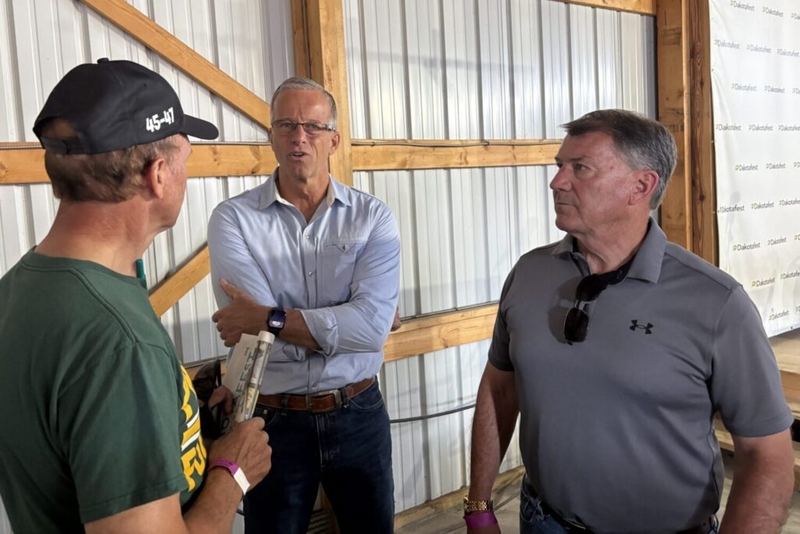
U.S. Senate Majority Leader John Thune, center, and Sen. Mike Rounds, right, Republicans from South Dakota, speak with an attendee, left, at the Daakotafest agricultural trade show in Mitchell on Aug. 19, 2026. (Photo by Joshua Haiar/South Dakota Searchlight)
The Trump administration is moving on two fronts to weaken protection for South Dakota’s wetlands and streams.
One proposal could remove most seasonal streams and wetlands from the Clean Water Act. The other could permanently certify old and potentially inaccurate maps associated with the Swampbuster program, which is supposed to discourage farmers from converting wetlands to cropland.
Together, they threaten prairie potholes, waterfowl, fishing, flood protection and South Dakota’s outdoor economy. They also present a defining test for Sens. John Thune and Mike Rounds, who portray themselves as hunters and defenders of South Dakota’s outdoor heritage.
The U.S. Department of Agriculture is accepting comments on its Swampbuster rule through Sept. 28. Comments on the Environmental Protection Agency and Army Corps of Engineers’ supplemental “waters of the United States,” or WOTUS, proposal are due Oct. 9.
This matters beyond environmental organizations and federal regulators. South Dakota sold more than 317,000 habitat stamps to hunters and anglers last year, with revenue used to support wildlife habitat and public access projects. A statewide survey, commissioned by the National Wildlife Federation, found that 53% of South Dakota voters consider themselves hunters, anglers or both. About 59% camp, half watch birds or wildlife, and 47% boat, canoe or kayak.
Those numbers describe how South Dakotans spend time with their families, teach children about the land and remain connected to this place.
The EPA proposal would limit Clean Water Act jurisdiction to relatively permanent rivers, lakes and streams, and wetlands directly connected to them. Under its narrowest alternative, streams would need to flow continuously except for predictable dry periods totaling no more than about one month a year.
That could eliminate federal protection for seasonal streams, including many streams in western South Dakota. Wetlands would need to be “indistinguishably part” of another protected water, with surface water present for at least 11 months of a typical year.
Waters excluded from the Clean Water Act could be polluted, filled or destroyed without federal review under that law. EPA estimated its original 2025 proposal would leave only about 19% of the nation’s wetland acreage federally protected. The September alternative could reduce that estimate further.
The Supreme Court had already narrowed Clean Water Act protection in its 2023 Sackett v. EPA decision. The administration is now deciding how aggressively to extend that ruling — and whether to adopt an interpretation leaving only a sliver of wetlands and seasonal streams protected.
The separate USDA interim rule concerns Swampbuster determinations issued between November 1990 and July 1996. Swampbuster does not prohibit farmers from draining wetlands. It conditions eligibility for crop insurance subsidies, commodity payments, farm loans and other federal benefits on protecting them.
But in a February 2019 memo, The Association of State Wetland Managers Inc. reminded everyone that of the 3 million pre-1996 wetland determinations about 60% were inaccurate. Over 90% in North Dakota were deficient.
A prairie pothole missed by both the Clean Water Act definition and an old Swampbuster map could effectively disappear from federal protection.
Those shallow potholes produce the insects that breeding ducks and other birds need when they return in spring. The Prairie Pothole Region produces more than half of North America’s waterfowl.
Wetlands also hold runoff and trap sediment and nutrients. Losing them can mean more flooded property, damaged roads and additional water treatment.
A study prepared for South Dakota Game, Fish and Parks found that hunting, fishing, wildlife viewing, boating and trapping generated more than $1.4 billion in annual spending based on 2021 activity. That spending supported more than 14,500 jobs and $123 million in state and local tax revenue.
Thune and Rounds are not spectators in this debate.
Rounds has written about pheasant hunting with his children and grandchildren and acknowledged that habitat supports rural businesses. Thune has described pheasant hunting as an economically significant and treasured part of South Dakota’s heritage.
Thune is Senate majority leader, a longtime Agriculture Committee member and a past defender of conservation compliance and the Sodsaver program, which discourages the conversion of native prairie to cropland. He has the influence to challenge the administration and protect policies he previously championed. If those protections are dismantled on his watch, silence cannot credibly be called neutrality.
Rounds has advocated for stronger landowner discretion over wetlands on their property. Landowners deserve a fair process. But automatically certifying potentially inaccurate determinations is not fairness. It accepts possible errors permanently, with wildlife, downstream landowners and the public bearing the consequences.
Both have the standing and influence to demand changes.
Wearing blaze orange, attending pheasant openers and celebrating outdoor heritage are easy. Protecting the habitat that makes those traditions possible — particularly when that requires confronting an administration of one’s own party — is the meaningful test.
Thune and Rounds have made South Dakota’s outdoor heritage part of their public identity. If these protections disappear and they decline to intervene, that will become part of their legacy.

Pierre, SD