Maryland leaders must fight to restore climate justice funding
Sep 14, 2026 | 6:57 pm ET
Description
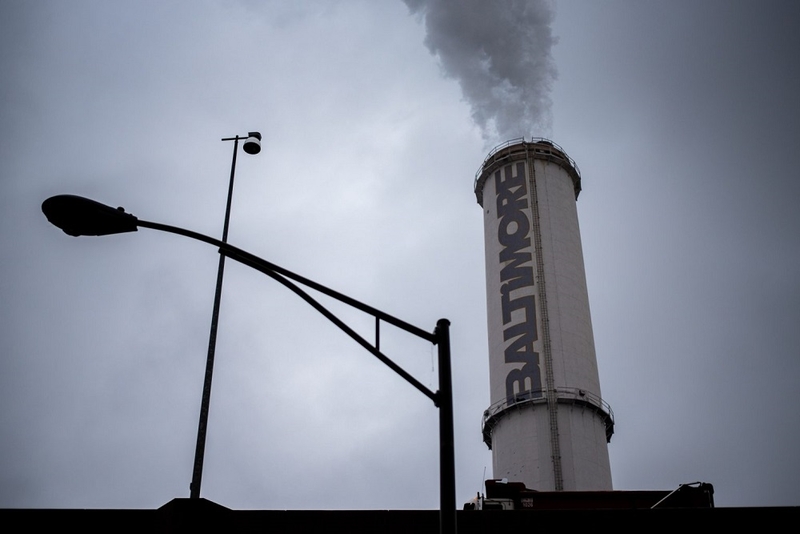
Effects of climate change are felt more severely in Black and brown communities, writes Sacoby Wilson, which is why lawmakers need to fight to restore climate justice grants eliminated by the Trump administration. The smokestack of the WIN Waste incinerator in Baltimore. (File photo by Joe Ryan/Capital News Service)
Flooding. Heat waves. Brutal storms. Power outages. Thanks to the Trump administration’s clawbacks of approved grant funding, Maryland residents are less prepared for these and other impacts of a changing climate. Low-income communities and people of color — who are hit first and worst by climate disaster — will suffer the most.
Back in 2024, I served on a team that won a $20 million grant for a program to improve climate resilience in Prince George’s County. The competitive application process was rigorous, involving extensive planning and mountains of paperwork. The evidence-based program included tree planting to keep neighborhoods cool; stormwater management to reduce flooding; and weatherization efforts to lower bills and reduce emissions while building a skilled trade workforce.
We were thrilled in the fall of 2024 when the Environmental Protection Agency announced that our project, BrightFuturres, was the winner for the state of Maryland. We began the precertification process during the winter of 2024/2025 — filling out more mountains of paperwork. Then the new administration came in, stopped the process, and BrightFuturres never received a dime.
We were not alone. Last year, the Trump administration canceled nearly $3 billion in environmental and climate justice block grants awarded to cities, nonprofits and tribes, along with another $20 billion in clean energy grants. All of these grants were approved by Congress as part of the Biden-era Inflation Reduction Act.
Of course, Congress still holds the “power of the purse,” as granted by the Constitution. Accordingly, federal courts recently ruled that the administration’s clawbacks of appropriated funds were illegal. But, when ordered to reinstate the funds by Sept. 30, Trump’s EPA argued in court that it lacks the staffing and money to do so. That is, the EPA lacks staffing and money because the administration itself has eliminated them.
Putting aside the administration’s shenanigans, our state needs this money and should fight for it.
Climate change is now a daily reality, in Maryland and around the globe. Human activity has raised atmospheric carbon dioxide to levels not seen in 2 million years, raising global temperatures by more than 2 degrees Fahrenheit. We could see the planet warm by 5.6 degrees to 7.9 degrees by the end of this century.
Already, the impacts are severe: In 2024 — the last year the federal government collected such data — Americans endured 27 major weather disasters, which killed 568 people and cost at least $182.7 billion.
Here in Maryland, rising temperatures mean more heat waves and air pollution. Flooding is a growing concern, both from sea level rise and increased rainfall. Along our nearly 3,200 miles of coastline, tidal marsh has swallowed nearly 30,000 acres of forest and farmland since 1984. While storms are more intense and rainfall is heavier, we are also seeing more droughts and wildfires.
Climate change does not affect all Marylanders equally. The legacy of redlining and other racist policies has left Black and brown neighborhoods more vulnerable to climate impacts. Crowded with polluting industries and lacking parks and green spaces, these neighborhoods are hotter and more flood-prone than their wealthier, whiter counterparts. In Baltimore, low-income Black neighborhoods can be up to 17 degrees hotter than the leafy enclaves of the affluent. Partly as a result, the rate of heat-related deaths among Black Americans is about 200% higher than for non-Hispanic Whites.
Climate impacts are layered atop other environmental injustices and the health impacts they cause. Black communities in Maryland and across the U.S. already bear a disproportionate burden of industrial pollution. Cancer risk from air pollution is more than twice as high in majority-Black census tracts as in majority-white tracts. That’s one reason Black Americans are 40% more likely to have asthma than white Americans, and Black children are eight times more likely to die from asthma than their white peers. The heat and wildfire of climate change is worsening these disparities.
Building climate resilience — especially in hard-hit parts of our state — is one way to address this generational injustice. It’s also a practical solution that makes good fiscal sense. A report by the U.S. Chamber of Commerce and the Allstate insurance company found that every dollar invested in climate resilience strategies saves saves $13 in economic costs, damages, and cleanup.
That’s why our elected officials must fight — in the courts, and in Congress — to restore the climate grants that were lawfully appropriated to our state. We won that $20 million fair and square. And those resources are essential to help prepare Marylanders for a hotter, wetter, more dangerous future and ensure equity in climate mitigation, adaptation, and resilience.
Annapolis, MD