These NY Teachers Are Ditching Screens. Lawmakers Want Others to Follow.
Sep 03, 2026 | 5:00 am ET
Description
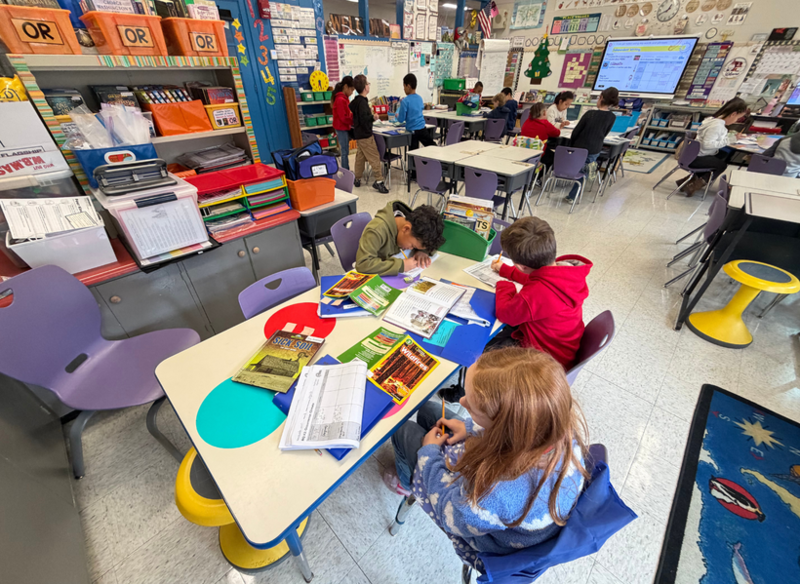
Students in Westchester teacher Jill Anderson's third grade class write by hand during a classroom activity. / Photo: Jill Anderson
When in-person schooling resumed after the Covid pandemic, Ned Campbell went “all in” on educational technology. He had his high schoolers use their Chromebooks every day to fill out interactive worksheets, visit informational websites, and watch videos about history and politics. He thought the screens would help them learn more and stay engaged.
But Campbell, who teaches US history at Brooklyn’s James Madison High School, quickly grew suspicious of how his students were using their devices. They’d look up the answers to assignments, charge their phones, and email friends, he noticed. They would submit essays a few minutes apart that were nearly identical. The day after online homework quizzes, Campbell asked students to answer the same questions on paper, and watched as As turned into Fs.
Campbell began spending more time monitoring the use of technology than he spent teaching, he said. When he asked one student how they had gotten every question right the night before but failed the next day, he said the teenager responded, “ChatGPT.”
“I just had to admit that it wasn’t working,” Campbell said. “The kids didn’t learn. They didn’t retain anything.”
Last school year, Campbell eliminated technology from his classroom. The Chromebook cart remains untouched during class time. Instead, students pick up a hard copy of a worksheet and a dictionary, and spend the first 15 minutes reading, writing, or completing a vocabulary activity. Homework is completed by hand and turned in the following day.
“I have pretty much gone back to the way I was teaching when I first started,” said Campbell, who has been a teacher for 25 years.
In recent years, the use of ed tech has exploded. About nine in 10 public schools nationwide had a 1-1 device program providing every student with a laptop or tablet during the 2024–25 school year, according to federal data. But as schools pour millions into ed tech and artificial learning programs, parents are increasingly questioning whether those investments improve learning — and a growing number of teachers are ditching tech for traditional analog instruction.
Policymakers are beginning to respond, too. On Wednesday, New York City Mayor Zohran Mamdani announced a one-year moratorium on student-facing generative AI and caps on screen time through middle school. A new state bill would go further: the FOCUS Act, introduced by state Senator Andrew Gounardes last month, aims to sharply limit reliance on screens and to “create a right to analog learning.”
If the bill passes, it would be the most comprehensive restriction on ed tech in the country.
Some of the teachers who’ve already implemented those changes say they’re seeing promising results. It took some time for Campbell’s students to embrace the changes, and they didn’t do too well on their first exam without access to technology — but improved by 20 points on the second. After students spent more time in his class learning vocabulary, Campbell heard from other teachers that their English grades also went up. He noticed a boost in student confidence, as they received better grades on work they completed independently.
His classroom became noisier, but in a good way: Students came to him with questions and talked over classwork with each other, rather than staring at their Chromebooks.
Westchester teacher Jill Anderson had a similar experience in her third grade classroom.
When the children were supposed to do work on their Chromebooks, Anderson would often walk around and discover them playing with different text fonts and colors, browsing YouTube, or customizing their avatars on online learning platforms.
During the 2024–25 school year, she stopped allowing her students to use 1-1 devices except for mandatory online testing and occasional writing activities. This month, as she prepared her classroom for the new school year, she decided the best place for her district-issued cart of Chromebooks was the storage closet.
“A kid who is off task on a device … who knows what they might get into,” Anderson, who’s been teaching for 20 years, said. “A kid who’s off task sitting at their desk with paper and a book is maybe daydreaming and bored, but maybe they’re coming up with something great.”
Gounardes’s bill is the latest in a string of efforts by state lawmakers to rein in the ed tech boom.
It would require screen-free instruction in pre-K through fifth grade, and give older students and their parents the right to refuse to use a school-issued device if there is a reasonable alternative.
School-issued devices would have to be free of social media, gaming, direct messaging apps, chatbots, generative AI, and cameras. Ed tech companies would have to register with the state Attorney General before offering products to school districts, and the State Education Department would update its learning standards so that students are taught about the impact of excess screen time and social media use.
“We’ve rushed to put these devices in kids’ hands, and these platforms in front of their faces without ever asking, ‘Is it effective, and cognitively, is it good for kids?’” Gounardes told New York Focus.
The bill has the support of the powerful New York State United Teachers union, among other groups. In a statement, NYSUT President Melinda Person applauded lawmakers for “moving quickly to begin the crucial work of defining which technologies belong in our classrooms — and which should be limited.”
“We’ve rushed to put these devices in kids’ hands, and these platforms in front of their faces without ever asking, is it effective, and cognitively, is it good for kids?”
—Andrew Gounardes, New York state Senate
Some districts have already taken steps in response to parent backlash. Mamdani’s Wednesday announcement means New York City Public Schools, the nation’s largest school district, will adopt a sweeping new technology policy barring individual screens through second grade and generative AI tools for students through eighth grade. The new guidelines recommend that students in grades 3–5 be limited to 30 minutes of daily screen time, and middle school students to 45.
Research has linked excessive screen time to poorer academic performance, lower attention spans, and behavioral issues. A 2026 study across 50 countries by the Brookings Institution’s Center for Universal Education also found that using AI in education can undermine children’s cognitive, social, and emotional development.
Richard Culatta, CEO of the International Society for Transforming Education, a nonprofit that helps educators use ed tech in schools, acknowledged that after the pandemic, school districts focused on getting technology into classrooms without preparing teachers to use it in meaningful ways.
But he argued that the solution is not to legislate the number of devices in each grade or the minutes students spend in front of a screen. Instead, Culatta said, school districts must set clear expectations of what quality ed tech looks like, and train teachers to use it in ways that enhance their instruction, boost student creativity, and support special education students and English language learners.
“You can walk into a lot of schools and see technology being used in ineffective ways, but that does not mean we should stop using technology in ways that are really helpful and prepare our students for their futures in a digital world,” he said.
Saranac Lake English teacher Kelsey Francis first noticed a major problem with students using AI when they returned from spring break in 2023. Assigned a simple, 250-word essay about the best ice cream in the Adirondacks, students turned in formal writing responses about the history and origin of the dessert, with no local context. They then started asking ChatGPT to generate personal narratives to use for college applications, she said.
Last school year, she required her students to handwrite all of their essays and class assignments. This summer, the teacher bought a classroom set of dictionaries, so students could learn how to look up words without relying on the AI summary at the top of Google searches.
Francis, who’s been teaching for 26 years, has also started assigning significantly less homework, because she said there’s no way to stop students from using AI on their own time.
“Until someone comes up with something better, if we want to actually gauge their abilities and what they have learned, it has to be done in front of us,” she said.
“I have pretty much gone back to the way I was teaching when I first started.”
—Ned Campbell, Brooklyn high school teacher
Substantial improvements in students’ writing abilities will require a longer-term commitment to limiting educational technology, Francis said. But after a year of returning to analog instruction, she said she has noticed that students are more engaged with their assignments, scribbling down their initial thoughts and developing their own unique ideas rather than turning in polished work that lacks individuality.
About 250 miles south, in a small district of around 900 students near West Point, ninth grade English teacher Paul Lukacik has also turned his teaching routine on its head. For much of the past 30 years, students read and discussed literature in class, then completed writing assignments about those works at home.
Recently, his school’s English department decided that all writing must now be completed in class, by hand, on paper. Every day, Lukacik signs off on where students finish their work and prohibits them from adding to their notes at home.
“It’s gotten to a point where all they can have on their desk is a pen, a piece of paper, and the literary source they are using,” Lukacik said. “They can’t have any notes because I’m just catching too many students who have already written the work of AI in their notebook, and then just transfer it while they are in class.”
Lukacik acknowledged how time-consuming the new writing policy is, emphasizing that he used to get significantly more work done.
It’s been an adjustment for students, too. “Some students can’t functionally write,” the high school teacher explained. “They don’t actually hold a pen or a pencil correctly. I don’t want to call anybody out in class, so I have to model in front of everyone how you’re supposed to hold it.”
Lukacik said it’s too early in the process to see significant results, but he hopes to see the payoffs in student learning before he retires.
Some teachers who’ve made the switch feel they were initially oversold on the benefits of ed tech. A few years ago, Anderson, the Westchester teacher, thought it would help differentiate instruction for her students and get them interested in learning to code.
But her experience as a parent changed her mind. Anderson allowed her own child to use the ed tech she had access to as a teacher, she said, and realized it only made them crave more time on a screen. She found success removing iPads and gaming consoles from her home, and began thinking more critically about the use of technology within her classroom.
“I have such regrets,” Anderson admitted. “Because guess what? Those kids I taught how to code, they aren’t even going to code like that anymore.”
As she shifted away from 1-1 devices, Anderson noticed her students became more engaged in assignments and collaborating with others. Playing learning games with each other, rather than on a computer, taught them sportsmanship and how to solve conflicts. “We connected so much more without it,” she said.
Anderson is excited by the FOCUS Act’s potential to curb screen time in schools. Her district supports her traditional approach to instruction, but not all teachers are as lucky, she said, and the ability to limit technology in a classroom “shouldn’t depend on a district’s director of technology or superintendent.”
“I think there were a lot of promises about how technology would help us differentiate instruction and reach more students,” she said. “But the more tech you bring into your classroom, the less connection and human skills you build.”

Albany