There’s a $11.25 billion housing bond on the ballot this November. Here’s what you should know
Oct 16, 2026 | 8:00 am ET
Description
In summary
Supporters say California desperately needs money to fund housing construction and make a dent in its homelessness and affordability crisis. Critics say bond financing isn’t the way to do it.
For years, California has grappled with a problem that has affected nearly every aspect of our society: The state doesn’t have enough homes that people can afford to live in. Proposition 1 aims to address that crisis.
It’s estimated that more than 180,000 Californians are homeless. Rents are so high that a minimum wage worker would need to work 102 hours a week to afford a typical one-bedroom apartment, according to the National Low Income Housing Coalition.
A big piece of that problem is construction: Not enough homes are being built. Fewer than a third of California cities and counties are on track to permit enough market-rate housing to hit their state-mandated targets, and fewer than 6% are on track for very low-income housing. Those targets are based on the state’s assumption that we need nearly 2.5 million more homes.
Legislators have passed multiple laws trying to address that by making it easier, faster and cheaper to get projects permitted and built. Prop. 1 is supposed to supply the money.
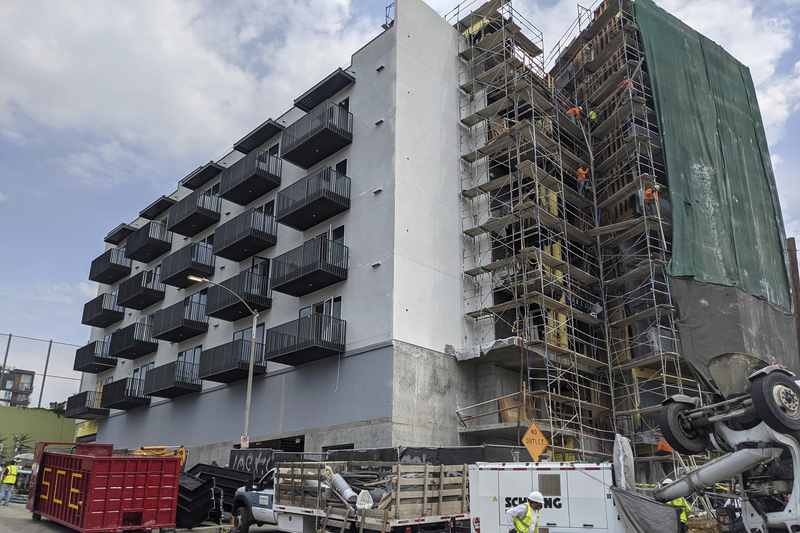
A recent report estimated nearly 40,000 affordable units throughout California have been designed, permitted and partially funded and are sitting stalled because developers just can’t quite get enough money to build them.
What would Prop. 1 do?
If it passes, Prop. 1 would allow the state to sell $11.25 billion in general obligation bonds to fund various types of housing, including homes for veterans, homeless Californians, renters, homeowners, farmworkers, students and tribes.
Where would the money go?
Prop. 1 would fund a variety of programs. Here’s how it breaks down:
- $7.2 billion to buy, build or renovate apartment buildings, generally through low-interest loans to developers. Projects funded this way would have to reserve a certain number of units for low-income households. Some would be used for “supportive housing,” homeless housing that includes additional services. This, in combination with other funding sources, would help support up to 40,000 rental units, according to the nonpartisan Legislative Analyst’s Office.
- $1.25 billion to help veterans secure loans to buy homes.
- $1.1 billion to help low and moderate-income households buy homes.
- $500 million for the infrastructure that supports new housing construction, such as water, sewage, parks and transportation improvements.
- $450 million to build or renovate an estimated 2,500 units of farmworker housing.
- $350 million to fund affordable homes for an estimated 1,200 University of California and California State University students.
- $200 million in housing grants to tribes, which could fund both home construction and renovation.
- $200 million up for grabs to cities, counties and other groups that pitch pilot projects to develop low-cost housing.
How would California pay for it?
It would cost the state between $500 million and $600 million each year for about 25 years to repay the cost of the general housing bond, according to the legislative analyst. That money would come from the state’s general fund, and factors in interest. The $1.25 billion for veterans housing would not cost the state anything, as participating vets would pay it off through monthly loan payments.
Have we done anything like this before?
California voters approved (by the slimmest of margins) another bond in 2024 that provided $2 billion to fund homes for people who need mental health and addiction services and veterans. That 2024 bond also was dubbed Prop. 1.
What do supporters say?
Supporters include housing developers and advocates, veterans groups, the California State University and University of California boards, groups representing California’s cities and counties, Democratic legislators and Gov. Gavin Newsom.
Donors backing Prop. 1 also reflect some who would benefit. The campaign has received more than $12 million, including about $2 million from carpenters’ unions, $1 million from Airbnb and $1 million from Building a Better California, a PAC funded by Google founder Sergey Brin and other Silicon Valley billionaires.
Vivian Wan, chief executive of affordable housing provider Abode, says her organization has four projects with a planned total of about 230 units in the works that she hopes Prop. 1 will fund. Three are in the Bay Area and one is in Yolo County. Without that cash infusion, all four projects are stalled, she said. Projects for homeless and low-income residents need large subsidies since their tenants don’t pay enough in rent to offset the cost of building. They often also have to fund additional services, such as case managers to help residents navigate their physical and mental health, addictions, finances and more. City and county dollars can pay for some but not all of that.
Prop. 1 would be “huge,” Wan said. But it wouldn’t magically solve the housing crisis.
“Is it enough? Absolutely not,” she said. “We are lightyears behind in terms of production to meet the need. We have underinvested in housing for decades. This is going to help, for sure, but we really need a permanent source.”
What do opponents say?
When this measure came up for a floor vote before the Legislature, two Republican senators voted no, as well as seven Republican assemblymembers.
Sen. Tony Strickland, a Republican from Huntington Beach who opposed the bill, said calling it “The Veterans and Affordable Housing Bond Act of 2026” amounted to a bait-and-switch maneuver, as only a small fraction of the total funds go to vets.
“It really just says that you’re using veterans to pass your $10 billion general obligation bond,” he said during a June hearing.
And, he said, there are better ways to get families into housing than using a bond to “borrow money against the future.” The strong revenues California experienced this year won’t continue, making it risky to push the state deeper into debt, he said.
Opponents have not reported receiving any contributions.
Sacramento