For Texas schoolchildren, minor misbehavior can mean criminal charges
Oct 18, 2026 | 6:00 am ET
Description
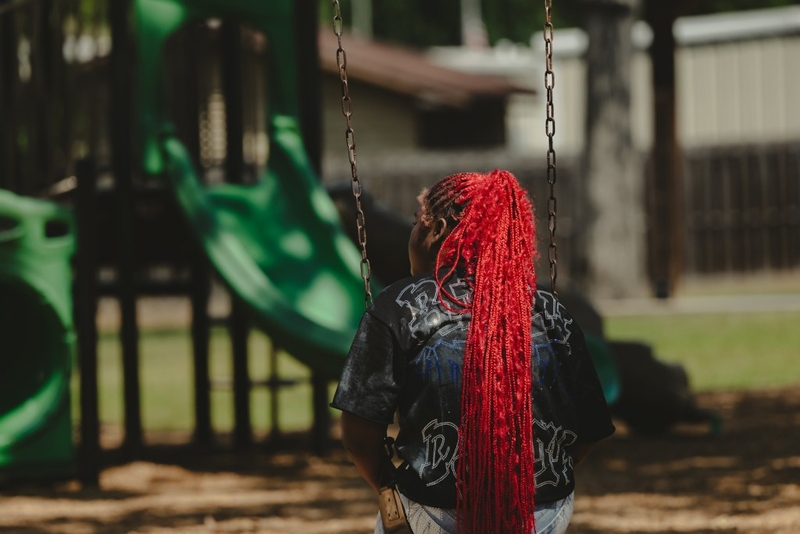
A 12-year-old in the Galveston school district was arrested after being disruptive and refusing to head to the school lobby. (Meridith Kohut for The New York Times)
This article was reported in collaboration with The San Antonio Express-News and Big Local News at Stanford University as part of The New York Times’s Local Investigations Fellowship.
Over the past decade, school districts across Texas have sought to make classrooms safer by swelling the number of police officers on campuses and taking a tougher stance on misbehavior. But the crackdown has had an unexpected consequence: sweeping tens of thousands of elementary students and middle schoolers into the justice system.
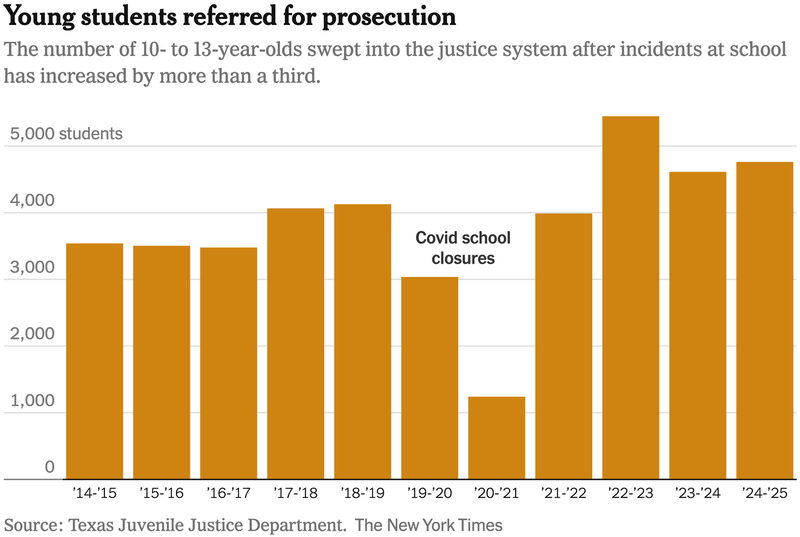
Children ages 10 to 13 were referred for prosecution after incidents in schools more than 47,000 times since 2014, an analysis by The New York Times and The San Antonio Express-News found. About 4,800 students in that age group were referred during the 2024-25 academic year alone, the most recent school year for which data is available. That is a third more than the number a decade before.
Most of the students were accused of minor offenses, like making threats, using cannabis vapes or lashing out at classmates or teachers, the analysis found. Few caused serious physical harm.
Outside Austin, an 11-year-old bumped into a school counselor. In Victoria, a 10-year-old said he saw someone on campus with a weapon, but later admitted he had made up the story. In El Paso, a 10-year-old kicked an assistant principal after his cellphone was taken away.
All three found themselves in the justice system.
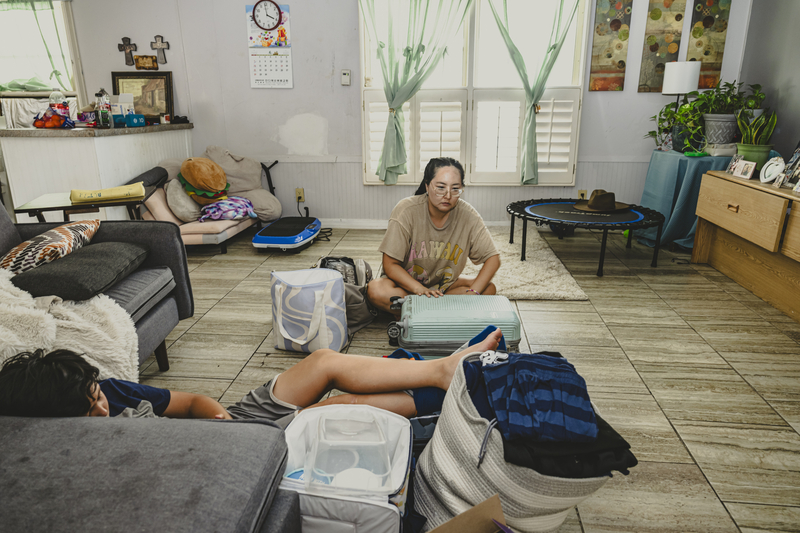
While the case against the boy in El Paso was dropped two months after the incident, court records show, the consequences for his family were immense. His mother, Grace Lee-Vazquez, said she shouldered thousands of dollars in legal bills. The boy, who has attention deficit hyperactivity disorder and still struggles to double-knot his shoelaces, became anxious about school. His grades tumbled.
School district officials would not answer questions about the incident, but wrote in a statement that they were “committed to maintaining safe and inclusive learning environments for all students.”
The ordeal, Ms. Lee-Vazquez said, “broke us.” She moved the family out of state in June for a fresh start.
In rare instances, children 13 and under have been accused of serious offenses. Last year, for example, an 11-year-old boy at Harris Middle School in San Antonio was charged with carrying a weapon in a prohibited place after school officials found a gun in his backpack.
But William Shaw, a juvenile judge in San Antonio, said that many of the cases that came before him could have been handled by a school principal.
“Kids are sometimes not going to get along,” he said in an interview. “They may end up pushing each other, maybe even fighting. That can be considered adolescent behavior. It isn’t necessary to arrest.”
The Times and The Express-News reported this year that Texas’ multi-billion-dollar investment in school policing had transformed discipline, subjecting thousands of students to physical force, at times over seemingly minor misconduct. Some were tackled, blinded with pepper spray or shocked with Tasers.
For the new analysis, our journalists examined data collected by the Texas Juvenile Justice Department, identifying tens of thousands of instances since the 2014-15 academic year in which minors were referred into the justice system after an incident at school. Such referrals, as they are called, typically occur after an officer takes a child into custody. The youngest a child in Texas can be referred is 10; students 17 and older are considered adults.
Some of the children who were referred were required to appear before a judge and assigned community service, counseling or court supervision. In the most serious cases, they were committed to state juvenile justice facilities.
But even when children were released with just a warning, they were often taken from school in handcuffs, separated from their parents for hours and processed into the juvenile system — all of which, research shows, can hurt academic performance and is linked to future contact with law enforcement, feeding the so called school-to-prison pipeline.
Encounters between police officers and schoolchildren have not gone unnoticed. In July, The Texas Observer used law enforcement records to document thousands of arrests and criminal citations involving preteens in about 200 of Texas’ 1,200 school districts over a four-year period.

The analysis by The Times and The Express-News examined referrals statewide. It found that referrals of children 10 to 13 had increased by a greater percentage than referrals of older students. They rose for young children of every race, though Black children were referred at about twice the rate of white and Hispanic children.
After the Covid-19 pandemic, when students returned to in-person instruction, schools reported more fights, state data shows. But referrals of children 10 to 13 grew far faster.
The growth outpaced that of the student population, undoing years of work by advocacy groups and policymakers to end the school-to-prison pipeline.
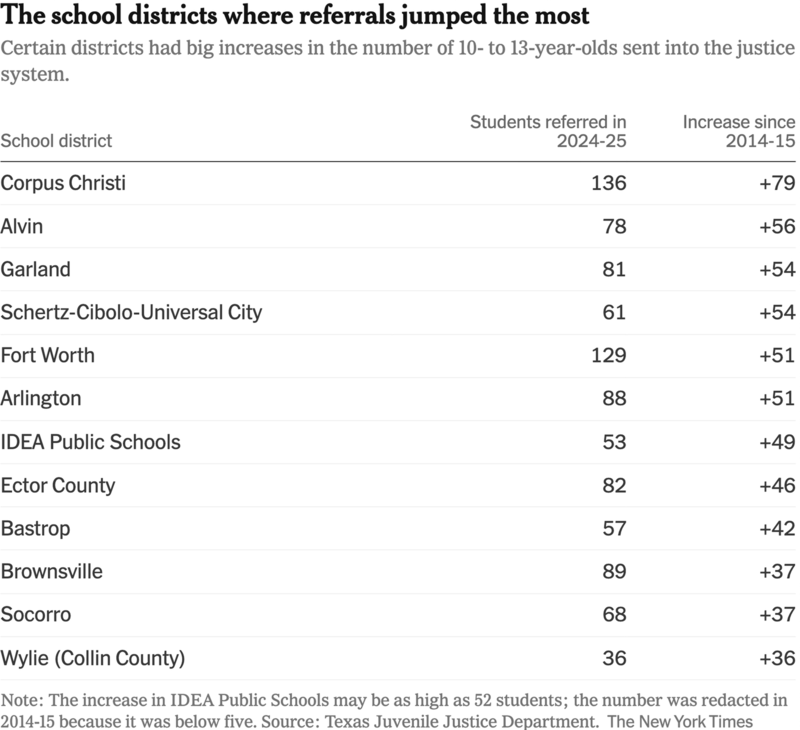
Some of the state’s largest school districts, including Houston and Dallas, have decreased the number of referrals in recent years, data shows. The statewide increase was driven by roughly 60 districts, which account for about a quarter of Texas’ students. Many added officers to their elementary and middle schools during the period we examined, records show, or had taken a more aggressive approach to policing students.
Officials in some of those districts said they believed the referrals represented progress toward safer campuses, a top priority since the 2022 school shooting at Robb Elementary in Uvalde.
Representative Joe Moody, an El Paso Democrat, cosponsored a 2023 state law requiring a police officer at every public school. When shown our analysis, he said that the increase in referrals among young children was alarming, and that he would push for stricter limits on policing in schools when the state legislature convenes in January.
“No one should want that as a result of what we did,” he said.
‘She just gave up’
Laquital Thompson knew that her daughter’s transition to Central Middle School in Galveston might be difficult.
Like many 12-year-olds, the girl enjoyed filming videos for TikTok and trying different hairstyles. She liked school, too, especially math and science. But she had been acting out in class, Ms. Thompson said, and the school district had identified a behavioral disorder that led her to challenge authority. (The Times and The Express-News are not naming the children in this article to protect their privacy.)
Within a week of starting classes in August 2024, records show, the girl was sent to the principal’s office for being “disruptive.” School officials suspended her and told her to wait for her mother in the lobby. But the girl refused to go there.
Eventually, a school police officer, Vincent Ramirez, was summoned. When he arrived, several school employees were hovering nearby.
In an exchange captured by the officer’s body camera footage, one school administrator said that the girl’s mother had consented to the use of handcuffs on her daughter. Another warned that the girl could be arrested if she did not go where she was told.
Officer Ramirez turned to the girl. “You’ve got four seconds to walk over there,” he said. “Otherwise, I’m going to put you in handcuffs, and we’re going to give you a ride.”
She did not budge.
“OK, I’m done,” Officer Ramirez said. He slid off the girl’s pink backpack and handcuffed her wrists behind her back.
His body camera footage shows the sequence.
The girl is in the lower right corner above, facing a glass display case.
The officer confronts her, telling her she has four seconds to comply.
Ninety seconds later, he handcuffs her and leads her down the hall.
In a recent interview, the girl told our reporters that she was confused when the officer detained her. “I didn’t really know why it was happening,” she said. “Why would they put me in handcuffs?”
The officer drove her to the school police headquarters at a nearby campus, where she continued to ignore instructions. When she would not put her hand on a fingerprint machine, officers twisted her opposite arm behind her back until she screamed and complied, according to body camera footage.
Later, as she sobbed and yelled profanities, the school district police chief, Josette Rivas, held up a cellphone and apparently began recording her, body camera footage shows. She told the girl it was for Facebook.
“You all see how she’s acting?” Chief Rivas said as she held the phone.
Chief Rivas and Officer Ramirez declined to comment for this article. The Galveston school district’s superintendent, Matthew Neighbors, wrote in an email that the officers had “remained calm and respectful.” Asked if cellphone video of the girl had been posted online, he said no.
Records show the girl was charged with trespassing. Two former school district police chiefs who reviewed the case at our request said that the arrest and referral were unnecessary.
Threatening to post video of the girl was particularly concerning, added Bryon G. Gustafson, who was previously the police chief for the Stockton, Calif., school district and now teaches at the University of Virginia. “A police chief doing that is just unfathomable to me,” he said.
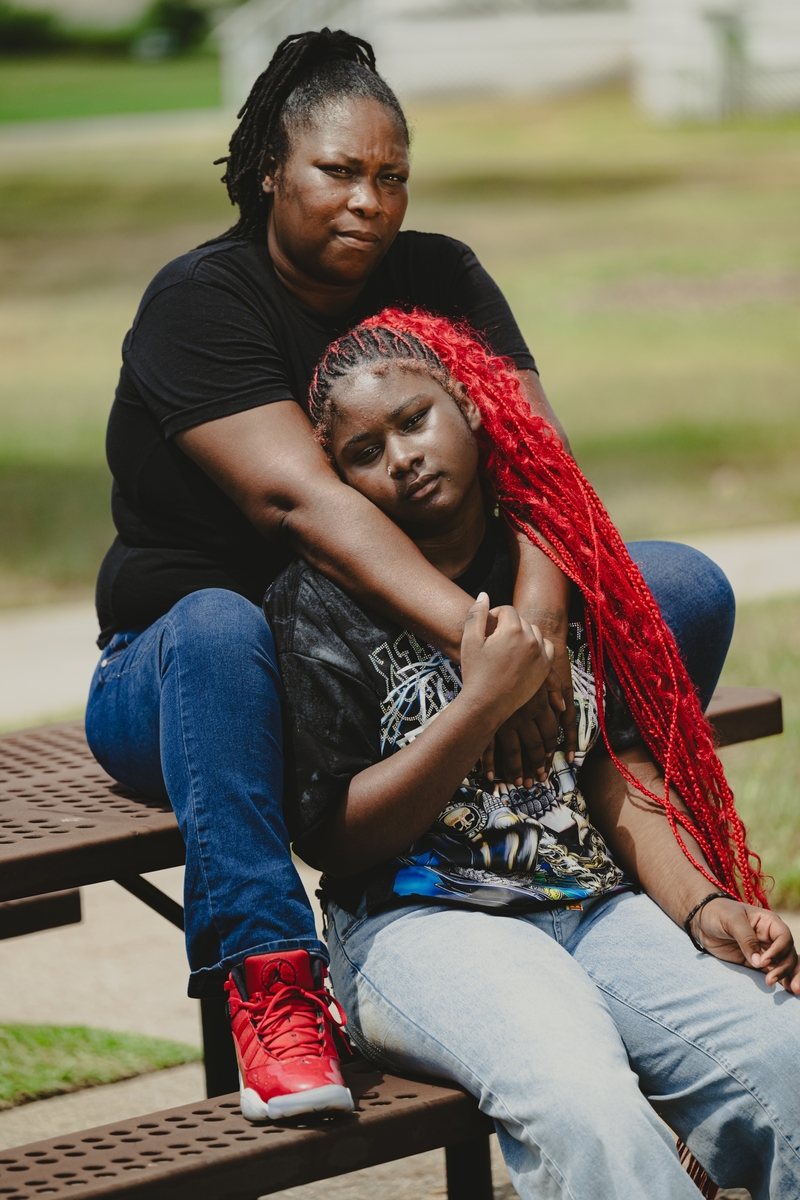
The girl pleaded guilty and was put on probation for a year, Ms. Thompson said. After that, she had even more trouble paying attention in class.
“She just gave up,” her mother added.
Ms. Thompson said that she had agreed to the handcuffs because in that moment, she did not want to question the administrator’s judgment. But after learning what had happened, she wondered why the school officer had been called to handle the situation at all.
“Why couldn’t they just let her stand in the hallway and be quiet and wait on me?” she said.
‘Cops are going to do what cops do’
In the past, principals and teachers typically handled minor misbehavior themselves. Now, as more schools like Central Middle station officers in their hallways, educators can turn to law enforcement when students are disobedient, even if the children are young or pose minimal threat.
Under state law, school officers are supposed to stay out of “routine student discipline.” But the law does not define the term or detail repercussions for violations.
“The cops are supposed to be there to protect the children from shooters,” said Phillip Lyons, the dean of the College of Criminal Justice at Sam Houston State University in Huntsville and a former police detective who handled juvenile cases. “If there aren’t any shooters, the cops are going to do what cops do, and that is arrest.”
At Walsh Middle in the Round Rock district, near Austin, an assistant principal directed a mother to school police officers when her daughter, a sixth grader, said that three boys had hit her in the head with their fists and a cellphone. The boys, ages 11 and 12, gave different accounts of what happened that afternoon, records show; two said that they had been playing a game and another said he had accidentally hit the girl with a stuffed monkey.
All three were charged with misdemeanor assault, the records show.
“I thought we would sit down and apologize and he would serve lunch detentions,” said Kimmy Lueders, the mother of one of the boys.
The district superintendent, Hafedh Azaiez, said in an interview that the school administrator should have tried to handle the situation before involving law enforcement. “It’s not something we’re proud of,” he said.

In some districts, the expansion of policing has been accompanied by a more hard-line approach to violent behavior. Officers have taken more students into custody for suggesting they might hurt someone. Over the past decade, the count of students 10 to 13 referred for making a “terroristic threat” tripled statewide, to more than 600 annually.
At times, officers’ efforts have thwarted potential school shootings. Last year, officers arrested a 13-year-old who they said was plotting an attack on his San Antonio middle school.
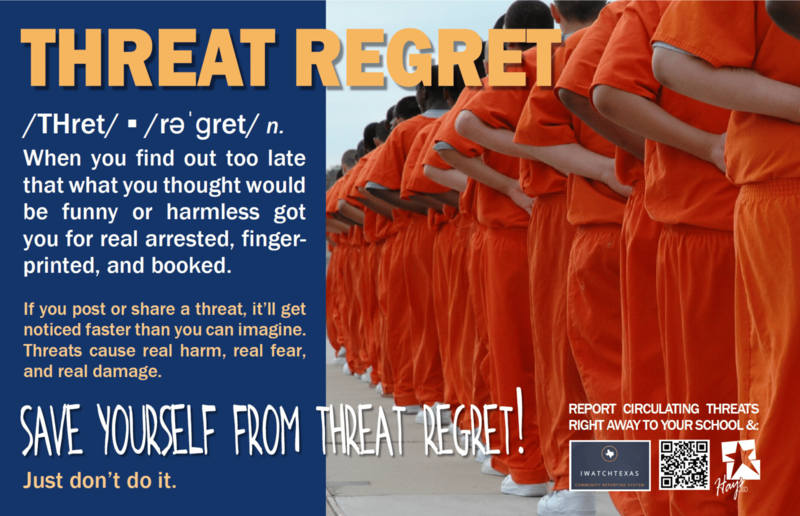
But threats made seemingly in jest or as playground bluster can also attract police attention. In the Wylie school district, near Dallas, district officials told teachers to warn third and fourth graders that once they turned 10, they could be charged with a crime for making a threat they did not mean. In the Hays school district, outside Austin, officials circulated a poster with a row of boys in orange jumpsuits urging students not to have “threat regret.”
The threats did not always involve mass violence. In February 2025, a 12-year-old with an intellectual disability and autism had a meltdown after an aide at his Lubbock middle school unplugged a classroom phone that he wanted to use, records show. “Respect me or you’re dead,” the boy told the aide.
A school police officer came to arrest him. When the boy did not comply with the officer’s orders, a second officer showed up. The two pulled the boy to the ground by his sweatshirt and handcuffed him, police records show. Afterward, the boy was terrified of the police, said his mother, Colette James. He avoided his family’s church because it had hired officers for extra security. For a time, he slept in his parents’ bed.
Lubbock-Cooper school district officials declined to comment, citing student privacy laws. The aide, Jennifer Huckabee, told a reporter she had felt threatened because the boy was bigger than she was.
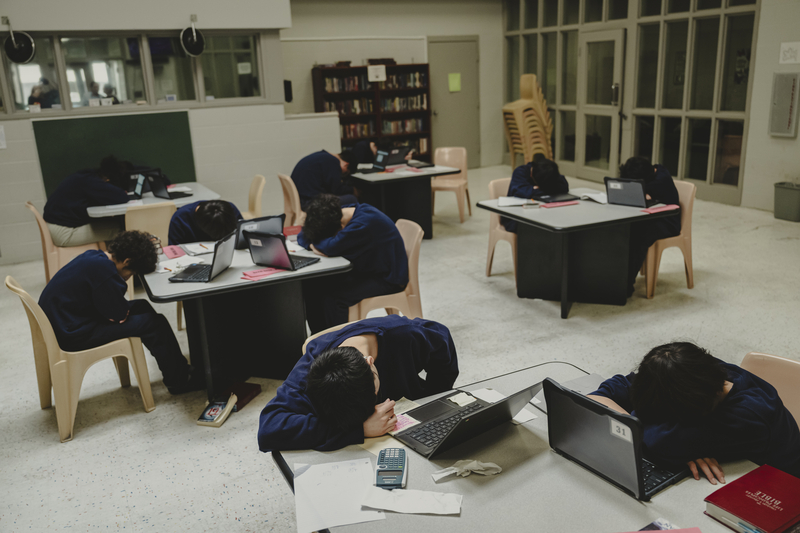
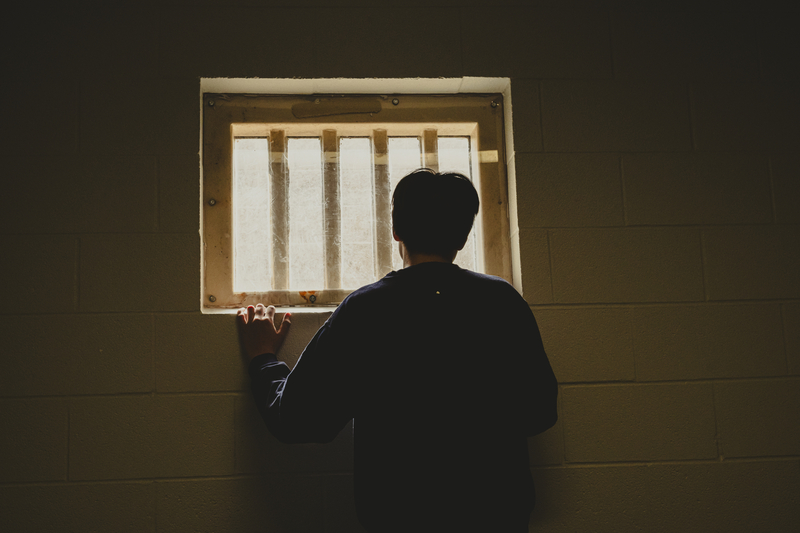
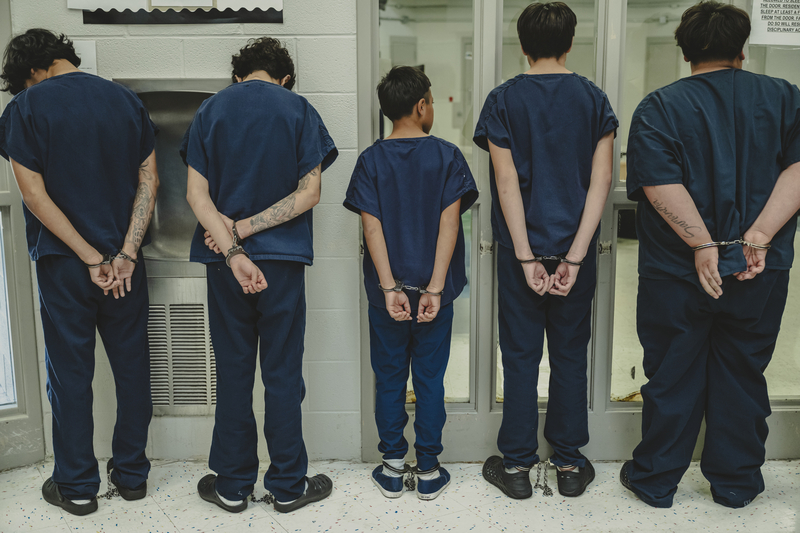
In another case, in Corpus Christi, a 13-year-old was referred after shouting “I’m going to kill you” at classmates who had beaten him up, his mother said. He was held at a county juvenile detention center for nearly two weeks. The county’s juvenile judge, Timothy J. McCoy, sometimes holds children who make threats for counseling and to ensure they do not follow through, he said.
In an interview in his cell, the boy said he had not meant the threat literally. “I was angry,” he said. “I shouldn’t have said it.”
Of the dozens of children in the facility that day, the youngest was 11. Some of them sat at tables of four in a common area, reading, working on laptops or resting their heads. When a reporter asked how many of them were there because of incidents at school, about half raised their hands.
‘A teaching moment’
In some districts where referrals went up, the increases reflect what officials consider a tough love approach.
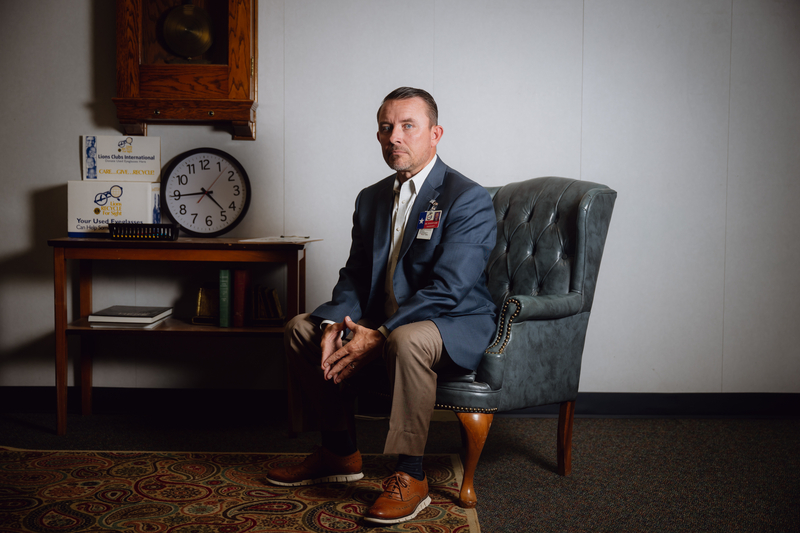
In an interview last year, Kirby Warnke, the chief of the Corpus Christi school district department and president of the Texas School District Police Chiefs’ Association, said he believed the state’s juvenile justice system gave children a chance to learn from their mistakes.
“It’s a teaching moment for them,” Mr. Warnke said.
Referrals of young children in his district more than doubled over the past decade, state data shows. They reached a record high, of 171, in the 2022-23 school year, more than in the Houston and Dallas districts, each of which have more than four times as many students as Corpus Christi.
The Forney school district, east of Dallas, cracked down on violent behavior and threats when it created its own police department in 2020, said Joseph Sanders, who was then the department’s chief. The following school year, 42 students 10 to 13 were referred by the school police — more than had been referred in the previous six years combined.
“We just set the tone and set the tone early,” said Mr. Sanders, who left the district in 2024 and now trains law enforcement leaders.
But elsewhere, officials who were troubled by the uptick took steps to reverse it.
Donny Lee, the superintendent of the Wichita Falls school district in North Texas, said that before he was hired in 2022, school officers would “arrest kids first and ask questions later.”
“We were having charges put on our elementary kids,” he said.
He hired a new chief who agreed with him that arrests should be a last resort, and they replaced most of the officers. Mr. Lee also convened regular meetings to review law enforcement data.
Referrals dropped for students of all ages, data shows. For children 13 and under, the annual number was cut by more than half, to 44 from about 100.
Mr. Lee said that the district had achieved those results without being “soft” on discipline. Students who broke the rules were assigned in-school suspensions or community service and offered counseling.
“We’re not in the crime and punishment business,” he said. “We’re in the education business.”
Disclosure: The New York Times has been a major financial supporter of The Texas Tribune. Philip Lyons has been a financial supporter within the past five years. The Texas Tribune is a nonprofit, nonpartisan news organization that is funded in part by donations from members, foundations and corporate sponsors. Financial supporters play no role in our journalism. Find a complete list of them and more information about our financial and disclosure policies here.
Justin Mayo contributed reporting. Kitty Bennett, Alain Delaquérière, Georgia Gee, Sheelagh McNeill and Kirsten Noyes contributed research. This article was reported in partnership with Big Local News at Stanford University, and with support from the Fund for Investigative Journalism.
Produced by Rumsey Taylor.
Austin, TX