Whitmer attorneys dispute Enbridge argument that Michigan lacks authority to revoke Line 5 easement
Aug 28, 2026 | 3:46 pm ET
Description
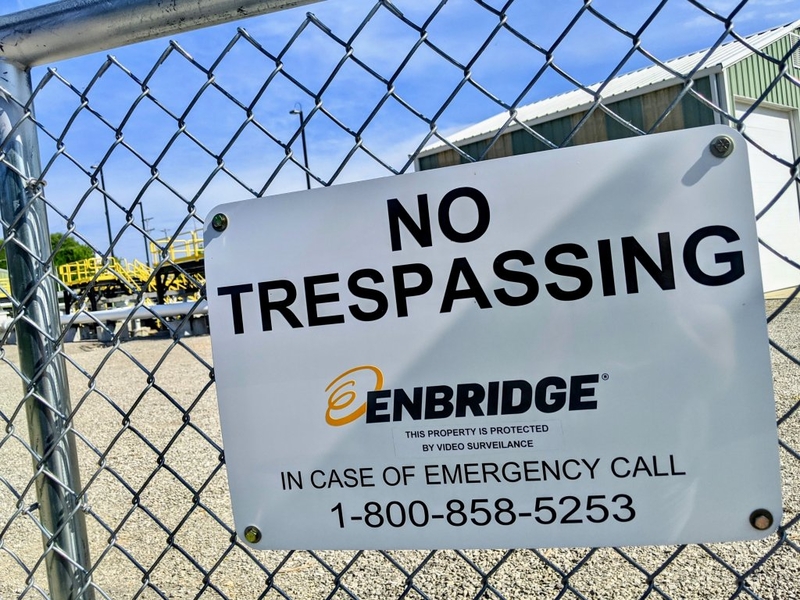
(File photo by Laina G. Stebbins/Michigan Advance)
After a federal court ruling found Michigan Gov. Gretchen Whitmer’s move to terminate the easement to operate the Line 5 pipeline in the Great Lakes unenforceable, the governor and the head of the Department of Natural Resource challenged the decision, filing further arguments with the 6th Circuit Court of Appeals on Friday.
In their initial brief filed in May, attorneys representing Whitmer and DNR Director Scott Bowen argued that Judge Robert Jonker of the U.S. District Court for the Western District of Michigan’s Southern Division had erred in siding with the pipeline’s operator, Enbridge, which argued that the Pipeline Safety Act of 1992 prevents states from imposing safety regulations on interstate pipelines.
The Canadian company also pointed to a 1977 treaty between the United States and Canada, arguing Whitmer’s decision to revoke the pipeline’s easement would breach the nations’ agreement regarding the flow of oil and natural gas across borders.
On appeal, attorneys for Whitmer and Bowen argued Jonker’s decision deprived the state of its rights over the Great Lakes bottomlands, asking the federal appeals court to determine whether the Pipeline Safety Act and the Foreign Affairs Doctrine bar the state from terminating Enbridge’s easement.
“In the district court’s view, it does not matter whether Enbridge has any valid property rights: Congress forced states, having once granted permission to use state land, to forever surrender their rights in that land regardless of whether the occupier complied with the terms under which the state granted access—an endless, congressionally compelled occupation,” the state’s initial brief reads. “No law remotely supports that outcome.”
Enbridge filed its response at the end of July, noting that the lower court determined “the Governor sought to enforce ‘multiple state-imposed safety requirements to justify shutting down Line 5, ’” reasoning that these actions were taken to enforce a safety standard.
“On appeal, the Governor does not challenge the district court’s reasoning directly but tries to achieve the same preempted result via
slightly different paths,” Enbridge’s attorneys wrote in their response.
“She urges the Court to look past the safety motivations driving her shutdown order and focus on the source of the state law she invokes — which she claims is property law,” the attorneys continued, arguing that the district court correctly rejected this argument.
In their response to Enbridge filed Friday, attorneys for Whitmer and Bowen hit back, stating that “Enbridge is wrong: neither the Pipeline Safety Act (PSA), the Foreign Affairs Doctrine, nor the 1977 Treaty entitles it to use Michigan’s land without consent or a valid easement.”
They noted another federal appeals court had recently underscored the importance for pipeline operators to obtain valid land rights in the Bad River Band of the Lake Superior Tribe of Chippewa Indians case against Enbridge. The U.S. Court of Appeals for the 7th Circuit affirmed a lower court’s decision that Enbridge has been trespassing on the Bad River reservation since its easements to operate Line 5 on the band’s sovereign territory expired in 2013.
“The same is true here,” Whitmer’s attorneys wrote. “The State Officials allege that Enbridge does not have consent or a legal privilege to operate Line 5 in the Straits because its easement was terminated and revoked. Nothing in the PSA authorizes Enbridge to operate an oil pipeline on the State’s land without its consent or a valid easement.”
They also argued that the 1977 Transit Pipelines Treaty does not preempt the state’s notice revoking Enbridge’s easement, noting that the Canadian Government acknowledges that the terms and conditions for operating a pipeline may include “obtaining easements,” and multiple Presidential Permits point to valid easements under state law as a condition for operating a transit pipeline.
Tribal leaders, clean water advocates rally in Lansing as Line 5 fight intensifies
“The Great Lakes power Michigan’s economy, supply drinking water to millions, and define our way of life,” Whitmer said in a statement. “Protecting these natural treasures is a top priority. My brief continues my seven-year fight to stop Enbridge from pumping oil through the Great Lakes. Michigan must have a say in what runs through our waters. We must get Line 5 out of the water and work together to protect our precious Great Lakes for generations to come.”
In a statement to Michigan Advance, Enbridge spokesperson Ryan Duffy said the state had fought for more than five years to shut down the pipeline due to “unsupported claims about its safety.”
“The Court affirmed that the Pipeline and Hazardous Materials Safety Administration (PHMSA) is the exclusive federal regulator of pipeline safety,” Duffy said. “PHMSA has taken no action against Line 5, underscoring its safe operation. Enbridge has always worked closely with PHMSA and will continue to do so.”
Duffy argued that any further dispute around the pipeline’s operations must be handled through the 1977 Transit Treaty’s dispute resolution process, noting that Canada has already invoked this process.
“The Court’s ruling makes clear that efforts by Michigan officials to permanently shut down Line 5 would interfere with U.S. foreign affairs – authority vested exclusively in the federal government,” he said.
While pipeline opponents back state’s legal arguments, bad blood with Whitmer remains
During her 2018 campaign for governor, Whitmer promised she’d take action to get Line 5 out of the Great Lakes. However, in recent months, the support Whitmer once enjoyed among opponents of the pipeline has soured, as her administration approved permits for the controversial Line 5 tunnel project, which would replace the dual pipelines resting on the bottom of the Straits of Mackinac with a single segment housed in a tunnel beneath the lakebed.
Tribal leaders and environmental advocates gathered in Lansing earlier this week to lay out the future of their fight against Line 5, with Liz Kirkwood, the executive director of Flow Water Advocates, urging attendees to push Whitmer to “finish the job” she started when she revoked Enbridge’s easement in 2020.
David Holtz, coordinator of the Oil and Water Don’t Mix Coalition, remained skeptical, calling Whitmer’s Friday statement about protecting the Great Lakes “message management.”
“We’d welcome a governor who actually opposes Line 5, full stop, with the Straits, tunnel, and the 645 miles in between,” Holtz said in a statement. “Today’s filing isn’t evidence of that.”
Lansing, MI