Texas Democrats shiver with excitement over US Senate race. Kansas Dems face a bigger challenge.
May 29, 2026 | 4:33 am ET

Description
U.S. Sen. Roger Marshall, R-Kansas, takes part in an Aug. 8, 2025, briefing by an air ambulance crew before a flight from Newman Regional Health in Emporia. (Photo by Tim Carpenter/Kansas Reflector)
Eighty-seven years.
That’s how long it’s been since a Democrat represented Kansas in the U.S. Senate. Of course, it has been even longer since a Democrat won an election, with George McGill in 1932.
In the years following, we have been through a second world war, lived under 15 presidents and elected 12 new senators for Kansas.
Eighty-seven years is a long time, especially in politics.
States we might consider overwhelmingly partisan don’t come close to Kansas. Georgia, which has voted for a Republican presidential candidate in seven of the past eight presidential elections, has two senators who are — against all odds — Democrats.
No other state has a streak that approaches the partisan leaning of Kansas. Utah and Wyoming have shut out Democrats for the past 49 years. On the opposite extreme, 49 years have ticked by since Hawaii has been represented by a Republican.
So, it’s a bit cute at this time of year when everyone starts hyperventilating about Texas.
“Will they elect a Democrat?” we all wonder, our national focus fastened on the Lone Star State.
That question came into sharper focus this week as President Donald Trump’s choice for the Texas seat won the Republican primary. GOP stalwart John Cornyn lost to an unbridled prince of corruption in Ken Paxton.
Republicans worry that Paxton, with his menagerie of scandals, will weaken conservative turnout. If so, pundits and polls suggest, this might be the moment for Democrat James Talarico to earn the seat with his positive vibes and centrist appeals.
The Republican streak in Texas, we hear, might be ending.
However, it’s been a paltry 33 years since Texas had a Democrat in the Senate, with Lloyd Bentsen 1993. If you want to see party domination, Texas, mosey up to Kansas.
How did I arrive at these numbers on U.S. Senate polarization? Ballotpedia provides historical Senate data for each state. I simply found the last year that a Democrat or a Republican represented each state. In the case of a senator changing parties (such as Joe Manchin switching to independent in 2024), I treated that as the final year for a Democrat from that state.
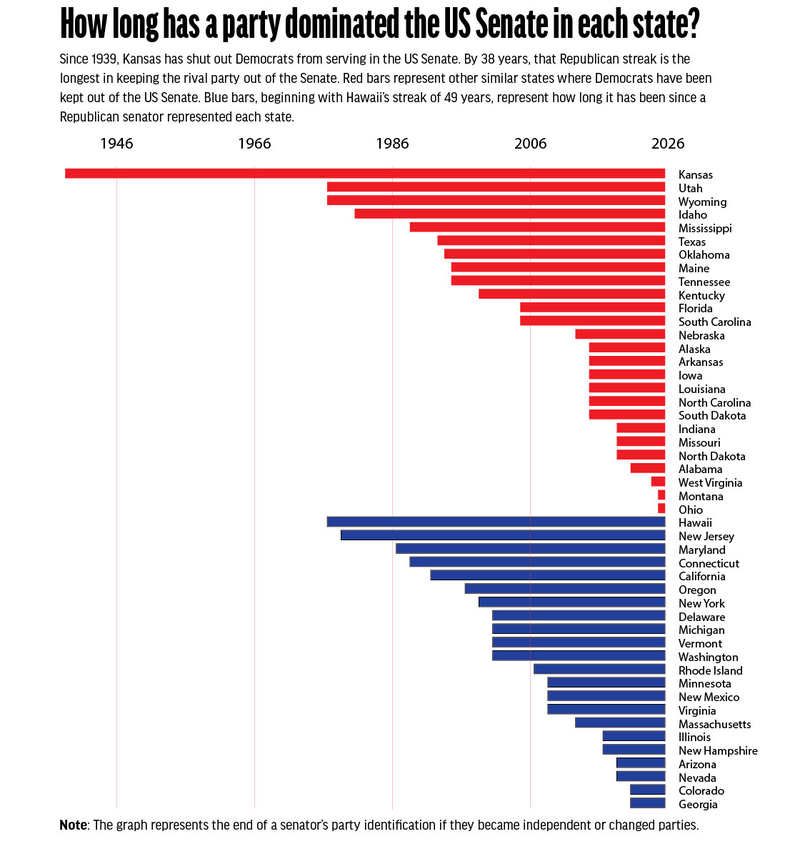
As others have noted, an alarming feature of this graph is not just the length of one-party domination in many states. Our country often has had regions with wild polarization.
No, the scary part is that only two states are absent: Pennsylvania and Wisconsin. Today, those are the only two with split delegations in the Senate, with one Democrat and one Republican.
The moderate middle has not held. Point anywhere on the map, and you are likely to find partisanship. Twenty-four states have shut out one party for at least 19 years. That means that most 18-year-old first-time voters have only ever lived in a state represented by a single dominant party.
That is certainly the case for my Kansas kids, one of whom will be eligible to vote for our next U.S. senator from Kansas, both in the primary and the general election.
Hopeful for some rare electoral drama, liberal Kansans might wink at you hopefully and wonder: “Will our Senate race be like Texas? A chance for a change?”
It’s tempting to nod along with their arguments. A blue wave might crest nationwide as Trump’s approval dips and his disapproval climbs, fueled by … well, it seems almost cruel to make this Trumpian naughty list: rising gas prices, an unpopular war, a slush fund furnished by tax dollars and likely more missteps to come.
Between now and election time, Trump might become more unbridled. His extreme policies and heedless executive orders could find even more tolerance in Congress as he endorses and promotes the most MAGA of the MAGA. Surely this veer further to the right could poison candidates nationwide, especially the most careless Trump loyalists. (Here’s looking at you, Roger Marshall.)
In addition to six other Democrats hoping to run against Marshall as the incumbent, there’s the wild card: Johnson County megachurch pastor Adam Hamilton.
After eight decades, this confluence of conditions, both national and nearby, has to be the window, many understandably desperate Kansans will say.
Just like Kansas Reflector writer and editor Clay Wirestone, I will believe the end of this streak when I see it — not just in Kansas but in Texas, too. The long red line that reaches back to 1939 in Kansas has avoided interruption through incredible national and political turmoil.
During the 1960s, a reorganization of the parties around issues of racial equality and civil rights. With Richard Nixon, a president resigning after corruption and lying. With Donald Trump just six years ago, a failed election that caused a riot at the national Capitol. Recessions. Failed wars. Terrorist plots. Resounding political victories.
Yet, in Kansas, the streak has held.
What would convince me that this blue wave is so tall that it will wash over Kansas?
Here’s my personal barometer: If indeed Hamilton is a serious threat to Marshall’s reelection, people in my life will start talking about Hamilton in a different way over the next few months.
Since I offer my thoughts in my column each week, people often chat me up about politics. And I’m glad for those conversations, which sometimes focus on Hamilton, whose main church campus is in Leawood, where I live.
The most common remark about Hamilton is actually a question: “What do you think about him running?”
It’s a note of curiosity. It’s flirting with him as a candidate. It’s Kansans processing his mix of politics and religion. In short, those asking that question sound undecided and noncommittal.
Undecided won’t cut it in a state where one party has been so weak that it has failed over and over again to send a statewide election winner to Washington.
Breaking a streak like that — whether in Texas or Kansas — demands an enthusiasm that borders on mania. Blizzards of yard signs. A social media barrage. Fawning over a revelatory candidate who could break the streak.
That kind of voter zeal is what’s necessary to convince a state that it isn’t as red as it supposes.
Only with that kind of enthusiasm will Kansans stand in their front yards, in their cornfields, on their apartment balconies and on their main sStreets and say, “I don’t think we’re in Kansas anymore.”
Eric Thomas teaches visual journalism and photojournalism at the William Allen White School of Journalism and Mass Communication at the University of Kansas in Lawrence. Through its opinion section, Kansas Reflector works to amplify the voices of people who are affected by public policies or excluded from public debate. Find information, including how to submit your own commentary, here.
Topeka, KS