At 50, Sojourner House survives and advances
May 29, 2026 | 5:30 am ET
Description
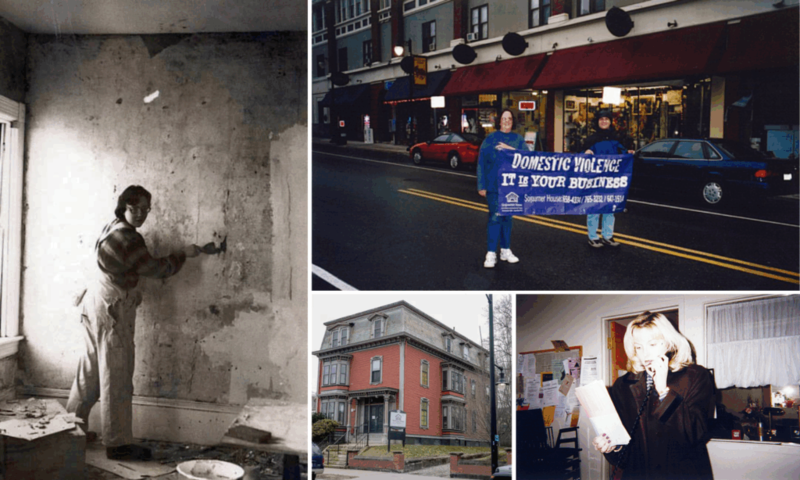
Clockwise from left, a Sojourner House volunteer removes plaster in 1988, marching in Woonsocket in 2003, a staff member handles a call in the mid-1990s and the Drop In Center at 1570 Westminster St. in Providence’s West End. (Contributed photos)
As a law student, one of the first cases I handled under a third-year student practice rule involved a woman seeking a protection order from an abusive boyfriend. During our meeting, she calmly explained that he had locked her in the trunk of a car.
I stopped her mid-sentence. I was certain I had misunderstood.
“Wait,” I said gently. “Where did you say he locked you?”
But I had heard her correctly. She survived only because a passerby heard her screaming and pounding from inside the trunk.
At the time, I was shocked and thought this was an extreme story. This was in 2005, decades after domestic violence shelters and rape crisis centers had already become established throughout the country. I assumed society had evolved far beyond the conditions that originally sparked the movements that created agencies like Sojourner House, which was founded 50 years ago.
After spending much of my professional career working with victims and survivors, I can say with certainty that the brutality has not disappeared. In many ways, it has simply become more complicated, more hidden, and more difficult to escape.
On the one hand, 50 years feels extraordinary. On the other hand, this anniversary is deeply sobering, because it forces us to confront an uncomfortable truth: Sojourner House still exists because the violence that led to our founding also still exists.
When Providence residents and Brown University students first formed Sojourner House as a part-time and volunteer hotline in 1976, shelter was viewed as the central intervention.: Victims needed immediate safety, and advocates helped provide them with a safe place to stay. Today, emergency shelter remains critically important, but over time we have learned that safety is about far more than a roof over someone’s head for a few nights.
We now know many survivors need affordable housing, legal advocacy, childcare, financial support, and job training. They need help navigating school systems for children who have experienced trauma, and increasingly, they need support responding to online stalking and harassment carried out through social media and technology.
Most survivors who come through our doors do not arrive with one isolated problem; they arrive with multiple parts of their lives simultaneously collapsing.
And escaping from abuse has become harder, not easier.
After spending much of my professional career working with victims and survivors, I can say with certainty that the brutality has not disappeared. In many ways, it has simply become more complicated, more hidden, and more difficult to escape.
Housing costs have reached unsustainable levels for many in Rhode Island and across the country. At the same time, wages have not kept pace with inflation, and many people are profoundly isolated from the kinds of support systems that once helped people survive difficult moments. For many victims of abuse, there is literally nowhere to go.
At the same time, the public’s understanding of domestic violence and sexual assault remains frustratingly shallow. People often recognize abuse only when someone is hospitalized, murdered, or appears in a headline, but abuse is typically not just one explosive moment. It often is a continuum of coercion, intimidation, humiliation, manipulation, and fear that slowly erodes someone’s sense of safety, autonomy, and self-worth over time.
Trying to maintain consistent funding for this work can feel exhausting. Federal funding streams are repeatedly reduced or restructured, programs are forced to compete against one another for shrinking resources, and foundations often provide short-term grants while simultaneously asking organizations to develop “sustainable” plans for continuing the work after the funding cycle ends.
Meanwhile, the demand for services from victim services agencies continues to grow. At Sojourner House, we received 1,759 calls for shelter in 2025, but we could only help 11% of the victims who reached out to us for help on any given night. And when victims cannot access help quickly enough, the consequences ripple outward. Survivors remain trapped in dangerous situations longer, children endure ongoing trauma, and violence becomes normalized across generations.
Early in my career, I believed that organizations like Sojourner House would no longer be necessary within my lifetime. I can no longer say that I believe that with any conviction.
But what keeps me hopeful after all these years is not the illusion that abuse will suddenly disappear. It is the extraordinary resilience of survivors themselves, the advocates who continue showing up to do emotionally difficult work despite burnout and uncertainty, and the volunteers, donors, policymakers, and community members who still believe this work matters.
And perhaps most importantly, it is the growing recognition that looking away has never actually made the problem disappear.
At the beginning of the domestic violence movement, violence was widely dismissed as a “private family matter.” Survivors were often blamed, ignored, or expected to quietly endure abuse behind closed doors.
Today, we understand far more clearly that violence in the home is not private at all. It affects workplaces, schools, hospitals, neighborhoods, children, and entire communities. A society where people cannot safely exist inside their own relationships is not a healthy society.
As Sojourner House marks 50 years of service, my hope is not simply that organizations like ours continue the work. My hope is that more people recognize that this work belongs to all of us.
Because no one should have to choose between safety and homelessness. No child should grow up believing violence is normal. And no community can truly flourish when so many people are living in fear.

Providence, RI