Texas A&M drag ban cases before federal judges after conflicting rulings
Sep 23, 2026 | 6:00 am ET
Description
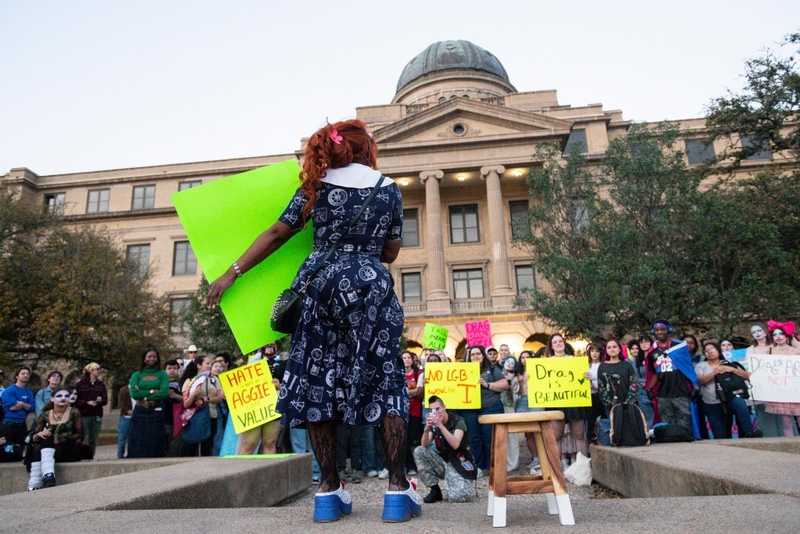
Dulce Gabbana, a local drag performer, speaks to students at a protest against the cancellation of Draggieland at Texas A&M University in College Station on March 6, 2025. (Ishika Samant for the Texas Tribune)
Judges on the 5th U.S. Circuit Court of Appeals pressed Texas A&M’s lawyer Wednesday on a central tension in the university system’s defense of its drag-show bans: how officials can compare such performances to blackface while also arguing the shows are not expressive enough to trigger First Amendment protection.
University administrators were targeting conduct, not a message, said William “Billy” F. Cole, the principal deputy solicitor general in the Texas Attorney General’s office who is defending the system. But when a judge asked about the regents’ concern that drag could promote “gender ideology,” Cole acknowledged to the court that rationale, standing alone, could create a viewpoint-discrimination problem.
He argued the judges should consider the regents’ other stated reasons for the ban, including concerns about discrimination against women. When a judge asked whether any women complained that the shows objectified or harassed them, Cole said no. However, he argued that universities do not have to wait for actual complaints before enforcing anti-discrimination policies.
Judges pressed the lawyer representing the students groups suing the over the ban just as hard on how far First Amendment protections would extend under his argument.
One judge asked whether Texas A&M would have to allow a staged political protest depicting the rape of the Statue of Liberty in Rudder Theatre on its College Station campus. Another asked whether a public university could ban a blackface performance because officials found its message offensive.
J.T. Morris, deputy director of litigation for the Foundation for Individual Rights and Expression, said the university can regulate the conduct but not bar a performance because it objected to its message or viewpoint.
The judges also focused on a broader question that could shape First Amendment cases beyond these disputes: how courts should decide when conduct counts as protected expression.
Chief Judge Jennifer Walker Elrod noted that federal appeals courts have taken different approaches and asked both sides which one the Fifth Circuit should adopt.
Morris argued it should be enough that viewers understand a performer is communicating something, even if they do not take away one specific message. Cole urged the court to take a narrower approach and focus primarily on the conduct itself, arguing that an intent to communicate is not enough unless the conduct conveys a message to viewers.
How did the two cases get here?
The legal fight began at West Texas A&M University in 2023, when President Walter Wendler canceled a drag show organized by the student group Spectrum WT. Spectrum and two of its student leaders sued, arguing university administrators violated their First Amendment rights.
Two years later, Texas A&M University System regents adopted a broader policy barring drag performances at special-event venues across the system’s schools. The Queer Empowerment Council, which organizes Texas A&M’s annual Draggieland pageant, challenged that policy in a separate lawsuit.
In January, U.S. District Judge Matthew Kacsmaryk, an Amarillo-based judge in the Northern District of Texas, upheld West Texas A&M’s ban after a trial. However, in the systemwide case, U.S. District Judge Lee H. Rosenthal, of the Southern District of Texas in Houston, temporarily blocked the policy, finding the students were likely to succeed on their First Amendment claim.
What happened at West Texas A&M?
Wendler argued that drag performances discriminate against women by turning womanhood into a caricature. In a letter to the campus, he called drag shows “derisive, divisive, and demoralizing misogyny” and compared allowing a drag show to allowing blackface on campus. Spectrum planned to donate proceeds to the Trevor Project, an LGBTQ suicide-prevention organization. Spectrum sued, arguing Wendler could not suppress student expression because he found the message offensive.
The case moved between the trial and appeals courts for more than two years. Kacsmaryk initially refused to block the ban while the lawsuit proceeded. In August 2025, a divided three-judge Fifth Circuit panel reversed him and temporarily blocked it. The full Fifth Circuit agreed to reconsider that decision, but before it could, Kacsmaryk issued a final ruling in January upholding the ban after a trial. That ended the earlier appeal over whether the ban should remain in effect while the case was pending.
Kacsmaryk found that Spectrum had not shown its planned performance was inherently expressive conduct protected by the First Amendment.
He also ruled that Legacy Hall, where Spectrum planned to hold the show, was a limited public forum because university officials screen and approve events held there. That gave administrators more authority to restrict what could take place in the venue, as long as its rules were reasonable and did not discriminate based on viewpoint.
What happened with the Texas A&M System ban?
Texas A&M University System regents voted unanimously in February 2025 to ban drag performances at special-event venues across the system. Regents said the shows were inconsistent with Texas A&M’s mission and values and could create a hostile environment for women by mocking or objectifying them. The resolution also noted that hosting drag shows could be viewed as promoting “gender ideology.” It cited President Donald Trump’s Jan. 20 executive order barring federal funds from promoting what he called “gender ideology” and a Jan. 30 letter from Gov. Greg Abbott directing state agencies to follow state and federal law, including Trump’s order.
During Wednesday’s arguments, Cole said the system was not arguing that Draggieland was obscene and did not dispute the council’s assertion that the show would involve no nudity or partial nudity. Morris likewise said obscenity and nudity were not at issue.
In its lawsuit, the Queer Empowerment Council argued the system violated the First Amendment by suppressing student expression because officials considered it objectionable.
Rosenthal temporarily blocked the ban in March 2025. Her ruling allowed Draggieland to go forward at Rudder Theatre in College Station. The system appealed to the Fifth Circuit.
Why did is the full Fifth Circuit hearing both cases?
On May 15, the parties jointly asked the 5th Circuit to have the full court consider the appeals together rather than send each through a separate three-judge panel, arguing they raise the same First Amendment questions and the district judges in the circuit have reached conflicting answers.
The court agreed June 22 and consolidated the cases for oral argument purposes only.
What is the Fifth Circuit deciding?
The 5th Circuit is considering several First Amendment questions that run through both cases.
The first question is whether drag performances themselves are protected expression. The university defendants argue that they are not automatically protected simply because their organizers intend to communicate a message. In the Texas A&M case, they argue the Queer Empowerment Council has not shown that Draggieland conveys a message viewers would readily understand.
The council argues the system’s own justification for its ban undercuts that position. Regents said allowing drag shows on campus could be viewed as promoting “gender ideology.” The council argues that if officials believed drag communicated an ideology, they cannot also maintain that it is not expressive.
The system responds that the possibility that some drag shows could be perceived that way does not prove Draggieland itself communicates a particular message.
The court must also decide how much authority universities have to restrict events in campus venues. While public universities, the defendants argue that the venues at issue are limited public forums where administrators have more latitude to impose reasonable restrictions that do not discriminate based on viewpoint. In the A&M case, the system argues Rudder Theatre qualifies because groups must get university approval to use it.
The council argues Rudder Theatre instead functions as a designated public forum because Texas A&M has opened it to a broad range of events, including Broadway musicals, beauty pageants, concerts, comedy shows and political programs. The group notes the district court found no evidence that administrators previously denied another request to use the theater.
During Wednesday’s arguments, a judge asked Morris whether the students could still prevail if the court agrees with the universities that Rudder Theatre and Legacy Hall are limited public forums.
Morris said yes because even in limited public forums, universities cannot discriminate based on viewpoint. He argued rules based on whether expression is “demeaning,” “mocking” or offensive give administrators too much discretion to judge student speech.
The 5th Circuit is also considering whether the universities’ restrictions are neutral rules about conduct or discriminate against a particular viewpoint. The defendants argue they objected to how the student groups sought to convey their messages through drag performances, not to their support for LGBTQ people. The student groups argue that distinction does not hold because university officials restricted drag precisely because of what they believed the performances expressed.
The court did not say Wednesday when it would rule.
What’s at stake?
After Texas A&M regents adopted their policy, the University of Texas System said its universities could no longer sponsor drag shows or host them in campus facilities, and the University of North Texas later revoked prior approval for a student group’s annual drag show.
The parties in the A&M cases cited both examples in asking the full Fifth Circuit to hear the cases, arguing that universities and students across Texas need clear guidance about when drag performances are protected speech.
In a friend-of-the-court brief supporting the Queer Empowerment Council, the American Civil Liberties Union of Texas and Equality Texas urged the judges to consider the restrictions in the context of broader government scrutiny of drag.
They pointed to Senate Bill 12, which Texas lawmakers passed in 2023 to prohibit certain “sexually oriented performances” on public property where they could reasonably be viewed by children or in the presence of anyone younger than 18. The final law did not explicitly mention drag, although an earlier version of the bill did. A federal judge blocked the law as unconstitutional in 2023. After the 5th Circuit sent the case back for reconsideration and the law briefly took effect this year, the judge again ruled it unconstitutional in August. Texas Attorney General Ken Paxton said the state would appeal.
The ACLU and Equality Texas argue the stakes extend beyond drag. They said requiring a performance to convey one clear message before it receives First Amendment protection could threaten other forms of art whose meaning is open to interpretation.
“Requiring a written script for constitutional shelter would expose all improvised comedy, theater, and dance contests — and nearly the entirety of jazz and other music genres — to unbridled government censorship,” they wrote.
The Texas Tribune partners with Open Campus on higher education coverage.
Disclosure: The Texas A&M University System has been major financial supporters of The Texas Tribune. Open Campus has been a financial supporter within the past five years. The Texas Tribune is a nonprofit, nonpartisan news organization that is funded in part by donations from members, foundations and corporate sponsors. Financial supporters play no role in our journalism. Find a complete list of them and more information about our financial and disclosure policies here.
Austin, TX