Attorneys lambast DA’s decision to retry Rickie Slaughter, question conflict of interest
Sep 24, 2026 | 8:00 am ET
Description
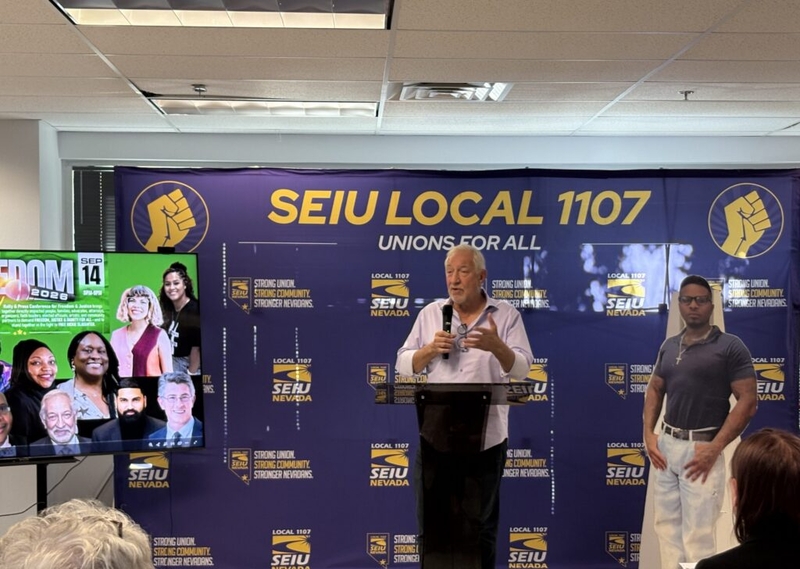
Mark Geragos, a high profile criminal defense attorney representing Rickie Slaughter, speaks at a rally.(Photo: Michael Lyle/Nevada Current)
More than six months after Rickie Slaughter’s conviction was vacated by a district court judge after finding prosecutors withheld evidence in his case, he is still incarcerated at High Desert State Prison.
Attorneys and local organizers are fighting for Slaughter to be released from prison as he awaits for a newly set trial date in early 2027, and they’re raising questions about whether it’s a conflict of interest for the Clark County District Attorney’s office to retry the case instead of releasing Slaughter, who has been incarcerated for more than 20 years.
Mark Geragos, a high profile criminal defense attorney now representing Slaughter, said Slaughter tried to dismiss the case in 2009 over the handling of evidence.
Clark County District Attorney Steve Wolfson’s office is choosing to retry Slaughter now. But when Wolfson was a criminal defense attorney in 2009, it was his law firm that represented Slaughter. Wolfson’s name appears on the 2009 motion seeking to dismiss the case.
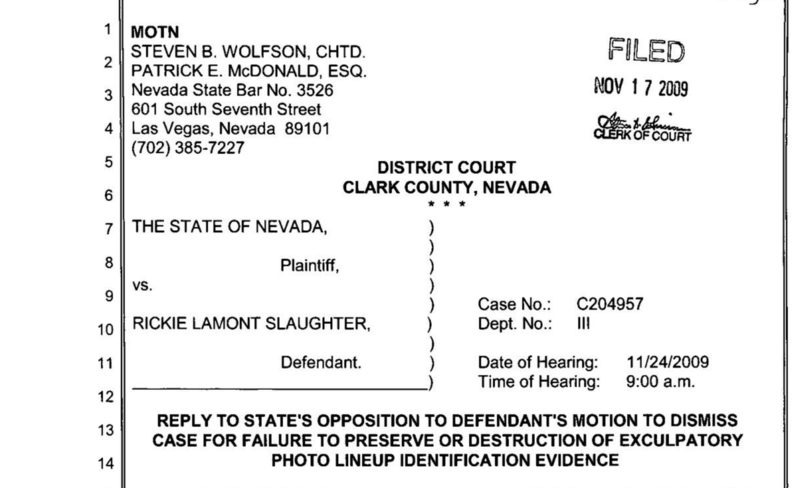
“He represented Rickie on the very issue that the judge vacated the conviction,” Geragos said. “That is the most astonishing conflict of interest I’ve ever encountered in 43 years, especially when a federal district court judge adopted the motion that he filed under his name 17 years ago, and then ordered him to either retry (Slaughter) or dismiss it. Now he’s going to make that decision.”
The district attorney’s office declined an interview request and didn’t answer a list of questions Nevada Current sent. Among the questions were whether there was a conflict of interest and why seek to retry the case.
“The DA’s Office will address its position on this matter in court,” Andryanna Sheppard, a spokesperson said in an email.
Geragos, whose high profile clients have included Hunter Biden and Michael Jackson, joined speakers from the ACLU of Nevada, the National Action Network Las Vegas Chapter, the Mass Liberation Project, and Progressive Leadership Alliance of Nevada on Sept. 14 to discuss Slaughter’s case.
For many, the case underscores long standing frustration with the criminal legal system, how it is overly punitive toward Black and brown people, and failures of the state, like the nation, to bring comprehensive justice reforms.
“The issues that we’re seeing today are products of bad policies that were put in place and a lack of accountability within every layer of government that’s existed,” said Athar Haseebullah, the executive director of the ACLU of Nevada.
Slaughter, in a phone interview, said that at the core of this case is the question about “who has the right to be free.” Slaughter, who maintains his innocence, has been incarcerated since he was 19 and the conviction “stripped away my entire life,” he said.
Even after a judge vacated his conviction, he said he is still struggling to find justice.
“They can just dismiss the charges,” Slaughter said of the DA’s office. “They want to follow one part of the order that says they can retry me but not the part of the order where the court says my conviction is vacated, which would release me from prison. Whether they retry me or not, I could be released from prison in the meantime.”
Slaughter’s retrial is scheduled for Feb. 8, 2027.
He was arrested in 2005 and charged with conspiracy to commit kidnapping and robbery, attempted murder with the use of a deadly weapon, battery, and robbery with the use of a deadly weapon.
He was convicted in 2012. After years of appeals, the court reopened his case May 11, 2022.
Federal District Court Judge Anne Traum, who vacated Slaughter’s conviction in a March 3 ruling, wrote “suppressed evidence would have affected various parts of this evidence and strengthened” Slaughter’s defense.
During a second pretrial photographic lineup, none of the witnesses identified Slaughter. That information was never presented to the jury, according to the ruling.
The ruling noted that “the prosecution presented no forensic evidence, such as DNA, hair, or fingerprints, from the scene that linked back to Slaughter, no incriminating evidence from the search of Slaughter’s apartment, and no confession. Thus, the prosecution’s evidence of guilt would have been markedly weaker had the second lineup not been suppressed.”
Geragos and the ACLU have since argued in court that Slaughter should be released since the conviction was vacated.
Christopher Peterson, the legal director of the ACLU of Nevada, argued in May that since the order vacated Slaughter’s conviction, he should “be treated as a pretrial detainee,” which would mean “he cannot be held at the Nevada Department of Corrections under state law.”
The motion was denied.
“The fact that a federal court has stated that his conviction has been vacated, and we are still in a state court that refuses to recognize that, and says that conviction only goes away the moment a retrial commences, flies in the face of the Constitution,” Haseebullah said at the rally.
In media interviews, including on Vegas PBS on Sept 18, Clark County Chief Deputy District Attorney Marc DiGiacomo has maintained that Slaughter is guilty.
“I wasn’t in court to understand how Judge Traum reached what she reached,” he said during the interview. “There was no evidence ever suppressed. (The defense) had the line up and the ability to ask the witnesses about that lineup.”
Sheppard, the spokesperson for the DA’s office, posted a video to the District Attorney’s social media page on May 5 saying Traum’s findings don’t equate to innocence.
“The only thing the court found was there were some errors at trial that warranted giving him a new trial,” Sheppard said.
Haseebullah, who admonished the social media post, said it was not just case errors but Brady violations, referencing a U.S. Supreme Court case Brady v. Maryland that found suppressing “exculpatory evidence” that can prove innocence violates a person’s due process rights.
“One of the key tenets of our Constitution is to protect against (Brady violations) to not allow for exculpatory evidence to lead to people’s wrongful convictions,” Haseebullah said. “The DA’s office has unilateral discretion as to whether to move forward on this case. Every single step of the way, they have rebuked the offer to engage in what’s just, and instead chosen the side of oppression.”

Las Vegas, NV