Missouri Medicaid enrollee challenges Trump rule on work requirement exemptions
Sep 24, 2026 | 8:00 am ET

Description
Five Medicaid enrollees, six medical organizations and the City of Columbus, Ohio are plaintiffs in a federal lawsuit arguing the Centers for Medicare & Medicaid overstepped its authority in requiring "medically frail" adults to demonstrate their conditions hinder their ability to fulfill Medicaid work requirements in order to be exempted (Getty Images).
Emily Byrd has lost Medicaid coverage twice due to paperwork problems.
Both times, Byrd, of Kansas City, submitted documents requested by the Missouri Department of Social Services. But duplicate letters, late notices and “confusing, inconsistent information” made it difficult for Byrd to regain coverage — the second time forcing them to reapply.
The 25-year-old, who relies on Medicaid for services and medications to manage symptoms of autism spectrum disorder, obsessive compulsive disorder and other conditions, is one of five Medicaid enrollees from five states who filed a lawsuit last week challenging a Trump administration rule they argue unlawfully narrows exemptions from new Medicaid work requirements for people considered “medically frail” under federal law.
The lawsuit, filed in the U.S. District Court for the District of Maryland, asserts the rule violates the One Big Beautiful Bill Act by requiring people to prove that their medical condition “significantly impairs (their) ability to comply” with work requirements to be exempt. It asks the court to vacate that provision and another that excludes people “in stable recovery” from a substance use disorder from the exemption.
Starting Jan. 1, 2027, the federal law will require states to verify that adults ages 19 to 64 covered through Medicaid expansion — the Affordable Care Act provision that allowed states to offer coverage to more low-income adults — work, volunteer or attend school at least 80 hours a month to get or keep coverage.
The law also directs states to exempt people in five “medically frail” categories from work requirements: those who are blind or disabled, have a substance use disorder, a “disabling mental disorder,” a “serious or complex medical condition” or “a physical, intellectual or developmental disability that significantly impairs their ability to perform one or more activities of daily living.”
Medicaid paperwork problems continue to cost thousands of Missourians coverage
The rule allows states to accept self-attestation of medical frailty throughout 2027 when there is no other reliable data source. Starting Jan. 1, 2028, states can only accept one self-attestation during an individual’s enrollment period.
A federal judge in July denied a request from 25 Democratic-led states’ to temporarily block parts of the rule while their legal challenge proceeds.The states argued that the rule came months after they began consulting with the federal government about how to implement work requirements.
Amber Christ, executive director of Legal Aid of Western Missouri, which is co-representing Byrd, told The Independent that by requiring people to prove that their medical condition prevents them from meeting work requirements, the rule “adds a test that Congress didn’t write.”
“When the administration wrote the rule, it really stripped away the protection Congress gave to people with serious medical conditions,” Christ said.
Jane Perkins, litigation director at the National Health Law Program, which is working with state organizations to represent Medicaid enrollees in the lawsuit, told The Independent the Centers for Medicare & Medicaid exceeded its authority with the rule, imposing a “backdoor work requirement” on people Congress meant to exempt.
“Our argument is that this additional new requirement goes beyond the statute, and the (U.S.) Supreme Court has been very clear that federal agencies can only implement the statutes they have responsibility for,” Perkins said.
‘A backdoor work requirement’
Christ said the rule’s limitations on the “medically frail” exemption are likely to worsen a familiar problem in Missouri: eligible people losing coverage because of missed or unprocessed forms.
Of the more than 333,000 Missourians who lost Medicaid coverage from January 2025 through February 2026, nearly 92% were dropped due to paperwork issues, according to data from the Centers for Medicare & Medicaid — not because the state found that they no longer qualified.
The second time Byrd experienced a lapse in Medicaid coverage due to paperwork issues, they had to reapply to regain coverage, according to the lawsuit.
“The new rule will require even more paperwork, even more proof,” Christ said, “and if this is already happening to people, it’s just going to be compounded by this new rule.”
It’s unclear how states will ask applicants to demonstrate that they meet the “medically frail” exemption requirements. The Centers for Medicare & Medicaid released non-binding guidance Sept. 8 suggesting states use a three-tier structure to determine medical frailty exemptions, including diagnoses that would automatically qualify someone, conditions that could qualify with additional information and cases with insufficient information that require an individualized review process.
The lawsuit says that for plaintiff Lauren Bush of North Carolina, uncertainty about how she would meet Medicaid work requirements — and how she would manage her type 1 diabetes without Medicaid — “causes her great stress and anxiety.”
In an email to The Independent, Baylee Watts, the department’s media director, said “Missouri is continuing to finalize its implementation approach for the federal Medicaid community engagement requirements, including the process for identifying and verifying individuals who may qualify for the medically frail exclusion.”
Watts said the department “has not yet finalized whether Missouri will use self-attestation during 2027 or what specific screening methodology it will adopt.”
During a meeting of the MO HealthNet Oversight Committee on Aug. 12, Social Services Director Jess Bax said the department would work with patient and healthcare advocates throughout 2027 to determine how to assess medical frailty when self-attestation is no longer allowed.
“We’ll utilize the period of having the ability to do self-attestation and develop a plan together with stakeholders to implement what…the technology side of that (looks) like as we go into that year two of community engagement requirements,” Bax said.
Watts said that while the department does not comment on individual cases like Byrd’s, it “remains committed to accurate and timely eligibility determinations and minimizing avoidable gaps in coverage for eligible participants.”
The federal lawsuit argues that the rule will require medical providers to assess whether patients’ medical conditions impair their ability to fulfill work requirements without clear criteria.
“The imposition of this responsibility on clinicians will cause patients to schedule appointments solely to obtain Medicaid eligibility documentation, reducing the overall capacity of clinicians to provide services,” the lawsuit says.
Besides asking doctors to make judgments outside of their medical expertise, the lawsuit contends that as people in need of ongoing medical treatment lose Medicaid coverage, medical providers and local governments will bear the cost of providing more uncompensated care.
Along with the five Medicaid enrollees, the lawsuit’s plaintiffs include six medical provider groups, among them the American College of Physicians and the American Academy of Pediatrics, and the City of Columbus, Ohio.
Perkins said that as people with serious chronic medical conditions lose Medicaid, community clinics and emergency medical services funded through local governments will see increased demand and less compensation.
“People who lose Medicaid because of this added requirement are going to with certainty continue to need healthcare,” Perkins said. “That’s going to be true because they’re medically frail, and they’re going to go to these payers of last resort….”
Cities like Columbus, the lawsuit says, provide medical services regardless of residents’ insurance coverage, and when patients are uninsured, they “must make up for this budget shortfall.”
Christ said most of her organization’s clients want to work. Uninterrupted Medicaid coverage, she said, “keeps them stable enough to do that, to even try.”
That includes Byrd, Christ said.
After graduating from high school, Byrd studied to become a certified nurse assistant but was unable to complete their training because of their mental health conditions, according to the lawsuit. They have also worked as an assistant manager, cashier and stocker at three retail stores, but they are not currently working.
Byrd “does not know how (they) will comply with the work requirements,” the lawsuit says.
The rule, Christ said, will make it harder for people to maintain Medicaid coverage that they are entitled to by law.
“Our clients aren’t going to lose coverage because they don’t qualify,” Christ said. “They’re going to lose it because a form got missed, a deadline passed by them or a doctor couldn’t produce the letter that this rule now demands.”
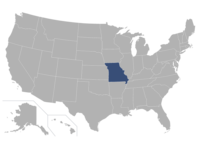
Jefferson City, MO