Tennessee judicial panel dismisses private-school voucher lawsuit
Oct 20, 2026 | 3:23 pm ET
Description
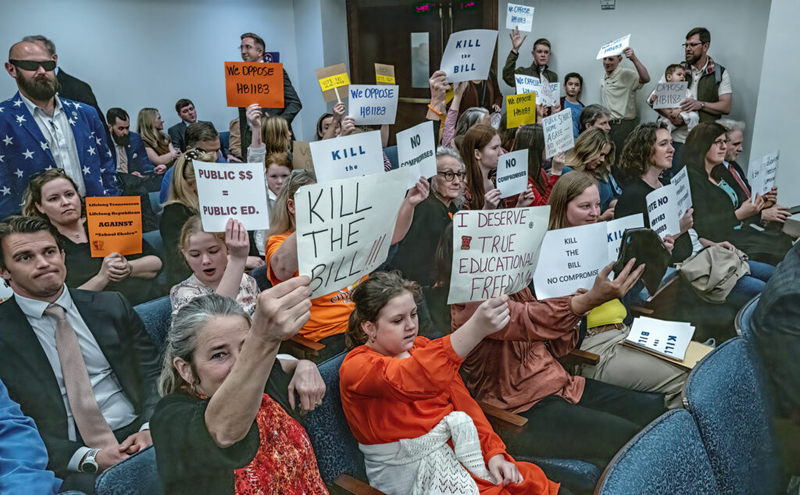
A crowd in a Cordell Hull Legislative Building committee room expresses displeasure with Gov. Bill Lee's 2024 school voucher plan. A three-judge panel ruled in October 2026 the voucher plan doesn't violate Tennessee's constitution. (Photo: John Partipilo)
A Tennessee judicial panel dismissed a legal challenge of the state’s private-school vouchers, finding that the constitution doesn’t prohibit creation of the $260 million-plus program.
The three-judge panel dismissed the entire case filed in 2025 by a group of parents who said Tennessee’s Education Freedom Scholarship Act violates the constitution by shifting funds to unaccountable private schools that discriminate against students. The decision also dismissed claims against Gov. Bill Lee based largely on the finding that he is not responsible for enforcing the act.
The program provides vouchers worth about $7,500 to 35,000 students in its second year and can be expanded annually by 5,000 children, depending on funding by the legislature. It provides funds for three categories of students, including those at 300% of the federal subsidized lunch program, up to $180,000 for a family of four, students with no family income requirement and children who qualify for the state’s Education Savings Account program for low-income children.
Tennesseans challenge state’s private-school voucher program
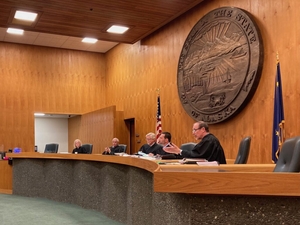
The panel, made up of Chancellor John Rambo of upper East Tennessee, Judge Joseph Howell of Madison County and Chancellor Anne Martin of Davidson County, found that Tennessee’s Constitution doesn’t prohibit creation of a private-school voucher program, even though it requires a system of free public schools. The ruling found that the constitution’s “silence” about private-school funding gives the General assembly broad power to set up the program.
The group of parents who sued the state claim it diverts hundreds of millions of dollars in state funding away from public schools, exacerbating “an already deficient educational system” that lacks staff, services and programs to enable children to learn successfully.
Defendants argued that the constitution “merely mandates” the legislature keep a free public school system “in existence and does not address any requisite level of funding.”
The panel found that the plaintiffs’ constitutional challenge should be made against a statute such as TISA, which funds the public school system, not the private-school voucher program.
EdChoice Legal Advocates, a pro-voucher group that represented two families who intervened in the lawsuit, called the decision “an important victory” for Tennessee parents who want to keep their children in schools where “they’re happy, learning and thriving.”
Critics of the private-school voucher program say it creates a new entitlement that serves students who were attending private schools already, placing a burden on the state budget and shifting money from public schools.
Nashville, TN