Surge in advance voting for Republican runoff driven by party switchers, county auditors say
Jul 15, 2026 | 3:07 pm ET
Description
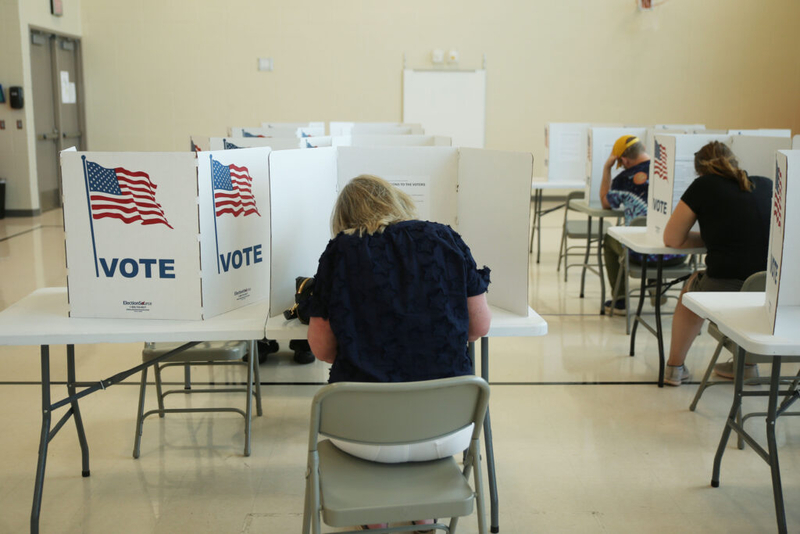
Voters fill out their ballots at a Sioux Falls polling place during the South Dakota primary election on June 2, 2026. (Photo by Makenzie Huber/South Dakota Searchlight)
Advance voting in the runoff for the South Dakota Republican nomination for governor is ahead of the pace it was on for the primary election, and some county election officials are attributing it to people switching parties.
“I’ve got an election coordinator and that’s basically all she’s been doing since the primary: processing those party changes as they come in,” said Brown County Auditor Lynn Heupel.
Through Monday, 12,617 Republican voters statewide had cast ballots for either Gov. Larry Rhoden or businessman Toby Doeden. The runoff election is July 28.
That’s about 3,300 more than a comparable timeframe ahead of the June 2 primary — a 35% increase. Early voting for the primary, however, started about a week late due to delayed ballot printing.
Unlike the primary, this election is only for Republican voters (many Democrats, independents and other voters had local races or ballot questions to consider in the primary election). About 19% of advance voters in the primary were non-Republicans, according to data from the Secretary of State’s Office.
Since the primary, the Republican Party in the state has grown by 7,350 voters. In Minnehaha County, the state’s most populous county, the Republican Party has increased by 1,802 voters.
Minnehaha County Auditor Leah Anderson suspects, “based on the activity that’s come to our window,” that much of the growth is from people switching their party affiliation to Republican so they can vote in the runoff.
Voters who filled out the form to switch parties often voted immediately after the change was processed, Anderson said. About 85% of advance voting in Minnehaha County so far has been in-person. Advance voting also includes mailed ballots.
In the last few days before the voter registration deadline, which was Monday, Anderson said requests to switch parties overwhelmed her staff, forcing her office to suspend immediate voting while forms were processed. Those voters can return to cast their ballots anytime until the election on July 28.
Temporary party switchers receive encouragement and criticism ahead of Republican runoff election
“We’ve had a lot of people come and change their party, go vote upstairs and then come down and ask to change it right back,” Anderson added.
Anderson said her office is waiting until after the runoff to implement those reversal requests to ensure voters’ ballots are counted. A stack of requests is sitting in her office.
In Brown County, home of Aberdeen, Heupel said her office processed 65 party affiliation changes on the last day of voter registration. Her office has sent 1,022 voter registration acknowledgments since the primary, which includes party affiliation changes and new voter registrations. The majority, Heupel said, are due to party switchers.
The Republican Party has grown by 785 voters in Brown County since the primary election.
Unlike Minnehaha County, Heupel’s office does not allow voters to cast a ballot immediately after updating their registration — voters must wait to receive a mailed acknowledgment, which can take a few days.
The county has had 980 people vote in-person so far, Heupel said. Another 207 requested mailed ballots.
Lincoln County Auditor Sheri Lund said her office offers advance voting immediately after people change their party affiliation.
“Probably 90% of those people take us up on that,” Lund said. “A lot of them are shocked they can do that.”
The Republican Party has grown by 1,023 voters in Lincoln County, which includes part of Sioux Falls, since the primary election.
Lund said party affiliation changes are common ahead of primary elections, but are more pronounced this year due to the interest in the runoff.
“I have heard people say this is election fraud. It’s not election fraud at all,” Lund said. “It’s 100% your right to vote however you want to and change your party affiliation if you want to. Is it right or wrong? That’s on their conscience.”
Doeden finished first and Rhoden finished second in the June 2 primary, ahead of U.S. Rep. Dusty Johnson and state House Speaker Jon Hansen. Because nobody received 35%, a runoff was triggered between the top two finishers.
The winner of the runoff will face Democratic nominee Dan Ahlers in the Nov. 3 general election.

Pierre, SD