Supreme Court rejects Virginia Democrats’ bid to salvage redistricting plan
May 16, 2026 | 4:51 am ET
Description
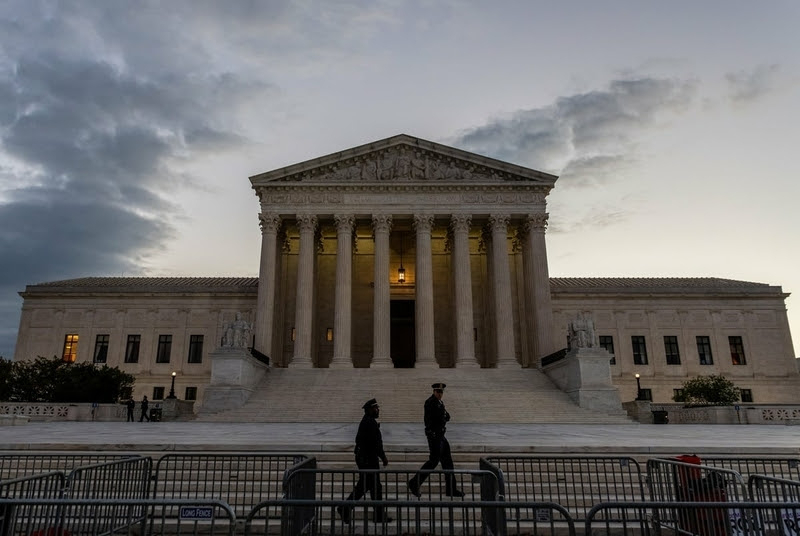
The U.S. Supreme Court building at dusk. (Photo by Ariana Figueroa/States Newsroom)
The U.S. Supreme Court rejected without comment Friday a petition by Virginia Democrats to revive the voter-approved redistricting amendment that had been struck down a week earlier by the Supreme Court of Virginia.
The one-line order from the high court dashes Democrats’ hopes of pausing the state ruling while an appeal moved forward. It also does little to quiet the national debate over redistricting, with the 2026 midterms inching closer.
In an emergency application filed Monday with Chief Justice John Roberts, attorneys representing Virginia House Speaker Don Scott, D-Portsmouth, Senate Majority Leader Scott Surovell, D-Fairfax, Senate President Pro Tempore Louise Lucas, D-Portsmouth, and the commonwealth of Virginia asked the court to pause the state ruling while the appeal moved forward.
“The irreparable harm resulting from the Supreme Court of Virginia’s decision is profound and immediate,” the lawmakers’ filing read.
“By forcing the Commonwealth to conduct its congressional elections using districts different from those adopted by the General Assembly pursuant to a constitutional amendment the people just ratified, the Supreme Court of Virginia has deprived voters, candidates, and the Commonwealth of their right to the lawfully enacted congressional districts.”
Virginia Supreme Court voids redistricting amendment, keeps current maps in place
The filing came three days after Virginia’s high court ruled 4-3 that the constitutional amendment authorizing mid-decade redistricting violated procedural requirements in the Virginia Constitution and therefore could not take effect, despite being approved by voters April 21.
That decision left in place the congressional map adopted in 2021 after Virginia’s bipartisan Redistricting Commission deadlocked. The current map, approved by the court at the time, is viewed as politically balanced and currently favors Democrats in six of the state’s 11 congressional districts and Republicans in five.
The amendment would have allowed the Democratic-controlled General Assembly to redraw Virginia’s congressional districts in response to similar efforts already underway in several Republican-led states. The new maps were projected to heavily favor Democrats in as many as 10 districts.
Writing for the majority last week, Supreme Court of Virginia Justice Arthur Kelsey said the amendment process violated the Virginia Constitution because lawmakers first passed the proposal without a 90-day public notice required by state law before the “next general election” took place.
The court concluded that the election included Virginia’s early-voting period, which had already begun when lawmakers first approved the amendment. The majority described partisan gerrymandering as a threat to democracy and said the constitutional violation “incurably taints” the referendum results.
Democrats argued to the U.S. Supreme Court that the Virginia court fundamentally misread both state and federal election law.
“The Court overrode the will of the people who ratified the amendment by ordering the Commonwealth to conduct its election with the congressional districts that the people rejected,” the emergency application states.
Virginia voters back redistricting amendment after months of legal and political battles
The filing repeatedly argues that elections under federal law occur on a single Election Day, even when states permit weeks of early voting beforehand. Attorneys say the Virginia court improperly expanded the meaning of “election” beyond its traditional legal definition — a key issue the court debated during oral arguments last month.
“The Supreme Court of Virginia’s decision was interwoven with a grave misinterpretation of federal election law,” the filing said.
The appeal also cited the U.S. Supreme Court’s 2023 ruling in Moore v. Harper, which limited how far state courts can go when interpreting election laws affecting federal races.
Virginia Democrats argued the state court “transgressed the ordinary bounds of judicial review” in its interpretation of the state Constitution. The filing further says the ruling creates logistical problems for election officials ahead of the November midterms.
Virginia’s congressional primary was recently moved from June to Aug. 4 because of the ongoing litigation, and election officials face approaching deadlines for ballot certification and absentee voting.
“This Court should act now to preserve the status quo while it considers the grave federal questions the decision below raises,” the application stated.
House Minority Leader Terry Kilgore, R-Scott, one of the appellants in the case, criticized Democrats for their effort after losing before the state’s supreme court.
“The Supreme Court of Virginia has already ruled that Virginia Democrats violated the Virginia Constitution,” Kilgore said in a statement at the time. “Now, rather than accept that ruling, they are running to the U.S. Supreme Court to overturn it. It’s time to stop the legal games, pass a budget for Virginians, and focus on the November midterms.”
Carl Tobias, a constitutional law professor at the University of Richmond, said earlier this week that the appeal raised significant constitutional questions but faced an uphill climb at the nation’s highest court.
“Most of these arguments are not grounded in law, as far as I can tell,” Tobias said, before Friday’s order was handed down. “We’ll see what the U.S. Supreme Court says about them, but I don’t think any of that is really compelling. I think those are just legal arguments they’re making, as I understand it.”
The court’s order Friday in the Virginia appeal came just over two weeks after it issued its ruling in Louisiana v. Callais, overturning race-base congressional districts in that state and gutting section 2 of the Voting Rights Act in the process. That has sparked a rush by states like Tennessee and others to redraw their congressional maps for partisan advantage ahead of the Nov. 3 midterm elections.
— This story was updated on May 15 to reflect the U.S. Supreme Court’s order. The story originally appeared in the Virginia Mercury, which is part of States Newsroom, a nonprofit news network supported by grants and a coalition of donors as a 501c(3) public charity. Virginia Mercury maintains editorial independence. Contact Editor Samantha Willis for questions: [email protected].
Annapolis, MD