Peggy Flanagan boosts affordability message with pledge to back labor’s populist economic agenda
Oct 08, 2026 | 5:49 pm ET
Description
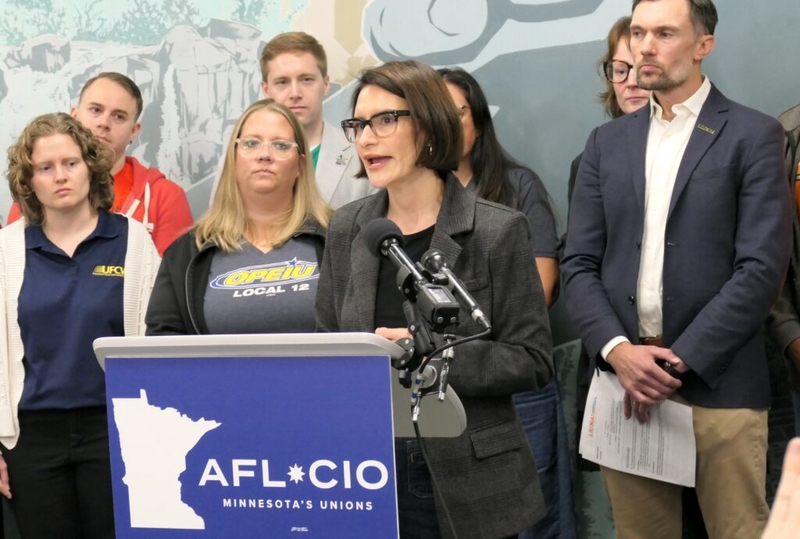
Democratic U.S. Senate candidate Peggy Flanagan pledges her support of a labor-led economic agenda that includes raising the minimum wage and lowering healthcare costs at a campaign event at the Minnesota AFL-CIO headquarters in St. Paul on Oct. 8, 2026. (Photo by Max Nesterak/Minnesota Reformer)
Democratic U.S. Senate candidate Peggy Flanagan promoted her affordability message on Thursday, pledging to support a union-backed package aimed at raising wages, reducing healthcare costs and weakening corporate power in Washington.
At a campaign stop at the headquarters of the Minnesota AFL-CIO, the federation of unions representing more than 300,000 workers, the lieutenant governor said unions built the middle class and are essential to a strong, fair economy.
“The rich keep getting richer, while the rest of us are told to settle for less, to stay quiet, and to accept scraps. That’s Donald Trump’s America,” Flanagan said.
Flanagan is the third U.S. Senate candidate to sign on to the working-class commitments, following Democrats Troy Jackson in Maine and James Talarico in Texas. The commitments were developed locally through surveys with workers and vary from state to state.
The 12 “Commitments to working Minnesotans” span a broad swath of populist economic proposals, including raising the federal minimum wage from $7.25 to $17 an hour, eliminating the income cap on Social Security contributions that winds up lowering taxes on the wealthy, creating a public option for health insurance, banning elected officials from trading individual stocks and making it easier to unionize.
“When this election is over, we are going to make sure these commitments become policy,” said Minnesota AFL-CIO President Bernie Burnham.
While union membership has suffered a decadeslong decline, unions continue to be a potent political force with widespread popularity. Americans’ approval of labor unions is the highest it’s been in six decades, with 71% in favor, according to Gallup.
Democrats have hammered Republicans on affordability, blaming President Donald Trump’s trade war and Iran war for driving up the cost of goods and gas, while the expiration of healthcare subsidies has resulted in double-digit insurance cost increases on the individual marketplace.
The median Minnesota family saw their purchasing power reduced by $1,410 in 2025 as inflation rose faster than wages, according to a study by North Star Policy Action, a left-leaning think tank.
After riding a wave of progressive enthusiasm to a Democratic primary landslide, Flanagan is now running a close race against Republican Michele Tafoya. Polls show Flanagan is essentially tied with the former sportscaster and conservative podcaster.
Tafoya has sought to tie Flanagan to Minnesota’s fraud crisis and Gov. Tim Walz, who dropped his bid for a third term amid intense scrutiny of the state’s management of safety-net programs. She’s also positioned Flanagan as a radical whose progressive policy ideas are out of step with the average voter.
“People are tired of crazy,” Tafoya recently told Fox News’ Sean Hannity. “This is a clear contrast in common sense versus crazy.”
But like Republicans across the country, Tafoya faces her own challenge: distancing herself from a deeply unpopular and erratic president — he suggested this week that Iran could “take out” southern California — without upsetting his loyal base. Tafoya’s campaign ads describe her as an independent voice, but in fundraising messages she’s asked donors for their support to protect the “President’s Senate majority.”
“These MAGA folks are either afraid of Donald Trump or proud to stand with him. The result is the same: that they do whatever he wants them to do,” Flanagan said.
Flanagan has deep ties to the labor movement in Minnesota, having campaigned to raise the minimum wage when she led the Children’s Defense Fund of Minnesota.
While she was lieutenant governor, Democrats took control of the Legislature and passed the most significant package of pro-labor laws in generations: paid family leave, paid sick time, increased enforcement against wage theft, a ban on captive audience meetings, a nation-leading labor standards board for nursing home workers and greater safety oversight of meatpacking plants and large warehouses.
“Everything that I have done that has been of real value, I have done in partnership with the people in this room,” Flanagan said.

Saint Paul, MN