Stricter e-bike laws could be right down the road for Louisiana
Nov 19, 2026 | 1:07 pm ET
Description
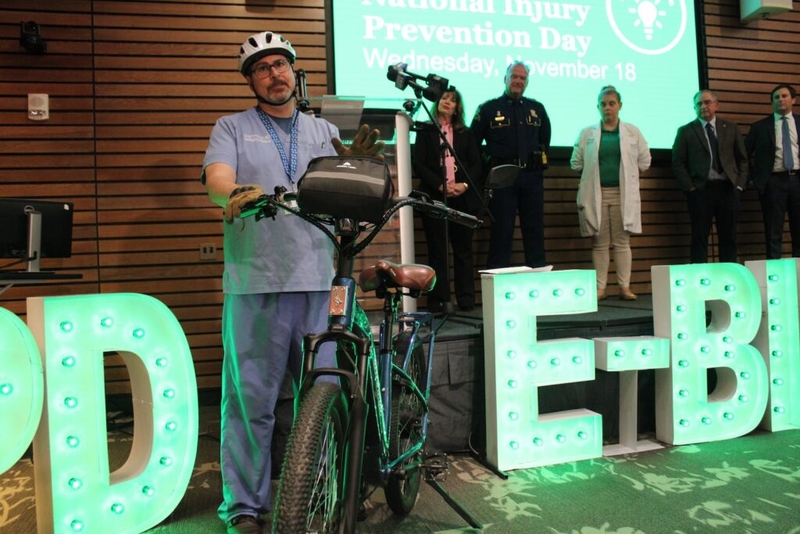
Dr. Greg Fernandez, an emergency medicine physician at University Medical Center in New Orleans and St. Bernard Parish's elected coroner, demonstrates safety tips for e-bikes Wednesday, Nov. 18, 2026, at an event held at the hospital to mark National Injury Prevention Day. (Photo by Greg LaRose/Louisiana Illuminator)
The increasing frequency of serious accidents involving electric bikes and scooters — and ambiguity in the rules that apply to them — could prompt Louisiana to put more stringent laws in place, officials said Wednesday.
One proposal that could be considered is requiring e-bike owners to carry insurance for models that can reach the speed of motorcycles, a measure already in place in one state.
A report the health data analysis firm Truveta Research published last month determined that from 2023 to this year, U.S. emergency room visits related to e-bike accidents have increased from 1.2 to 10.1 visits per 100,000 ER patients. Children and adolescents brought to emergency rooms for e-bike accidents have increased nearly twentyfold over that span, compared with just 1.5 times more for traditional bicycles.
Those numbers provided a backdrop for state and local safety officials who joined emergency room physicians Wednesday at University Medical Center in New Orleans for National Injury Prevention Day. Their messages focused on e-bike safety, public awareness for the growing number of riders and how laws on the books in Louisiana don’t adequately address their concerns.
The speakers included Sheriff Greg Champagne of St. Charles Parish, which last month approved some of the state’s first regulations for electric bikes and scooters. They require riders younger than 12 to use helmets when riding lower-powered models, and all riders on faster e-bikes must now wear headgear.
“The number one complaint that I personally received from my citizens has been in the last two years — it’s not about you know burglaries and robberies and rapes and everything else,” Champagne said. “It’s about what are you going to do about these e-bikes and all these kids out there that are risking their lives every day.”
The sheriff acknowledged the new parish rules could create constitutional issues, with the parish possibly stepping on the state’s toes, but he said he now at least has an enforcement tool on local roads.
“The laws have not kept up with the technology on e-bikes,” Champagne added.
New Orleans attorney Charlie Thomas was also part of the presentation. He specializes in cases involving bicycles and is also a bike shop owner and e-bike proponent.
Thomas said Louisiana and other states adopted federal e-bike classification standards put in place in 2002, and few changes have been made in the interim. Congress chose at that time to place e-bike regulation under the Consumer Product Safety Commission rather than treat them as motorized vehicles.
E-bikes are classified based on their power source. Class 1 models are low-speed, pedal-assisted that max out at 20 mph, Class 2 are low-speed, throttle-assisted, and Class 3 “high-powered” pedal-assisted bikes that are supposed to only reach 28 mph.
There are also “unclassified” e-bikes currently on the road that can travel much faster and, for all intents and purposes, should be considered motorcycles, Thomas said. Electric motors are available through Amazon that can replace a standard bicycle’s rear-wheel hub, creating what Thomas said is another unclassified category of e-bike.
“What we’re working to do in the next year or two is have the state redefine what some of these items are so we can know: are they legal, are they not legal and where can they be ridden,” he said.
In an interview, Thomas said he has watched with interest as New Jersey put in place the first state laws for e-bikes earlier this year. They require the bikes to be licensed, registered and — for the faster models — insured. Riders must now be at least 15 years old.
There’s no age restriction on low-powered e-bikes in Louisiana, though children under 12 have to wear helmets as required under state laws for bicyclists, and riders as young as 12 are allowed to use high-powered models.
Thomas said it’s too soon to tell if New Jersey’s regulations have made any difference with regards to safety, though he said sales have plummeted since its insurance requirement took effect.
State Rep. John Illg, R-River Ridge, attended Wednesday’s event and said in an interview he intends to sponsor legislation next year to address the e-bike concerns raised. He added that it was too soon to discuss specifics for his proposal, though he said an insurance requirement would be part of the discussion.
“We’re going to find something that works for everybody here,” Illg said. “But you know you can pass all the legislation in the world, but if it doesn’t get enforced” the laws are pointless.
Louisiana Highway Safety Commission director Lisa Freeman, who led the presentation in New Orleans, said Gov. Jeff Landry is supportive of policy changes that account for the growing popularity of e-bikes, though she didn’t offer any specific measures he would back. Landry appointed Freeman to her role in charge of the state body tasked with reducing motor vehicle accidents and fatalities.
“I can tell you that at the Capitol, there is commitment to making our roads safer for all road users because they all have rights and they all have responsibilities,” Freeman said.
In the meantime, New Orleans could become the next jurisdiction to consider its own e-bike regulations. Capt. Anthony Micheu, the NOPD’s Traffic Unit commander, said there have been four e-bike fatalities in the city this year. A safety task force Mayor Helena Moreno has put in place will discuss whether regulations should be brought forward, he said.
Thomas said any policy will have to address the need for safety standards while also ensuring e-bikes remain available to the people who rely on them for everyday transportation.
“It should be accessible to get around by bike, especially (because) parking is expensive. It’s expensive to maintain a car,” he said. “If you’re in the service industry and you’re trying to get to the French Quarter for your shift, an e-bike is the best solution.”
Baton Rouge, LA