State claims immunity from some sexual abuse lawsuits filed under the Child Victims Act
Jul 09, 2026 | 8:35 pm ET

Description
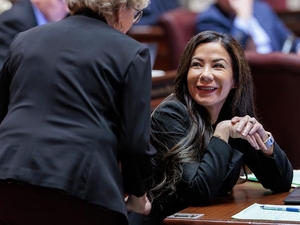
Attorney General Anthony Brown, left, and lawyers in his office have been arguing in courtrooms around the state that Maryland government has immunity in any civil lawsuit stemming from allegations of child sexual abuse that occurred before 1982. (File photo by Bryan P. Sears/Maryland Matters)
The Supreme Court of Maryland has agreed to hear the state’s challenge to the Child Victims Act in a case that could end hundreds of sexual abuse lawsuits and save the state and its taxpayers more than $1 billion, while denying some plaintiffs their day in court.
The state faces roughly 12,000 individual lawsuits filed under the Child Victims Act, a 2023 law that effectively eliminated time barriers for someone to file a claim in court of institutional sex abuse. The potential liability from those claims could equal nearly 15% of the state’s current operating budget by some estimates.
In their filing with the high court, the state’s attorneys argued that while the law lifted the limits on when a claim can be filed, it did not lift the ironclad immunity against lawsuits the state enjoyed prior to 1982.
“The Child Victims Act did not waive sovereign immunity as to such claims, for which sovereign immunity had never previously been waived,” the state wrote in its petition to the court. “Indeed, the Child Victims Act did not even mention sovereign immunity. Claims against the State and its agencies arising out of conduct preceding July 1, 1982 therefore remain barred by sovereign immunity, and this case should have been dismissed on that basis.”
The Attorney General’s Office has been making that argument in circuit courts across the state with mixed success. Judges in Frederick County and Baltimore City have agreed with the state, but the judge in State v. J.C., the Prince George’s County case on appeal, rejected the sovereign immunity claim.
Neither a spokesperson for Attorney General Anthony Brown, nor the lead attorney for J.C., the plaintiff in the Prince George’s case, responded to a request for comment. No date has been set for a Supreme Court hearing of the case.
Thousands are suing states over sexual abuse in juvenile detention facilities
1,300 lawsuits potentially affected
The appeal involves a claim by a female plaintiff, identified only as J.C., involving the old University of Maryland Prince George’s Hospital Center. J.C. said she was “admitted to a residential treatment institution operated by Defendants (the state) for the purpose of receiving medical, psychiatric, psychological and/or behavioral health services,” and was “molested” in 1977 by a doctor who was “checking on her condition after an anaphylaxis episode.”
The state asked the judge to dismiss the case “because the events occurred prior to the enactment of the Maryland Tort Claims Act,” which ended the state’s absolute sovereign immunity when it took effect in 1982. “The circuit court denied the motion without a hearing and without setting forth any reasoning,” the state said in its petition to the high court.
That petition said the state now faces roughly 12,000 individual lawsuits filed under the Child Victims Act, and that about 1,300 are claims that go back before 1982. Having to defend those older cases at trial and then raise a sovereign immunity claim on appeal means “much of the protection that it claims will already have been irreparably lost,” the state’s lawyers wrote.
“And the burdens of defending suits where sovereign immunity has been wrongfully denied are particularly acute in the context of the Child Victims Act. As noted above, the State faces an immense volume of cases, all filed within the last few years, for which the passage of many decades has made it difficult or impossible to locate evidence and mount a defense,” their petition said.
The 2023 law capped damages against the state at $890,000 per occurrence, but the definition of an “occurrence” is still being debated. At minimum, the lawsuits filed against the state represent a potential liability of nearly $11 billion. If an occurrence is defined — as some have suggested — as each instance of abuse rather than instances that might be bundled together based on any number of related circumstances, the financial liability to the state could increase.
If the state is successful in its claims of immunity, hundreds of plaintiffs would lose their day in court. But “potential exposure in these pre-1982 cases … exceeds one billion dollars,” at a time when when multibillion-dollar budget gaps are projected over the next several years, and there are murmurs about looming tax increases, including a possible sale tax increase.
Time restrictions, not immunity, lifted
The 2023 Child Victims Act lifted time restrictions to file a civil lawsuit to resolve claims of institutional sexual abuse. And while much of the focus at the time was on allegations against the Catholic Church, the law also lifted time restrictions for cases involving state and local governments.
Lawyers for the state have been arguing that the 2023 act did not expressly waive immunity for cases more than four decades old, when the Maryland Tort Claims Act passed.
“Nothing in the Child Victims Act purports to authorize the filing of lawsuits that never could have been filed, such as the claim at issue here,” the lawyers wrote. “Indeed, the State’s sovereign immunity is not a ‘time limitation’ at all. It is a structural protection that applies unless there is a clear and unambiguous waiver by the General Assembly.”
Courts in different jurisdictions in the state have issued conflicting rulings on the immunity claims, but a Supreme Court ruling in the term that begins in September could set a uniform standard.
Conflict in lower courts
So far, attorneys representing the state have filed roughly 200 motions to dismiss cases involving claims before July 1, 1982. Four had been granted at the time the Supreme Court appeal was filed.
Baltimore City Circuit Court Judge Shannon E. Avery agreed with the state’s sovereign immunity claim, writing in a 13-page decision last month that the legislature was “aware of the MTCA’s [Maryland Tort Claims Act’s] sovereign immunity framework when it amended the Child Victims Act in 2023.”
Avery said the Child Victims Act “on its own … does not waive sovereign immunity, and simply extends the limitations period for when CVA claims may be brought”
A Frederick County Circuit Court judge made a similar ruling recently in cases filed in that county.
Lawyers stressed the potentially high cost of settling cases and the pressure to resolve some they said may lack merit. Those costs “would be in addition to the cost of litigating such cases through discovery and trial, when the claims should have been dismissed at the outset.”
“In addition to the inherent importance of providing definitive guidance on the principles of sovereign immunity at issue here, review of this case is even more desirable and in the public interest given the volume of claims involved and the potential impact” on the state budget and taxpayers,” the lawyers wrote.
Annapolis, MD