GOP gubernatorial candidates trade personal blows, agree on taxes and data centers
Jul 09, 2026 | 10:04 pm ET

Description
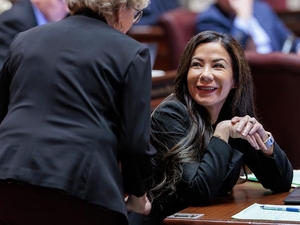
John James, Mike Cox and Perry Johnson during a televised debate in Grand Rapids. July 9, 2026 | Michael Buck/WOOD TV8
Michigan’s Republican gubernatorial candidates — U.S. Rep. John James (R-Shelby Twp.), businessman Perry Johnson and former Michigan Attorney General Mike Cox — gathered in Grand Rapids on Thursday to debate for the second night in a row.
Each of the candidates made a different pitch to Republican voters of Michigan on why they would be best suited to take on a Democrat in November.
“I know I’m an outsider. I’m funding my own campaign,” Johnson said in a closing statement. “I’m beholden to no one, and because of that, I’m in an ideal position to be able to bring the quality and efficiency to Michigan. And I will be leading our government with no one leaning on me.”
Johnson was also the only candidate to directly name Secretary of State Jocelyn Benson, considered the front-runner for the Democratic nomination, saying that he is “the only one that can even beat her.”
James heavily focused on his endorsement from Donald Trump, which he received in late June, and his two-term tenure in the U.S. House of Representatives.
“I deployed to the swamp to push back on socialism and support President Trump’s America First agenda,” he said. “I’m going to lead by example, working with anyone and everyone across the state, all 10 million of us, to bring us more prosperity.”
Cox leaned heavily on his two terms as the state’s attorney general — and how that means he has been elected to statewide office twice, including in a tightly contested race against now-U.S. Sen. Gary Peters.
“I feel these issues. I felt them as attorney general,” he said. “That’s why I took on Blue Cross and saved over $700 million for seniors. That’s why I took on the utilities and saved over $3 billion in rates, which not only impacts you at your home, but also makes manufacturing cheaper and easier. I also took on big pharma.”
“I’m the only person who can win and deliver,” he added to reporters after the debate. “I delivered. I’ve actually shrunk the size of state agencies.”
Alignment on lowered taxes, data center limits and improved education
Candidates were largely aligned on the issues presented in the debate, from lowering taxes in the state to improving outcomes in the education system.
For taxes, both Cox and Johnson have called to eliminate the state income tax entirely.
James, on the other hand, presented a plan to slash the income tax — not eliminate it entirely — through cuts to the state budget.
“First, we’re going to cut pet projects from politicians in Lansing. That’s $1.5 billion. Then we’re going to cut improper payments and fraud. That’s 0.85 billion dollars. Then we’re going to cut general funds that are unspent. That’s 0.65 billion dollars,” he said. “That’s up to a $3 billion cut that goes directly to you in year one, and that’s going to result in a 20% to 25% income tax cut.”
Affordability in the state was also a key point in the debate — and has been a centerpoint of the gubernatorial race on both sides.
James emphasized his “three-point affordability agenda that starts with health and then goes with housing and energy,” and Cox similarly pointed to those three areas as in need of change to make them more affordable.
Answering that question, Johnson took the chance to present his proposal for a full government audit — a proposal he calls the MEGA audit, which he has made the centerpiece of his platform.
“The major problem we have right now is the fact that we’re giving too much money away to the government to throw away,” he said. “Everyone will have $4,747 every year, year after year, think of what they can do with affordability then.”
That number has become a key point in Johnson’s campaign, saying that it is how much money an average Michigander could save with his tax cut plan. But that actual number itself has been called misleading, with higher earners saving more on a dollar-by-dollar basis if the tax is eliminated.
Michigan’s education system has similarly come under criticism from candidates on both sides of the aisle, but GOP candidates leaned in heavily to supporting school choice and parental rights.
“We take the best practices of other states. We don’t have to reinvent the wheel,” Cox said.
All three candidates also indicated some level of support for limitations on data centers, with Johnson taking the strongest stance against them with a one-year data center moratorium proposal, while James and Cox focused on elevating local communities to decide for themselves if they want a data center in their municipality.
Johnson pointed out that James has received significant campaign donations from both utility companies and data center developers, and indicated that this would compromise his ability to push back against data centers in Michigan as governor, again reiterating his argument that his own self-funding allows him to maintain a level of independence.
But James bit back hard — “I know when you were born, Black people could still be bought and sold in this country, but no one owns me,” he said.
Johnson later issued a statement calling for James to apologize for the remark.
“You need to apologize and retract the most pathetic, unfortunate, and desperate candidate mistake Michigan has ever witnessed on a debate stage,” Johnson posted on X. “It was a shameful attempt to distract from your favor-based relationship with special interest groups like DTE, and the data center builders who are funding your campaign.”
Personal attacks lessen, but do not cease
The debate had a more civil tone than Wednesday night’s, which quickly devolved into bickering and required the moderator to intervene multiple times. But it was not devoid of personal attacks — the first shot was fired by Cox about ten minutes into the debate, when he called a statement from James “Washington talk,” and all three candidates from that point on took aim at each other for the rest of the night.
Personal blows included comments that appeared to reference diversity, equity and inclusion initiatives, when Johnson referred to James, the only candidate of color on either side of the race, as the candidate of DEI, saying that his company received “an award from DEI because they’re very woke.”
Asked after the debate if that had anything to do with James being Black, he responded, “Black? No, it has nothing to do with that. I don’t think it has any relevance whatsoever.” He added that he did not know specifically what awards had been won, just that he “was just told that he had won these awards.”
In response to Johnson’s statement, James said after the debate that the attack showed that his opponents do not have a record of their own to run on.
“I think that they are pandering to a group of people who, frankly, are folks who don’t understand what Michigan is about,” James said. “Michigan is about all 10 million of us. I’m going to be a governor for all 10 million of us, and I don’t play in those games.”
James also said in the debate that Johnson’s companies also have DEI policies, saying that they have “the Italian standard for woke” in his companies, though that standard was never defined.
Lansing, MI