Southern leader wants new higher ed formula to address historic underfunding
Oct 13, 2026 | 5:44 pm ET
Description
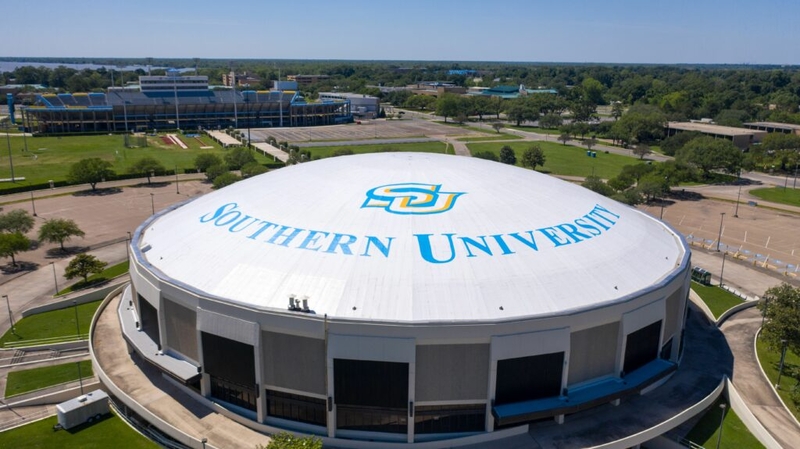
The F. G. Clark Activity Center at Southern University in Baton Rouge is also known as the "Mini-Dome" and is a multi-purpose facility used for campus and community events. (Photo provided by Southern University)
Interim Southern University President Orlando McMeans wants the task force studying how to revamp the state’s higher education funding formula to take underfunding of Louisiana’s largest historically Black college into consideration.
McMeans asked the task force, which met Monday at the State Capitol, to take into account the $1.2 billion disparity between what Southern and LSU has received from the state since the 1980s as it reconfigures the formula to ensure Southern, or any other university, is not financially harmed by the outcome.
“There were some assumptions made, in my opinion, when (the current) formula was put together, it assumed that … all institutions begin from the same baseline,” McMeans said. “That’s definitely not factual.”
“I would just ask that we do look at the 1.2 billion not as a whole, but as far as (increasing) our baseline (funding),” McMeans said.
The gap was brought to the forefront of higher education funding discussions in 2023 when the Biden administration sent letters to 16 governors, including Gov. John Bel Edwards, whose states have historically shortchanged their Black land grant universities.
Southern and LSU are among the more than 100 federal land grant universities in the United States. They were first established in the 19th century to create schools with a focus on teaching agriculture, science, engineering and military science. The colleges receive additional federal benefits, but states must match certain funds with their own dollars — a requirement Louisiana has not always met.
The Biden administration found Louisiana had shortchanged Southern University to a tune of $1.2 billion less in comparison to LSU, the state’s other land grant institution with a predominantly white student body. LSU did not admit Black students until the 1960s.
Similar disparities were found in other states, including Missouri, where alumni of of Lincoln University filed a lawsuit over a $549 million funding disparity earlier this month.
Former Southern President Dennis Shields and former LSU President William Tate both called on the legislature to address the funding disparity.
McMeans said he would like to see a $60 million to $100 million investment from the legislature to address infrastructure issues on campus, including an aging power grid that has led to repeated power outages and class cancellations.
“This is decades and decades of deferred maintenance that contributed to these deficiencies in our utilities infrastructure,” McMeans said in an interview.
McMeans said several years of disparate funding have impacted not only infrastructure but also student services and Southern’s ability to offer programs that meet the state’s workforce needs.
McMeans’ request came at the second meeting of the Legislative Higher Education Funding and Formula Task.
Questions about the formula were first raised earlier this year when some conservative lawmakers became aware of an old state metric that incentivized universities to graduate already-enrolled minority students. Though it had already been removed from the formula, this metric became the topic of an investigation by the Trump administration, which considers the standard discriminatory.
The removal of the metric moved money away from Southern and primarily-white universities like LSU, one of the most racially diverse universities in the Southeast, with about 37% of all LSU students being non-white.
Louisiana’s higher education funding problems are not new ones, although they have become more acute.
During Gov. Bobby Jindal’s tenure from 2008-16, the state was in a self-inflicted fiscal crisis, with the governor choosing to use single-year budget surpluses to fund ongoing state government expenses. Higher education was on the chopping block annually to balance the budget, leading colleges and universities to switch from being primarily state-funded to student tuition-supported.
Higher education leaders have said that Louisiana’s public colleges and universities are underfunded by more than $800 million compared with where they were at the beginning of the Jindal administration. This analysis doesn’t take into account the disparate funding between the state’s two land-grant universities, which stretches back to at least the 1970s.
Since the start of the COVID-19 pandemic, inflation has created additional constraints across state government. Gov. Jeff Landry has kept higher education spending at a standstill since he took office in January 2024.
Baton Rouge, LA