South Dakota universities’ Native American enrollment rises to pre-pandemic level
Jul 24, 2026 | 3:31 pm ET
Description
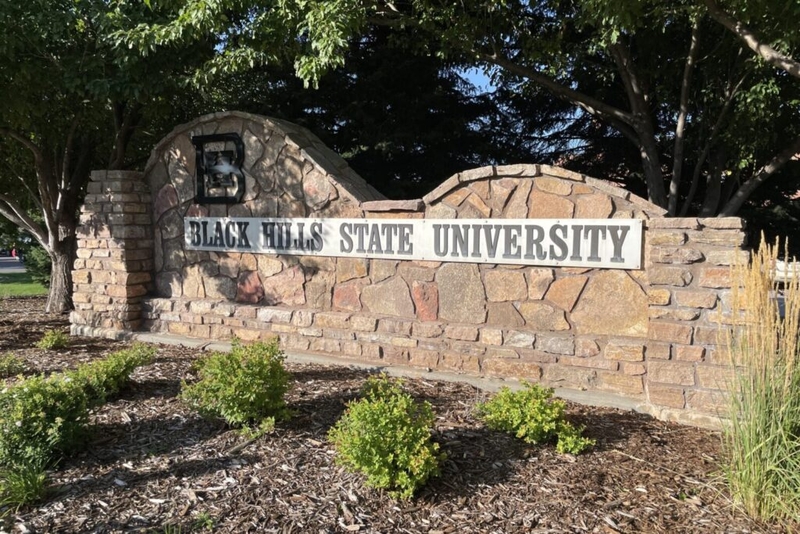
A sign marks an entrance to Black Hills State University in Spearfish, South Dakota, on Aug. 28, 2024. (Photo by Seth Tupper/South Dakota Searchlight)
Native American student enrollment at South Dakota public universities has returned to its pre-pandemic level, according to a new report.
Black Hills State University in Spearfish had 227 Native American students during the 2025-26 school year, up 49 from 178 the year before. That 28% increase was a major factor in the 6% systemwide growth in Native American students compared to the prior year.
The university’s student body typically has the highest percentage of Native American students of the six institutions in the system. Urla Marcus, director of the Center for American Indian Studies at the university and a member of the Northern Cheyenne Tribe, said the recent numbers are a sign that new programs are working to recruit and retain more students.
Higher enrollment leads to a “ripple effect,” Marcus added.
“They can go back to their communities and make an impact, set that example that more people are attaining these degrees,” Marcus said.
In 2019, the Legislature required the South Dakota Board of Regents, which oversees the public universities, to develop programs aimed at increasing Native American student enrollment and retention. The board submits a report by July 1 each year detailing activities and progress made.
Systemwide, Native American enrollment decreased during the COVID-19 pandemic and stayed lower for several years afterward despite increases at some universities.
The Native American percentage of the systemwide student body also dipped below 3% for several years but now stands at 3.2%. South Dakota’s overall population is 9% Native American.
Black Hills State’s latest increase pushed systemwide Native American enrollment to 1,155 — nearly reaching the 1,157 recorded in 2017. Native American enrollment increased this past school year by 16 students at South Dakota Mines and 15 at the University of South Dakota, but decreased by five at South Dakota State University, four at Northern State University and two at Dakota State University.
This is the first year since the pandemic that Native American enrollment decreased at South Dakota State. The university has played a significant role in increasing Native American enrollment within the South Dakota public university system in the last decade. President Barry Dunn, a member of the Rosebud Sioux Tribe, launched the Wokini Initiative in 2017 to recruit, retain and support Native American students. Enrollment of Native Americans at the university grew from 259 in 2017 to a peak of 329 in 2024.
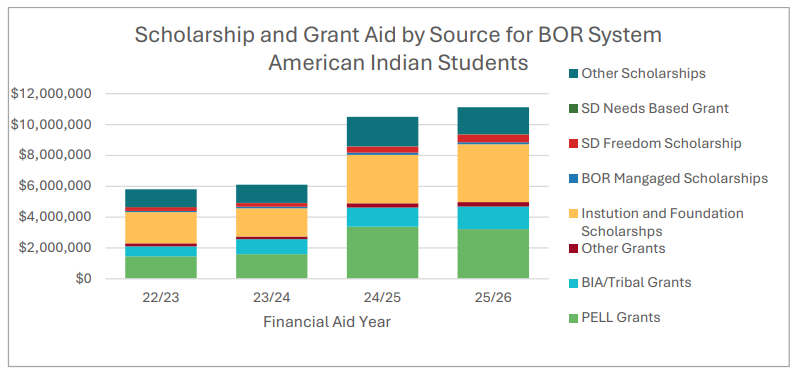
Scholarships and financial aid awarded to Native American students across the state have nearly doubled since the 2022 school year, driven largely by a near doubling in Pell Grants and scholarships from institutions and private foundations.
Black Hills State has not yet recovered its own pre-pandemic Native American enrollment numbers, despite the recent gains. Students at the time of the pandemic, Marcus said, were “very cautious,” and many chose not to enroll outside tribal land, with some opting for tribal colleges instead. Those schools offered incentives that the university did not, such as tuition discounts and supplies.
Between 2015 and 2022, the latest data available from the National Center for Education Statistics, enrollment at Oglala Lakota College on the Pine Ridge Reservation fell by 189 students and at Sinte Gleska University in Rosebud by 103. Sisseton Wahpeton College on the Lake Traverse Reservation gained 55 students over the same period.
As the pandemic receded and tribal college incentive programs ended, Marcus said more students have shown interest in enrolling at Black Hills State. Marcus said the university’s location in the Black Hills, an area of historical and spiritual significance for several tribes, is a draw for students. The school has Native faculty and staff working with the center.
“Students see a lot of opportunities for them to grow and be successful,” Marcus said.
‘They saw the potential’: SDSU program boosts Native American success
In addition to more targeted recruiting efforts, Marcus said the center has strengthened or created new programs to support students, including mentorship and scholarship programs.
The Native Scholars program is in its third year. Students in the program regularly engage with advisers and the center’s administration, participate in cultural activities and mentor their peers. Graduates receive a stole and star quilt. The program graduated six students last spring and expects to graduate another 13 next spring.
The peer mentor program grew organically before being formalized in recent years, Marcus said. The center pairs upperclassmen with freshmen and sophomores who share similar fields of study and home regions.
“We have a lot of silent leaders in our center,” Marcus said. “These students have taken some years getting closer and closer to graduation. Younger students look up to them, ask them questions and allow upperclassmen to share what they’ve learned and what they’ve stumbled on.”

Pierre, SD