Western New York School District Hits Pause on Robot Teacher Amid Scrutiny
Jul 24, 2026 | 2:31 pm ET
Description
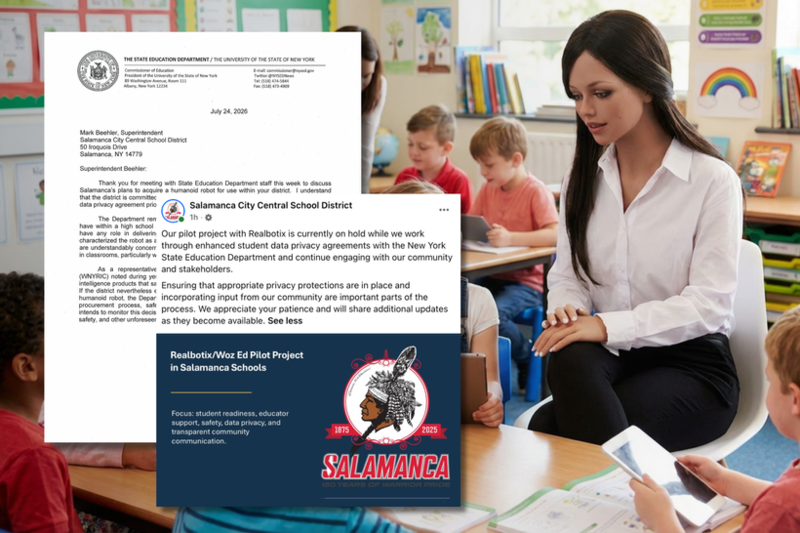
Salamanca City Central School District announced in a Facebook post on July 24, 2026 that its pilot project with tech company Realbotix has been put on hold. / Underlying image courtesy of Realbotix; Screenshot: Salamanca City Central School District / Facebook; Letter: State Education Department | Illustration: Kyle Constable
A Western New York school district has halted its plans to place a humanoid robot in a classroom after a New York Focus report on the plan sparked fierce debate over the use of artificial intelligence in schools and backlash from local parents.
Salamanca City Central School District announced in a Facebook post Friday afternoon that its pilot project with tech company Realbotix has been put on hold as school officials “work through enhanced student data privacy agreements” with the state education agency and engage with community members.

The news comes hours after state Education Commissioner Betty Rosa sent a letter informing Salamanca Superintendent Mark Beehler that “the Department remains concerned about the effect that a humanoid robot may have within a high school classroom.” According to the letter, the department met with the district to discuss the robot plan earlier this week.
“Many parents, teachers, and stakeholders are understandably concerned about the presence of artificial intelligence technology in classrooms, particularly when it involves robots that resemble humans,” Rosa wrote.
The district had planned to introduce the robot to high school students this fall, along with an artificial intelligence teacher’s assistant program that allowed students to interact with an avatar of the robot on laptops. The $57,590 investment was approved at a local school board meeting last month.
In a statement provided to New York Focus, Realbotix CEO Andrew Kiguel said, “We fully respect any decision the school makes and encourage thorough due diligence by all parties involved.”
“We want the program to be demonstrably safe, fully district-approved, and strongly supported by teachers,” he said. “We stand firmly behind [the program] as a supportive tool designed to assist teachers and students, not replace them.”
Salamanca and the Education Department could not be immediately reached for comment.
Realbotix had been in the process of building the robot, which it named Sally. According to the company, it would have a “lifelike” appearance, with silicone skin, long, brown hair, and a wide range of upper-body movements and facial expressions, though it would remain seated in a stationary position.
Kiguel previously told New York Focus that students would be able to access the avatar from their devices during or after class for help with their assignments, including by uploading photos of homework for feedback or receiving real-time translation in more than 100 languages. When approaching Sally during class, students would use a unique identification code so that the robot could access their conversations with the avatar.
After the district first publicized the plan, it drew strong reactions from parents, teachers, and other observers online. Some praised the district for embracing innovation and giving students access to cutting-edge technology. Others — including the state teachers union — raised concerns about student privacy, increasing screen time, and Realbotix’s ties to the adult entertainment industry.
Education is an entirely new venture for Realbotix, a Toronto-based company formerly known as Tokens.com. In April 2024, it acquired Simulcra, the Las Vegas parent company behind RealDoll, which creates hyperrealistic sex dolls.
In a statement released this week, New York State United Teachers President Melinda Person said “a robot built by a company associated with sex dolls has no business in our classrooms,” emphasizing that robots — no matter how “lifelike” — are incapable of the human connection students require in order to thrive.
“NYSUT is committed to fighting thoughtless expansion of this technology, and we will explore every avenue necessary to protect human-centered learning in Salamanca and in every classroom across the state,” the statement reads.
At a Salamanca board meeting on Tuesday, before the program was halted, Superintendent Beehler reiterated the district’s commitment to student safety. During a presentation to trustees, he noted that the robot and avatar would operate on a closed system that is not connected to the internet, and that Realbotix would not have access to personally identifiable student information.
After the district posted a recording of the meeting on Facebook, the comment section quickly filled with debate between local parents and community members who backed the investment and those who criticized it.
“Excited for this opportunity for our kids,” one user commented. “As someone who uses AI in my corporate career, this is a skill that will make them more employable.”
“You couldn’t just hire another normal teacher?” wrote another. “AI is killing our planet, and gets information incorrect all the time.”

Albany