South Dakota governor’s response to diesel prices may not help producers, ag leader says
Sep 29, 2026 | 9:28 pm ET
Description
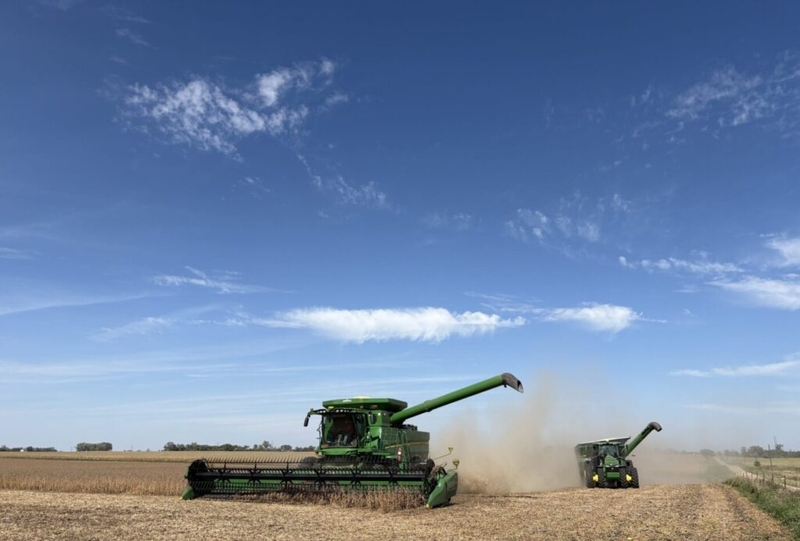
Andrew Streff drives his combine while harvesting soybeans on Sept. 29, 2025, near Salem, South Dakota. (Photo by Joshua Haiar/South Dakota Searchlight)
South Dakota’s Republican governor issued an executive order to blunt the impact of high diesel prices for farmers during harvest season, but an agricultural leader in the state said the order “doesn’t do anything” to help.
Gov. Larry Rhoden’s order allows producers to haul crops, livestock and other agricultural products at 10% above weight restrictions and suspends a $25 overweight trip permit.
Agricultural producers are typically only allowed to haul crop loads that are 10% overweight when they’re going from harvesting in the fields to the grain bins. The order expands the 10% allowance beyond crops and covers more trips, according to Josie Harms, a Rhoden spokesperson.
“Farmers haul from their bins to elevators, feedlots, ethanol plants, or other facilities and haul other products back (like dried distillers’ grain from ethanol plants),” Harms said in a message to South Dakota Searchlight. “This also applies to more than just crops, as all agricultural commodities are covered, including livestock, milk, and other commodities not from a field.”
Doug Sombke, president of the South Dakota Farmers Union, said a neighboring state’s response to the nation’s skyrocketing diesel prices was “a step in the right direction” that could have a greater impact.
Last week, Nebraska Republican Gov. Jim Pillen announced a 90-day pause on diesel taxes for producers hauling during the harvest season. Producers can submit fuel receipts to be refunded for diesel taxes over the coming months. Pillen also issued a separate executive order allowing ag producers to haul at 25% above the weight limit.
Gov. Pillen announces 90-day pause on diesel taxes for Nebraska ag producers
“It’s way better than what we’re being offered,” Sombke said.
Most trucks hold about 250 gallons of fuel, but some can hold more, Sombke said. Filling up an empty tank at the state’s $6 average per-gallon diesel price, he said, won’t be counteracted by pausing a $25 permit on overweight hauls.
“Not even close,” he said.
But South Dakota’s governor doesn’t have the same power to suspend the diesel tax that Nebraska’s governor does during an emergency, according to Harms. In South Dakota, the governor can only suspend administrative rules, she said. State law sets the tax at 28 cents per gallon.
Rhoden’s legal and policy teams are “reviewing potential action by the Trump Administration, as well as actions taken by other states, to see if there is opportunity for South Dakota to take further steps to provide flexibility for farmers,” according to a Monday news release.
Charlie Johnson, a Lake County organic grain producer, is concerned about heavier loads damaging roadways. The plan to allow overweight trucks to haul on public roads could end up costing the state more in the long term when it comes to maintenance and repairs for those roadways, Johnson told Searchlight.
The ongoing war in Iran and a volatile tariff policy from the Trump administration have had long-lasting effects on producers’ bottom lines, he said.
In a social media post, Johnson criticized Rhoden’s directive as an effort to “win votes in the days before the general election.”
“What Rhoden really should be doing is speaking out for farmers by taking the president to task for what he’s done to this state and to our farmers economically,” Johnson said.
Democratic governor candidate reacts to changes
Rhoden, who became governor in 2025 after former Gov. Kristi Noem resigned, is running to keep the job. Democratic challenger Dan Ahlers, a former state lawmaker from Dell Rapids, said “there are other things that we could be doing that would in the long run” to ease the burden on ag producers in the state.
He wants to see South Dakota producers and policy leaders standing up against federal policies like the ongoing war in Iran, tariffs and importing beef from foreign countries. Those actions are creating economic strain for producers, Ahlers said.
“I think that’s where the governor of South Dakota, along with producers, show up and have those conversations,” Ahlers said. “Getting photo ops with the president just isn’t good enough. We need to actually be out there, speaking on their behalf and working with our members of Congress.”
In a debate with Ahlers at the start of the month, Rhoden said he disagrees with President Trump’s push to import beef from other countries.
Ian Fury, a spokesperson for Rhoden’s campaign, told Searchlight that Rhoden “has always said good policy makes good politics.” He said Rhoden understands that diesel prices have an impact on farmers, especially during harvest season, and that he’s already received calls from producers who support Monday’s executive order.
Fury also provided South Dakota Searchlight with a letter Rhoden submitted on Sept. 21 to U.S. Department of Agriculture Secretary Brooke Rollins. In it, the governor recommends that the administration reinstate the Agricultural Advisory Committee, which Rhoden formerly served on in 2016. The group of producers and stakeholders offered input on agricultural policy during Trump’s first term in office.
“As is so often the case, while Mr. Ahlers shouts ‘we should do something,’ Governor Rhoden is working quietly behind the scenes and actually doing it,” Fury said in a statement to Searchlight. “He focuses on good policy and actually achieving results — not beating his own chest to make political hay.”
- 8:58 pmEDITOR'S NOTE: This story has been updated since its initial publication to include additional comments provided by Gov. Larry Rhoden's office.

Pierre, SD