Researchers say demographics, behavioral risks account for much of Iowa’s high cancer rates
Sep 29, 2026 | 7:08 pm ET
Description
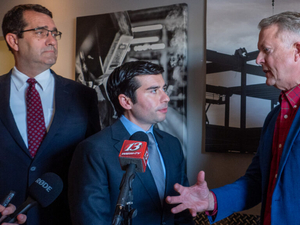
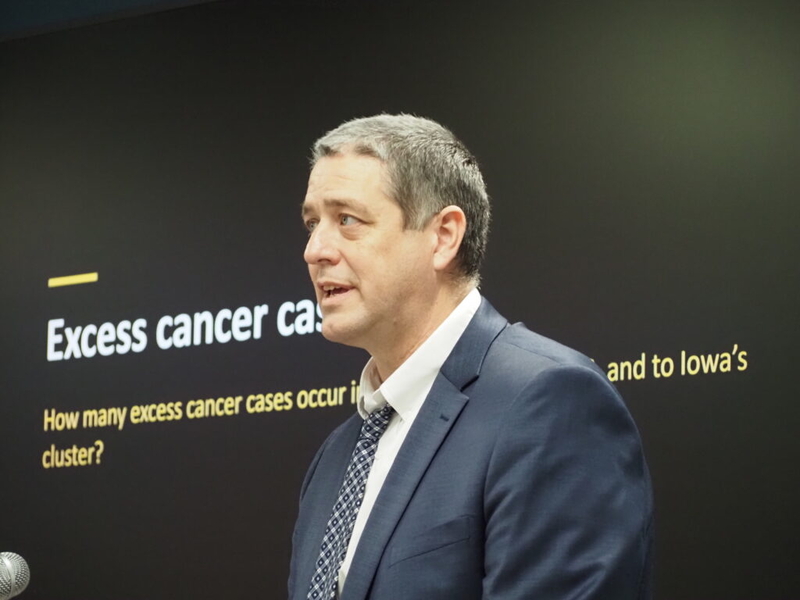
Jacob Oleson, a professor at the University of Iowa College of Public Health, shared details from a report compiled by UI researchers and the Iowa Department of Health and Human Services about the key factors driving Iowa's cancer rates at a news conference in Des Moines Sep. 29, 2026. (Photo by Robin Opsahl/Iowa Capital Dispatch)
After concluding year one of research into why Iowa has higher instances of cancer than other states, Iowa Department of Health and Human Services and the University of Iowa College of Public Health officials said their analysis found 76% of Iowa’s higher rates of five common types of cancer could be attributed to demographic and behavioral risk factors.
In 2025, Iowa lawmakers approved Gov. Kim Reynolds’ request to provide $1 million in funding for a year-long cancer research projected conducted by HHS and UI researchers to identify the key factors driving Iowa’s high cancer rates. Iowa has been one of the only states in the country where rates are rising for new instances of cancer. In 2026, the state had the second highest rate of cancer incidences in the country, and was one of only three states with a rising rate.
Preliminary data from the research project was first presented in February. Researchers concluded Iowa had higher rates of prostate, breast, lung cancer and melanoma, but found Iowa had a more comparable rate when compared to other states with similar rates of certain risk factors that increase instances of cancer — such as binge drinking, obesity and insurance rates, as well as certain demographic factors.
However, the research found Iowa had significantly higher instances of lung cancer and mortality rates when compared to the rates of other Midwestern states and nationally.
The updated report included more information about how demographic and behavioral risk factors might account for Iowa’s cancer rates. Edith Parker, Dean of the UI College of Public Health, said “selected risk factors explain approximately 76% of Iowa’s excess cancer burden across the five most common cancers.”
“The results suggest that prevention efforts targeting modifiable risk factors would reduce the number of excess cases of cancer in Iowa,” Parker said. “Counties and cancer groups with remaining excess cases may be influenced by additional factors not included in the current analysis.”
Even when accounting for expected excess cases based on behavioral risks like smoking, obesity and binge drinking, there were some specific groups that had higher than expected cancer rates. This included more cases of prostate cancer for men over age 50, higher rates of breast cancer for postmenopausal women, and more instances of melanoma amongst younger women.
For lung cancer, Jacob Oleson, a professor at the UI, said that when factoring in both smoking rates and potential radon exposure, all excess cases of cancer were explained for women, but that 13 counties have higher-than-expected lung cancer rates among men.
Researchers have not yet investigated the influence of genetic, environmental, or other factors and combinations on Iowa’s cancer rates. Parker said the next phase of the group’s research on environmental factors is expected to be more difficult.
“The data is not as readily available as it is for this, behavior risk factors,” Parker said. “For example, we don’t, in the state, monitor air quality in the community. So what we are looking at now is what data is available already. For example, most water systems, we do have data for that, and that comes with levels of monitoring.”
Researchers told lawmakers earlier in the year that Iowa does not collect information on state pesticide usage, which could contribute to cancer data, and said that although the state has robust systems for monitoring water quality and nitrate levels, unregulated private wells used by an estimated 300,000 Iowans could be the source of problems that would not be shown in the collected data.
Other researchers and public health experts have said a larger emphasis needs to be placed on mitigating dangers caused by environmental factors. The Harkin Institute for Public Policy and Citizen Engagement and the Iowa Environmental Council released a report in March — separate from the UI and HHS report — that found the five most common types of cancer in the state have connections to environmental risk factors like pesticides, per- or polyfluoroalkyl substances (PFAS), nitrate and radon. The report also found a majority of cancer types associated with these factors are increasing in the state.
Robert Kruse, the Iowa State Medical Director, said while research will continue, the behavioral risk factor data shows areas where Iowans and state government can take action to decrease cancer rates in Iowa by limiting alcohol and tobacco consumption, protecting skin from UV exposure and testing homes for radon.
“Our responsibility is to act where the evidence is strong, while continuing to investigate where questions remain,” Kruse said. “And those two things are not in conflict. Good public health requires us to do both.”
Kruse also said $93 million of the $209 million in federal funding awarded to Iowa in year one of the Rural Health Transformation Program is going to cancer prevention, screening and treatment services. Iowa’s rural health care improvement plan, “Healthy Hometowns,” received funding through the federal program that was created to offset expected an estimated $137 billion decline in Medicaid spending due to the 2025 “One Big, Beautiful Bill” Act. He said over the next five years “we anticipate that investment approaching $240 million” for cancer-related services.
Kruse said the new investments will build on ongoing efforts to address and prevent cancer in the state.
“Iowa has longstanding cancer prevention control efforts across public health, across healthcare systems, local public health agencies, and community organizations throughout the state,” Kruse said. “That work ranges from tobacco prevention and cessation to breast, cervical, and colorectal cancer screening, to radon education, to strengthening systems that ensure an abnormal screening result leads to timely diagnostic follow-up.
“This work is also guided by the Iowa Cancer Plan, our statewide roadmap developed with partners from across public health, health systems, community organizations, researchers, and cancer survivors. The goal is to reduce cancer risk, improve early detection, strengthen treatment and survivorship, and reduce disparities in access and outcomes. Healthy Hometowns does not replace that work; it strengthens it.”
Des Moines, IA