Social Security, Medicare top of mind for Montanans heading into Election Day
Oct 28, 2026 | 6:54 pm ET

Description
Photo illustration by Getty Images.
A high portion of Montanans are 65 and older, but those who receive Social Security benefits are facing a 22% cut in 2032 without action from Congress.
That’s according to data from the Social Security Administration.
The topic is a question from voters, and it was a rallying point for at least one political candidate on the ballot in Montana this year.
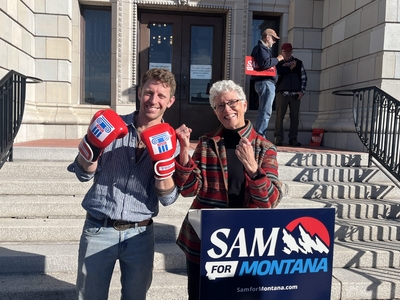
Sam Forstag, running for the western U.S. House district, recently received a pair of boxing gloves at a rally to represent his ability to fight for Social Security and Medicare.
Forstag, a Democrat, is running against Republican Aaron Flint in a competitive race.
At an event last week, four organizations that advocate for Social Security and Medicare announced their support for Forstag.
“He (Forstag) submitted one of the best completed questionnaires we’ve ever received with regard to his positions on Social Security, Medicare, Medicaid and drug prices,” said Social Security Works PAC President Jon “Bowzer” Bauman in an email. “His opponent, Aaron Flint, never even bothered to return the questionnaire. The contrast is stark.”
A spokesperson for Flint did not respond to requests for comment about his stance on Social Security. His campaign site said seniors should not pay more income taxes on Social Security, and Flint would protect it.
More than 22% of Montanans are 65 and older compared to 18% nationally, according to the U.S. Census.
In Montana, an estimated 226,293 people 65 and older receive Social Security benefits out of 270,750 in all, according to the Social Security Administration.
Montanans receive $6.07 billion a year in Social Security benefits, largely dollars that go directly into the economy, according to the National Committee to Preserve Social Security and Medicare.
The fund is projected to be depleted by 2032 without action from Congress, according to a 2026 Social Security Administration report. That means the fund wouldn’t have enough money to pay all scheduled benefits “in full and on time,” the report said. It estimates funds could cover 78% of people’s Social Security checks.
Focus on western House
Social Security Works PAC did not endorse in the U.S. Senate race or eastern House district; it typically endorses only in competitive races, said Linda Benesch, vice president for communications.
Two other organizations that recently announced support for Forstag also did not endorse in the other federal races in Montana.
The National Committee to Preserve Social Security and Medicare PAC endorsed Forstag, and Chairman Max Richtman said it’s the only race in Montana the organization has weighed in on.
“It’s the one we think has a realistic chance of success,” Richtman said.
Richtman said his organization likes Seth Bodnar, the independent candidate in the U.S. Senate race, but having the Democratic nominee, Alani Bankhead, stay in the race makes a win by Bodnar difficult.
Political analysts consider Republican Kurt Alme the favorite for the Senate race in Montana.
Incumbent Republican U.S. House Rep. Troy Downing is expected to win in the eastern district.
In the eastern district, Big Sky 55+ endorsed the independent in the race, Michael Eisenhauer. Democrat Brian Miller is also running.
Senate candidates on Social Security
At a recent debate, Bodnar said the person elected to the U.S. Senate will help decide what happens as people face a 22% cut in their benefits, and “the stakes are incredibly high.”
But he said the solution is easy.
He said raising the cap on income that’s taxable for Social Security from $184,000 would create a system that is both more fair and “more solvent for the long run.”
For example, for someone earning $100,000 a year, 100% of their income is taxable for Social Security purposes, Bodnar said. But he said that means for someone earning $2 million a year, less than 10% is taxable for Social Security.
“This is a simple fix, folks,” Bodnar said. “We just need leaders in D.C. who stand up and advocate and fight for this. I can be that leader.”
Bankhead’s campaign website describes Social Security as “the most successful anti-poverty program in our history.”
At the debate, she agreed on the fix and accused Bodnar of parroting her plan. She said Congress needs to “tax the wealthy their fair share.”
“You do that by removing the income limit on Social Security so that we can fund Social Security in perpetuity,” Bankhead said.
Alme addressed Social Security at a later debate.
He said he used to be budget director for the state and knows how to pay off debt, and he would focus on eliminating waste to help bolster Social Security funding.
He said he would strengthen the program and “will never support a cut in benefits for seniors.”
Rally for Forstag
On the steps of the Missoula County Courthouse, advocates for Social Security and Medicare announced last week their endorsements of Forstag, a smokejumper and union leader.
Many older Montanans are struggling, and Rep. Connie Keogh said senior homelessness is on track to triple by 2030.
“This is a result of a system that is failing us, and it’s certainly not the future that we should be demanding for our children and grandchildren,” said Keogh, a Missoula Democrat. “Sam is about solutions.”
Keogh represented the Montana Chapter of the Alliance for Retired Americans, which endorsed Forstag.
Trent Bolger, with Big Sky 55+, said Forstag demonstrated he understands the issues by earning the endorsements of his organization and the three others focused on Social Security and Medicare.
Tula Thompson, with the National Committee to Preserve Social Security and Medicare, said Social Security checks from the western district add more than $3.1 billion to Montana’s economy every year.
But Thompson said the benefit reduction would mean a $500 loss every month for the average senior in Montana if nothing changes.
At the rally, Thompson presented Forstag with boxing gloves so he could “continue to fight for seniors.”
Forstag said he’ll fight to expand Social Security and Medicare and fight to be sure all earners carry their own weight, to lift the payroll tax cap so the top 6% are paying the same rate as the bottom 94%.
In Montana, he said, 11% of the people living on the streets are older than 55, and 19 rural hospitals are at risk of closure.
“We are so much better than that, and we can fix those things,” Forstag said.
Helena, MT