As healthcare costs spike for Pa. employers and employees, state House Dems pitch universal coverage
Oct 28, 2026 | 4:29 pm ET

Description
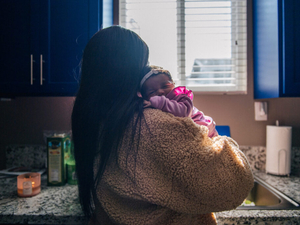
Healthcare costs are rising (again) in 2027 — and some people think it's time to start considering universal healthcare as an option. (Photo by Anne-Marie Caruso/New Jersey Monitor)
As millions of Pennsylvanians navigate their health insurance options during open enrollment, many could face double-digit premium increases over last year’s costs. The growth is reviving debates over universal healthcare and the government’s role in price-setting.
Employers across the nation expect prices to increase by 8.2% in 2027, the biggest recorded hike since 2003, according to consulting firm Marsh. More than one-third of the 1,800 surveyed employers anticipated increases over 10%.
“Many of our businesses are at their breaking point … but with every year that passes, it seems like we’re hearing more and more from our business owners that they believe it’s just simply unsustainable for them,” said Greg Moreland, the Pennsylvania State Director for the National Federation of Independent Business (NFIB).
According to KFF, job-based plans for workers are 9% higher this year than they were in 2025, with an annual cost of $7,471 for a family. For employees at businesses with less than 200 staff, it’s even more expensive.

For Rep. Greg Scott (D-Montgomery) and a select number of other liberal lawmakers, the continued cost burden signals a need to shift to a single payer system that covers all Pennsylvanians.
“In my household, I believe healthcare should be a right. I don’t believe it should be a privilege reserved for those that can afford it,” Scott stated during an Oct. 5 press conference.
Under House Bill 2763, which mirrors Senate Bill 1465, employers would pay a 7.5% payroll tax and employees would pay 2.5% — though employers can pay both — to replace “previous spending … on health premiums and out-of-pocket expenses.”
The coverage would also come without deductibles or copays.
Notably, Canada’s universal healthcare system started with a provincial plan in Saskatchewan and in the U.S., Oregon is exploring the option — potentially setting a precedent for a state-based version to advance.
Adopting such a policy, however, is no easy task.
A RAND Corporation analysis in New York state concluded that a single-payer plan could cover every resident, but would require “significant” new tax revenue, projecting that costs would decrease slightly over time. A proposed structure would decrease costs for most households and place the burden on high-income earners.
“The estimated effects of the New York Health Act are highly dependent on assumptions about provider payments, administrative costs, and drug prices,” said Christine Eibner, co-author of the study and the Paul O’Neill Alcoa Chair in Policy Analysis at RAND. “The actual cost of a single-payer health plan in New York would be sensitive to the extent to which state officials would negotiate or set price levels and generate efficiencies that would curb health care spending.”
States would also need to negotiate with the federal government, which currently uses tax dollars to fund insurance programs like Medicare and Medicaid.
Role of commercial insurance
In 2024, the United States as a whole spent $5.3 trillion on healthcare, or an average of $15,474 per person. But KFF also reports that Americans have “half as many in-person doctor consultations per person as peer countries.”
Hospitals make up the biggest portion of spending, and much of their revenue comes from commercial insurance, which pays higher rates than government-sponsored plans like Medicare and Medicaid.
The Pennsylvania Health Care Cost Containment Council reports that for each commercial patient discharged in 2025, a commonwealth hospital can expect to make $31,800, on average. That’s almost twice the revenue earned on a Medicare patient ($16,990) and 30% more than a Medicaid patient ($21,658).
Urban, rural hospitals closing at similar rates, study finds
Aside from hospitals, increasing drug prices have also pushed up spending, especially for those plans that cover GLP-1s. More than half of large employers who offer GLP-1 coverage for weight loss say that it’s had either a significant or moderate impact on their prescription drug spending, according to KFF.
One frustration for employers, Moreland added, is the inability to compare prices between plans, limiting competition. According to the KFF employer poll, 29% of large companies reported difficulty getting information.
“We don’t do a good enough job here in the United States of being transparent about what those medical costs are,” he said. “And then when you involve insurance, it becomes really, really confusing to the average person. It’s really confusing to me, and I live in this world every day.”
Getting more cost clarity wouldn’t solve all problems, he continued, but “would really, really make a difference in the long run.”
Moreland pointed to a few state-level efforts that NFIB supported, likening one to “a band-aid on a hemorrhage, but at least it’s something.” Options include creating a tax credit for businesses with 50 or fewer employees, allowing for association-level healthcare plans and another gives medium-sized companies access to their own aggregate claims data.
Only the first got any traction this year. But Moreland added that there’s a limit to what Pennsylvania’s lawmakers can do.
“I think it is a national crisis, and I think the only real solution for the entire country is going to come from the federal level,” he said. “The states — all they can do is nibble around the edges.”
Universal healthcare isn’t the only option. Healthcare policy researchers at Georgetown University floated other possibilities for Congress, including:
- Capping annual deductibles at $1,000 for a single person and $2,000 for a family, lowering the maximum out-of-pocket limit to $4,000 for a single person and $8,000 for a family.
- Limiting hospital prices with a Medicare-referenced hospital price cap — a method pursued by lawmakers in Indiana and Vermont.
- Requiring commercial health plans to cover certain services — like primary care, urgent care or behavioral health — and medications pre-deductible with no cost-sharing.
- Taking the negotiated drug prices for Medicare into the private sector.
- Prohibiting hospitals from billing for facility fees for routine office visits or in outpatient settings alongside other site-neutral billing.
Universal healthcare not universally loved
Still, Scott and other supporters say that their proposal would “help level the playing field” and make it easier for small businesses to opt into employee coverage.
“Businesses with fewer than 50 employees generally aren’t required to offer health insurance, yet many do because they want to take care of their employees. That’s becoming harder to sustain,” Scott told the Capital-Star.
In addition to the employee benefit, Moreland said offering healthcare coverage is a competitive advantage for businesses.
Drew Whiting, the CEO of Erie Downtown Development Corporation who also employs roughly 50 people with another small business, spoke at the same early October event as Scott in favor of universal healthcare — the system available in 25 of America’s peer industrialized countries.
Likening the nation’s health system to a company, he said the United States was doing something different from competitors that cost twice as much but got worse results. Continuing the analogy, he added that any business leader responsible for that decision “would be fired.”
“That’s what we’re doing with our healthcare system in the United States,” he concluded, even when other industrialized countries “have figured out there may be a better way to go.”
And costs aren’t likely to let up, he continued, pointing to anticipated federal changes cutting Medicaid funding and limiting public coverage options.
But not everyone is sold on the idea.
Moreland, a veteran, pointed to systemic frustrations with his coverage under the U.S. Department of Veterans Affairs as an example of poor delivery.
“I think anytime you look at putting the government in charge of anything and taking it out of the hands of the private sector, I think we have concerns,” Moreland continued. “Provide me another example of where the government just took something over and did it just flawlessly perfect. I don’t know that that’s where we want to go.”
Harrisburg, PA