The simple affordability fix Virginia just can’t seem to make
Oct 02, 2026 | 5:27 am ET
Description
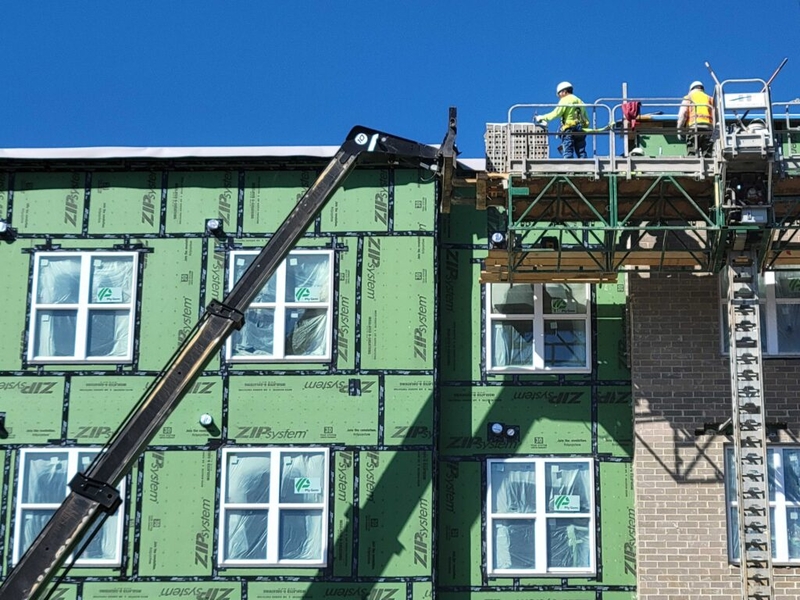
Townhomes under construction in Richmond, Va. on May 15, 2026. (Photo by Charlotte Rene Woods/Virginia Mercury)
Across the political spectrum, people who do the math come up with the same answer: the cheapest kilowatt-hour is the one you don’t need to use. A well-insulated building outfitted with LED lighting and energy-efficient appliances saves money for occupants over time even when upfront costs are higher.
It’s astounding, then, that Virginia’s residential building code treats these elements as optional luxuries rather than as basic standards that all home buyers and renters should expect, even – or perhaps especially – in an entry-level home.
Key efficiency provisions of Virginia’s housing code have not been strengthened in a decade and a half, lagging far behind national model standards that many states regularly adopt each time the model standards are improved.
Even more astounding, Virginia’s Board of Housing and Community Development (BHCD), which updates Virginia’s code every three years, is set to propose an “updated” building code with efficiency standards that lag even the 2012 edition of the national standards.
The national model code is called the International Energy Conservation Code, or IECC. Its globalist name notwithstanding, it is overwhelmingly a U.S. standard and serves as the basis for the efficiency provisions of most state and local building codes.
Every three years the International Code Council updates the IECC, almost always ratcheting up standards in line with improved technologies and capabilities.
If you buy a new house in Maryland, which regularly adopts the latest IECC, you can be assured of a weather-tight home built to a solid efficiency baseline. Across the Potomac in Virginia, your new house is likely to be built to lower standards, even by the same builder.
The builder may have saved a little money building the Virginia house, but whether you will save anything on the purchase price is questionable. As every buyer knows, supply and demand matter much more than a builder’s cost in determining how much you pay for your home.
What is absolutely clear (and demonstrated by research in case the point isn’t sufficiently intuitive) is that you will spend more money over time to heat and cool and power a less efficient home. By the time you’ve paid off your mortgage, Virginia’s lax standards are likely to have cost you tens of thousands of dollars.
Sure, once you’ve bought that Virginia home you can then spend more money to upgrade lighting and appliances and possibly do some extra weatherizing, assuming you are even aware that better performance is possible. But you’re pretty much stuck with whatever insulation the builder put into the walls. That’s why the time to maximize energy efficiency is when the home is being built, not later.
What’s especially irritating is that Virginia’s failure to adopt higher standards comes in spite of the General Assembly’s efforts to raise the bar. Legislators are hesitant to wade into the minutia of building codes, but twice in the last ten years they have passed laws nudging the Board towards stronger energy conservation standards.
Virginia law now calls for the Board to adopt a code that permits buildings to be “constructed, rehabilitated and maintained at the least possible cost consistent with recognized standards of health, safety, energy conservation and water conservation.”
It instructs the Board to have “due regard” for the “generally accepted standards” recommended by the International Code Council and the National Fire Protection Association. (The fire standards have done very well as a result; the efficiency standards, not so much.)
More pointedly, a 2021 act added a requirement that when the International Code Council issues an updated version of the IECC, the Board must consider adopting amendments to the Virginia building code that are “at least as stringent as” the provisions of the latest IECC.
In doing so, the Board must assess “the public health, safety, and welfare benefits of adopting standards that are at least as stringent as those contained in the IECC, including potential energy savings and air quality benefits over time compared to the cost of initial construction.”
I’m sure the Board would say that it does consider these things, right before dismissing them. We should take that with a grain of salt; the BHCD has long been dominated by builder interests.
And according to Bill Penniman, an activist and attorney who participates in the BHCD process, the board operates according to a rule it made up that says there must be “consensus” among the members of the various working groups that review the code before a more stringent provision makes the final cut.
But, according to Penniman, the board defines “consensus,” to mean unanimity, and thus consensus is never reached in favor of strengthening energy conservation provisions because, again, builders and their allies dominate the process. (Interestingly, he notes, non-unanimous proposals to weaken the code don’t suffer a similar fate.)
And so, in spite of the law, Virginia’s wall insulation and air-leakage standards remain weaker than IECC standards from 2012, 2015, 2018, 2021 and 2024.
Now, according to Penniman, the BHCD plans to submit to the governor proposed code amendments that once again fall short of even the 2012 IECC. At a July 13 meeting, the board rejected even an amendment offered by Penniman and other efficiency advocates that would have brought wall insulation requirements up to the IECC standard in effect from 2012 to 2018.
Penniman says there will be a final vote in December before BHCD publishes the proposed rule for “updates” that will take effect in 2028.
Having written on this topic before, I’ve heard from home builders who say that increasing the efficiency of new homes makes them too expensive for entry-level buyers. The choice, they say, is not between building homes to lower standards or higher standards, but between building them to lower standards or not at all.
Houses can be built to use much less energy. Why aren’t they?
If you really want to add to the housing stock, they urge, you need to make homes as cheap to build as possible, including skimping on energy-saving measures. And since it wouldn’t be fair to have higher standards for well-off buyers than for poorer folks, everyone alike must suffer from below-standard housing.
Well, okay, they don’t put it in quite the same words I use, but so far they have won the argument at the Board.
What is interesting here, however, is that while most homebuilders focus on maximizing profit by building as cheaply as possible, companies like Habitat for Humanity and Viridiant, which regularly serve low-income communities, consistently choose EarthCraft or Energy Star standards – which both exceed code. They know a home isn’t affordable if the occupants can’t afford to pay for heat and electricity.
Clearly it is time for the governor to weigh in. Her just-released Energy Plan has a lot of welcome language on energy efficiency as well as other technologies that save money while lowering carbon emissions. (I’ll unpack it in more detail in a future column.)
The plan leans in on the importance of home efficiency and touts state programs that provide support for retrofits of existing homes. But while it also notes that adopting the latest model building codes could yield billions of dollars in energy cost savings over the life of new homes, it does not actually call for Virginia to take that path.
Residential heating and cooling is a significant expense for most households. An energy affordability agenda that leaves out home efficiency is one with a gaping hole in it.

Richmond, VA