Movie made inside Beckley Exhibition Coal Mine shows truth is scary as fiction
Oct 02, 2026 | 5:55 am ET
Description
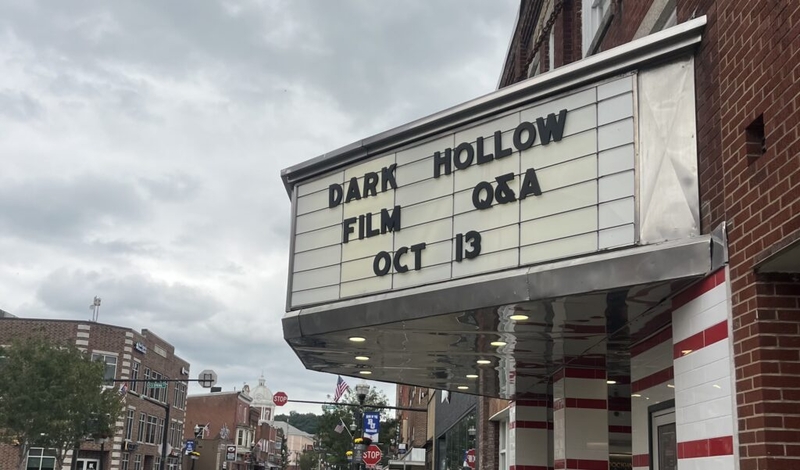
"Dark Hollow," a horror movie filmed in Beckley, West Virginia, will show at the Colonial Arts Center in Buckhannon, West Virginia, on Oct. 13, 2026. (Photo by Paula Kaufman for West Virginia Watch)
“Dark Hollow” is a West Virginia horror film shot inside of a coal mine. And while I’ve never watched a horror movie, I’m looking forward to this one. It is heavier on drama and the supernatural elements than gore I have been told. I’ll be able to handle it.
The plot follows a monster lurking in an Appalachian coal mine and a mother who must defeat it to protect her family.
The film is written and directed by internationally award-winning filmmaker Daniel Byers, who is known for incredible wildlife and culture documentaries. But he also has a bloodthirsty side.
A West Virginia native, Byers has filmed in more than 60 countries, documenting subjects as varied as a harpy eagle — the world’s largest and most powerful eagle; a wolf he tracked by bicycle and on foot for hundreds of miles; and he filmed remote doctors on a Nepalese eye-care mission.
But for “Dark Hollow,” Byers turned his camera toward smaller — albeit much older — mountains: Our own. West Virginia is king of goth, of spook, ghosts and cryptids. We have one of the largest underground cave networks in North America, alongside miles of abandoned coal mine tunnels.
The film portrays the real horrors of inequality: of poverty and the “resource curse” of coal. It’s a film that tries to call out the real villains and flip the script on its head.
The screenplay to “Dark Hollow” — originally called “Paradise” — won the 2023 Austin Film Festival Screenplay Competition out of over 11,000 submissions.
Why? Perhaps because it challenged the line between truth and fiction. Creating a horror story about coal mining is complex; the past is not yet past and the present is just as scary.
The film is an indictment on power politics that put profit and greed above dignity and a miner’s health and humanity and above the environment, water and earth. Enough is enough.
Unfortunately, that trauma is alive and feeding. It is uncomfortable fictionalizing a horror when the real horror is still unfolding.
Mountains are still being blasted for coal. Since the 1990s, more than 2,000 miles of headwater streams have been buried beneath mining debris. And folks in the southern coalfields still can’t drink their water. And black lung disease — referenced in the film — has reached a 50-year high.
Maybe it takes the movie’s fictional monster to neutralize, neuter and defang the real one.
And, like in most films made in the state, the geography is a protagonist. Mountains are the plot, narrative, story. It’s the people who are the supporting actors. And in “Dark Hollow,” the monster is a nightmarish coal-man creature.
So, why make a film in West Virginia? In an audio message, Byers pointed to the economic advantages. He noted that New York and Los Angeles are increasingly unaffordable places to make independent films compared to West Virginia. But he emphasized something beyond dollars and cents. He said filmmakers come to West Virginia for its “unique stories, beautiful landscape, culture, music and heritage that are fertile ground for storytelling and making art.”
That sense of place extends into the film’s music. The epic score was performed by Daniel’s sister, professional vocalist and composer Barbara Byers. She contributed original Appalachian songs through her voice, mountain dulcimer, bowed (and plucked) psaltery, kacapi, jaw harp, spoons and flutes. Some of the music was inspired by a shape-note choir ballad from 1819.
For the 95-minute film, Byers handled the majority of its roughly 330 visual effects. It is an ambitious and personal project. It shows this month in Buckhannon and Huntington. The Floralee Hark Cohen microtheatre in Charleston will be an extra spooky location because the theatre is so tiny you can nearly feel someone’s knees behind you.
And how neat to watch in Beckley, where the film was shot inside the Beckley Exhibition Coal Mine, or Franklin-near Spruce Knob, another filmed location where the cast camped out in all elements to shoot scenes. Franklin’s historic Warner Drive-in Theatre is going to be a terrific venue. Park your car, pull out a blanket, set out a chair and watch the horror unfold under one of the darkest night sky locations on the east coast.
Because it’s all mixed in together. Mountain music, folklore and stories in West Virginia are inextricably intertwined. And the biggest monsters are those with enough power and money to end inequality, indifference and pain–and don’t.
The mountains are sending an SOS. Are we listening?
Charleston, WV