‘Super intelligence,’ featuring Speaker Mike Johnson, adds to worries over potential AI disaster
Oct 02, 2026 | 5:00 am ET
Description
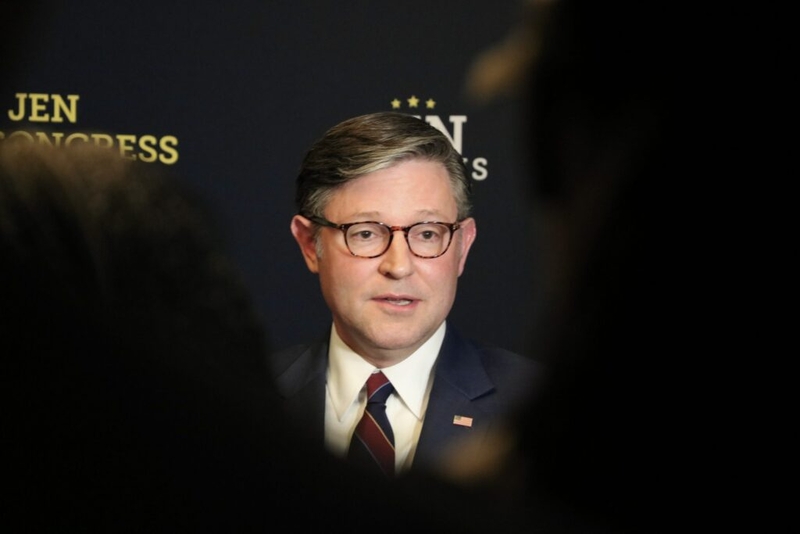
U.S. House Speaker Mike Johnson, R-La., speaks at a campaign event for U.S. Rep. Jen Kiggans in Virginia Beach, Virginia, on Aug. 17, 2026. (Photo by Charlotte Rene Woods/Virginia Mercury)
President Donald Trump’s attempt to rebrand artificial intelligence and place himself in lockstep with the industry’s leaders this week are the latest examples of how the administration has taken a hands-off regulatory approach to the rapidly evolving technology.
It does little to assuage growing concerns that autonomous AI poses a risk to public safety, national security and other vulnerable infrastructure. U.S. House Speaker Mike Johnson, R-Louisiana, has contributed to this apprehension, ignoring bipartisan calls from his colleagues in Congress to act on legislation that would place guardrails around AI development.
“They don’t need the government to tell them to slow it down. If they want to slow it down, they should,” Johnson said. AI companies should “self-regulate” and “self-police,” the speaker said last month shortly before sending House members home for a seven-week break to campaign for the midterm elections.
Driving the demand for regulation are outright acknowledgements from the AI industry that it has struggled to contain the technology’s ability to teach itself. The most recent proof has been in the emergence of Claude Mythos, a product in development that its creator Anthropic recently deemed too dangerous to release because of its ability to hack through cybersecurity.
In July, OpenAI confirmed two of its models escaped from its digital labs and infiltrated a competing AI startup’s infrastructure. The incident has been described as a hacking system that took offensive steps to steal the answers to a test it was taking.
These ominous clouds hung over a White House meeting Trump hosted Tuesday with Johnson and AI industry executives, including Elon Musk, Mark Zuckerberg and leaders from Google, OpenAI, Anthropic and Nvidia.
Anyone with hopes the tech titans would emerge contrite and careful after the meeting saw them dashed that same day when Trump issued an executive order to replace the term “artificial intelligence” with “super intelligence.” The edict applies to all official correspondence, public communications and policy documents within the executive branch.
No one expected Trump or Johnson to conceive a strict regimen to keep AI in check, but the executive order made it abundantly clear the president and speaker have no intention of reining in the industry.
This was reinforced with the Joint Commitment on Frontier Responsibilities, a document all six CEOs at the meeting signed, according to Trump. That the president, who blurs ethical lines to the point of obliteration, described the document as a “morally binding” accord is reason enough to doubt its value. Johnson went an octave higher on the oxymoronic scale when he said the agreement includes “voluntary” commitments.
Let there be no question that AI has the capacity to achieve huge advancements in fields that could better mankind. Medicine, agriculture and the environment come to mind as areas where “super intelligence” could help make historic strides.
But our chief executive and highest-ranking lawmaker, standing on the edge of the digital frontier with the ability to steer America into a better future, have chosen to be neutral passengers rather than thoughtful navigators.
Super intelligence, indeed.
It brings to mind the rise and fall of disaster movies and TV shows from the 1970s. The most notable from the genre were “Towering Inferno,” “The Poseidon Adventure” and multiple iterations of “Airport.” There were also far less memorable offerings with not-so-creative titles such as “Flood,” “Earthquake,” “Meteor” and let’s not forget “The Bees.”
And then there was “Supertrain,” a short-lived series from NBC in 1979 that welcomed small-screen viewers aboard a nuclear-powered, cross-country bullet train with an itinerary filled with mayhem. Most episodes featured a cavalcade of vintage Hollywood stars — imagine “Love Boat” but with Charro as a homicidal maniac.
How bad was “Supertrain?” Dick Van Dyke, quite possibly the most beloved figure in TV history, was cast in Episode 2 as an unhinged man who wants to pay back a stranger’s act of kindness by killing the man’s ex-wife.
In what had to be an act of desperation, the team behind “Supertrain” added a canned laughter track to its ninth and final episode. Its plot included a passenger who’s a murder suspect as well as a hostage situation. Chuckles galore, right?
The Trump-Johnson treatment of artificial intelligence feels like a disaster movie in the making, but without the formulaic script that assures us a square-jawed, steely-eyed hero will save the day in the end.
It doesn’t bode well for a sequel.

Baton Rouge, LA