Shrinking lake, shrinking access: Low water on Sakakawea tough on resorts, boaters
Aug 03, 2026 | 6:00 am ET
Description
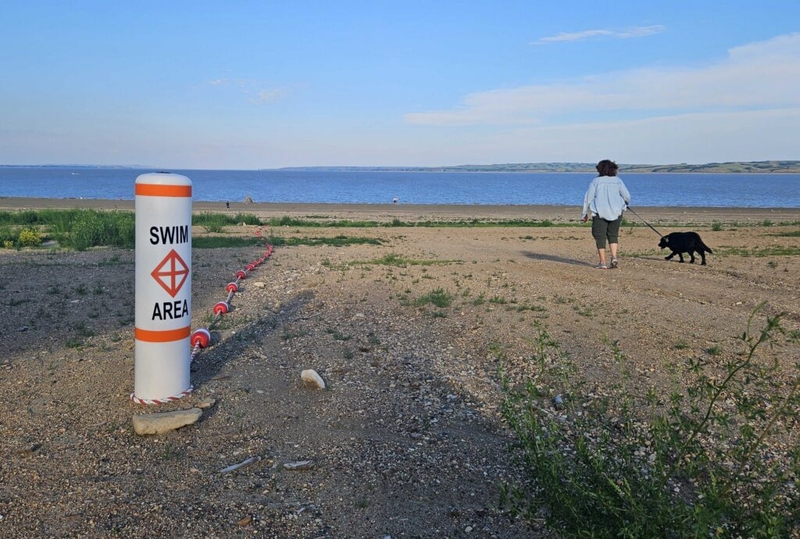
The swimming area at Lewis and Clark State Park near Williston, North Dakota, sits on dry land on July 2, 2026. (Photo by Jeff Beach/North Dakota Monitor)
Low water levels on Lake Sakakawea mean boat ramps that have been submerged for nearly 20 years will likely be needed to access the reservoir next year.
A lack of snowfall in the Rocky Mountains led to decreased runoff into the Missouri River basin in the spring and low water levels on Lake Sakakawea all summer, with drought conditions persisting in North Dakota and Montana.
As the lake level has gone down, some ramps and marinas can’t be used. Closed ramps mean more traffic and longer wait times at the boat ramps that remain open.
Bob Frohlich, fisheries development supervisor with North Dakota Game and Fish, said the department is preparing to use low-water ramps that were added to the lake in the years leading up to its all-time low level in 2007. Some of the ramps have been under water since the lake began to recover.
As more low water ramps emerge from Lake Sakakawea, they will need to be assessed to see what maintenance they will need and how much money it will cost to make them usable and prioritize the needs.
“The problem is, we don’t have enough money to do it all,” Frohlich said.
Lake Sakakawea stood at 1,827.3 feet of elevation on Sunday. That is about 12 feet below average, according to David Beck with the U.S. Army Corps of Engineers. The Corps is the operations project manager for Garrison Dam, which creates the Lake Sakakawea reservoir.
Based on current forecasts, the lake is not likely to reach its historic low set in 2007 at 1,807.1 feet — at least not in the next year or two, Beck said. But the shrinking shoreline will continue to limit access.
Beck said the ramps appear to be in good shape and will likely be in use next year. But making the ramps usable will come with a cost.
The Corps owns the land around the lake and controls a few access sites. But most access sites are leased to other entities such as state parks, county parks, Game and Fish wildlife management areas and tribal governments.
State Game and Fish helps pay for access roads to boat ramps, usually on a 75% state and 25% local cost share basis. The Corps provides engineering support and has to approve plans for roads or other work along the shoreline.
Frohlich said he can’t ever remember the Corps denying a permit application, but the process still takes time.
“It’s more complicated than a lot of people realize,” Frohlich said.
Meanwhile, resorts and parks are trying to deal with reduced access.
At Lewis and Clark State Park east of Williston, what is usually marked as the swimming area is all sand — though there is still a beach area along the water.
No boat ramps or marinas are open at the park. There is a ramp open at Lund’s Landing about 10 miles away.
Katie Ogden-Miley has managed Lewis and Clark State Park since 2018 and worked at the park since 2014.
“Our visitors are still enjoying themselves,” Ogden-Miley said. “The park has seen this before, and we bounced back.”
Dawn and Justin Ritts operate Van Hook Resort near New Town in partnership with the Mountrail County parks department.
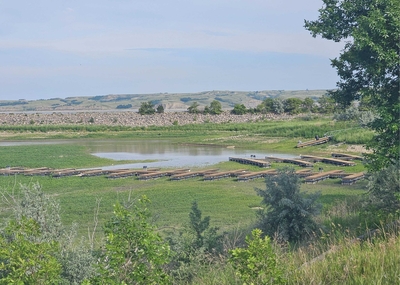
The resort usually has two double-lane ramps and one single-lane ramp. It has lost one double-lane ramp because of low water this summer.
Dawn Ritts said the shrinking lake means more traffic and more work for the resort, with moving docks an almost daily chore to adjust to the changing water level.
Ritts said the campground was already busy and more boat ramp traffic doesn’t necessarily benefit the resort’s bait shop and store.
“We have not necessarily seen an uptick in business because of the low water,” Ritts said. “From a management perspective, it’s a lot more work.”
Some of the low-water ramps that will be needed next year are at Van Hook.
Frohlich said there is a gap in lake elevation between what the ramps in use are able to serve and when the low-water ramps become usable. Game and Fish was at Van Hook recently looking at potential access points to bridge that gap.
“That’s probably the No. 1 used access point on the entire Lake Sakakawea. So for us, that’s a big priority,” Frohlich said.
Ritts said she has not seen the water this low in the 15 years she has been at Van Hook. It is unclear what next summer will be like.
“We are committed to having access,” Ritts said, adding that without knowing what the water level will be, it’s difficult to predict how many ramps will be available.
Ritts said resorts had plenty of bookings for this summer, but if they lose their water access, those visitors are less likely to return next year.
A bright side is that fishing is fantastic, Ritts said. But she said that may not last.
She said fishing improves at first when the water level is lower – with fish forced into a smaller area. But she said the fish population will adjust to the lower water level and if the water goes back up, it takes time for the fish population to recover.
Reach North Dakota Monitor deputy editor Jeff Beach at [email protected]
Bismarck, ND