Senate President Jackson looks to limit when people’s power can be disconnected
Jan 25, 2024 | 5:04 pm ET
Description
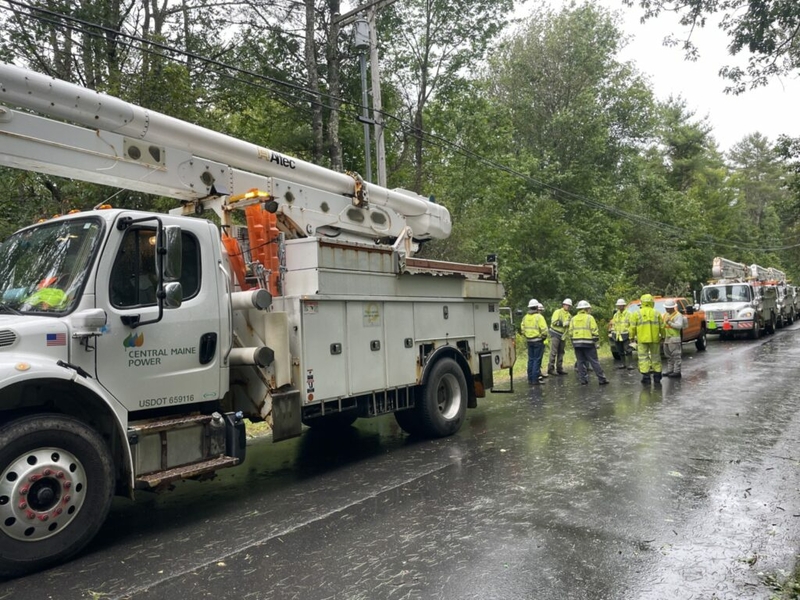
Central Maine Power workers repair lines after a storm. (Evan Houk/Maine Morning Star)
As many Mainers struggle to afford the cost of electricity, Senate President Troy Jackson on Thursday urged lawmakers to pass legislation to limit service disconnections by creating more stringent rules for when utilities can cut customers off.
LD 1962 would stipulate that the Public Utilities Commission issue rules that a utility cannot disconnect service unless a customer doesn’t pay or make a payment arrangement on a bill that is more than $225. It also calls for banning disconnections during extreme weather conditions, including heat and humidity.
The legislation would also expand the purpose of the PUC, which regulates Maine’s utilities, to include keeping rates affordable.
In addition, the measure would bar a utility from charging low-income customers with a restoration or reconnection fee and require that they waive late fees accrued prior to disconnection. Lastly, the bill would prevent a utility from disconnecting service remotely unless the company has made an in-person visit to a customer.
The measure comes as Maine’s for-profit utility companies, Central Maine Power and Versant, collectively sent tens of thousands of disconnection notices — which function as a warning of potential loss of service — to customers last year. On Thursday, Versant representative James Cote said the company sent out 48,500 such notices in 2023 while more than 60,000 were sent out by CMP.
CMP representative Linda Ball said Thursday that the company conducted a little over 30,000 actual disconnections last year between April and November for residential customers, a number that includes disconnecting some people more than once. Versant conducted a little over 2,000 disconnections along with 1,350 reconnections, company spokesperson Judy Long said.
While the companies offer payment plans to customers, critics say disconnections are a sign that rates have climbed too high, although Mainers are seeing some relief in the form of a decrease in the standard offer price for electricity in 2024.
During a public hearing Thursday on LD 1962 before the Energy, Utilities and Technology Committee, Jackson — a Democrat from Aroostook County — said his bill would help Mainers who are struggling financially retain their electricity.
“More and more Mainers are facing difficult choices that nobody should have to make,” Jackson said. “Whether to pay their electric bill or buy groceries for the week. Whether to buy medicine or keep the lights on.”
“I brought this bill forward to help mitigate the effects of such a choice,” he added.
The legislation also received the backing of AARP Maine.
“We support the reforms proposed by Senate Jackson to ensure that essential electricity and natural gas service is affordable and that additional steps be taken to prevent disconnection of service,” Alf Anderson, the group’s associate director of advocacy and outreach, said.
In his testimony, Anderson noted that Maine currently has strong protections that prevent disconnections during the winter months without permission from the PUC. He argued that extending those safeguards to instances of high temperatures is a common-sense step given the escalating impacts of climate change.
Utility companies skeptical
Maine’s major electric utilities were not enthusiastic about Jackson’s proposal. While Ball noted there are some provisions that CMP could support, she said the company is particularly concerned about requiring in-person visits before disconnection. She argued the requirement would be expensive and could create serious safety risks for workers, who would have to deal with people who may be angry about the prospect of losing service.
Ball also expressed concern about adding the requirement that rates be affordable to the mission of the PUC, which is currently tasked with ensuring that rates be “just and reasonable.” Ball called the concept of affordability “subjective” and a difficult bar to determine.
CMP believes the provision around barring disconnection during extreme weather has merit, but wants to see that term defined more precisely, Ball said.
Overall, Ball warned that the increased costs for utilities that the bill would create would ultimately be passed onto customers.
“We oppose LD 1962 because as written it will add significant additional and unnecessary costs for all ratepayers, with questionable added value other than to make it easier for customers to not pay their bills,” she said.
Financial data shows that CMP parent company Avangrid made a net income of $881 million in 2022, even as CMP requested a distribution side rate increase.
Versant also expressed skepticism about multiple aspects of the bill, although the company said it would support the extreme heat provision and does not oppose the proposal to waive reconnection fees for low-income customers.
Both CMP and Versant have come under increased scrutiny in recent years, with critics of the companies running a referendum campaign to replace them with a consumer-owned utility that proponents argued would increase reliability and lower prices. However, that ballot measure was soundly defeated in November amid a deluge of advertisements and other spending against the referendum.
Although both utility companies and some lawmakers expressed concern that the costs of preventing certain disconnections would ultimately lead to higher rates for all customers, Public Advocate Bill Harwood said he doesn’t believe the bill would dramatically increase prices for most people.
Harwood, whose job is to advocate on behalf of customers in utility matters, said the measure would primarily protect 40,000 to 50,000 low-income households in a pool of around 800,000 customers. While there would be a financial cost that would be passed onto ratepayers, he said the effect could likely be relatively small by spreading that increase out among the totality of customers.
Harwood ultimately testified neither for nor against the bill. He said the addition of keeping rates affordable to the PUC’s mission is a common-sense step to enhance financial protection for customers. Harwood also supports getting rid of the reconnection fee for low-income people and the extreme heat provision.
However, while he said the current threshold of $50 for when a utility can disconnect service is too low, setting the threshold at $225 could result in bills piling up too high for some low-income people.
The PUC also testified neither for nor against the bill but raised some similar concerns as Harwood and the utility companies.
During her testimony, Deirdre Schneider, legislative liaison for the PUC, noted that the commission currently has a rulemaking process open. One possible path forward that multiple people testifying on Thursday brought up is for lawmakers to recommend some reforms to disconnection regulations that could be changed within PUC rules rather than through a legislative measure that goes into statute.
Augusta, ME