Seminoe Reservoir slips to ‘near-worst case’ scenario amid debate over controversial hydroelectric project
Aug 06, 2026 | 6:20 pm ET
Description
Photo courtesy of WyoFile
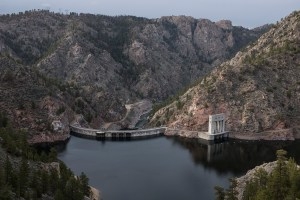
Driven by historically low snowpack and above average temperatures this summer, Seminoe Reservoir has slipped into “near-worst case” water quality modeling scenarios that federal officials are relying on to greenlight a controversial pumped-water storage hydroelectric project there.
The Carbon County reservoir, which stores water in the North Platte River system, measured just 29.4% capacity Wednesday, with a surface water elevation of 6,303 feet above sea level, according to the U.S. Bureau of Reclamation. That’s 12 feet below a “near-worst case” scenario of 6,315-feet elevation for the reservoir based on modeling of past years that opponents of the storage project have criticized as incomplete and shortsighted in consideration of changing climate in the region.
If the facility were in operation today, Seminoe’s current water level would trip a regulatory trigger enforced by the Wyoming Department of Environmental Quality, requiring developer rPlus Hydro to temporarily curtail operations, according to state and federal documents.
“Not a single shovel has hit dirt yet, and we’re already living in the near worst-case scenario,” Trout Unlimited’s Wyoming Government Relations Director Patrick Harrington told WyoFile. “What happens if next year looks like this year and we don’t refill Seminoe? What happens when the system experiences conditions that are drier than those that underpin the environmental analysis?”

Utah-based rPlus Hydro, along with its subsidiary Black Canyon Hydro, expects to receive final approval from the Federal Energy Regulatory Commission this year to construct its Seminoe pumped-water storage project. The company wants to carve a new reservoir on a hill above the Seminoe dam, pump water from Seminoe uphill during the day and release the water through hydroelectric-generating turbines in the evening — an electrical “battery” to provide power when it’s most needed, it says.
The commission in June issued its final environmental impact statement for the project, sparking criticism that it ignored input from local leaders and failed to incorporate more protective measures for fisheries and wildlife, including for the Seminoe-Ferris bighorn sheep herd.
Miracle Mile worries
Among local concerns regarding the $4 billion, five-year construction project is the Miracle Mile stretch of the North Platte River below the Seminoe and Kortes dams. It’s a world-class trout fishery that attracts millions in tourism dollars annually. It’s also designated as an “Outstanding Resource Water.” That decades-old designation, according to the Wyoming Department of Environmental Quality, requires that it suffer “no further degradation from human activity” — a legally enforceable sideboard that the state, as well as natural resource advocates, hope will protect the popular fishing destination.

A cold-water species, trout get stressed when water temperatures range between 70 and 75 degrees Fahrenheit. Prolonged temps beyond that can result in a fish kill, according to the Wyoming Game and Fish Department.
Typically, “tailwater” portions of rivers immediately downstream of dams like the Miracle Mile get the benefit of the coldest water in the reservoir, because dam outlets are far below the surface where temperatures tend to be warmer. But rPlus Hydro’s facility would churn the reservoir’s water temperature strata, especially when water levels are low, according to state and federal analysis.
The North Platte River system has suffered low-water conditions this year, beginning in February with various “priority administration” calls that limit irrigation for some users. Though no towns or industrial water users along the main stem have gone without, many of them have dipped into a state-owned backup water supply held in reserve at Pathfinder Reservoir, according to Wyoming State Engineer Brandon Gebhart.
“The entire state is under some classification of drought,” Gebhart told the Wyoming Legislature’s Select Water Committee Thursday. “Over 83% of the state is in severe or extreme drought.”
Gebhart added that many reservoirs in the North Platte drainage system — excluding those on the main stem of the river — are at “dead pool,” meaning water levels are lower than the dam’s outlet, preventing downstream release.
Regulatory analysis, stipulations, so far
Under “moderate” drought conditions, the facility’s daily churn “has the potential to exceed the 1.1 °C [about 2 degrees Fahrenheit] criterion” for the Miracle Mile if Seminoe shrinks below 6,326-feet elevation in July and 6,315-feet elevation in August, according to DEQ. That’s likely to happen about once a decade, the agency concluded in its “adaptive management plan,” which prescribes how rPlus Hydro must comply with the Outstanding Resource Water designation for the Miracle Mile, among other water quality regulations.
But Trout Unlimited and other natural resource advocate organizations note that the analysis is based on a slice of past hydrological data for the Seminoe-Kortes-Miracle Mile waters — from 2013 through 2016. The former was the lowest water-year dataset used to help determine reservoir water level and water temperature parameters, though data was available from other years when water was lower, according to Trout Unlimited and the Lander-based advocacy group Wyoming Outdoor Council.
“Why would the model not include the historic range of natural variability to set realistic triggers for the [water quality adaptive management plan] when at least 25 years of historical data was available, including two highlighted years of lower water availability?” the Outdoor Council said in comments to the FERC.

Trout Unlimited’s Harrington said his group believes the modeling method is sound, but the concern is that the data is too limited. “We’re not saying that the water-quality model itself is bad. We’re just saying if you feed it incomplete information you’re going to get incomplete answers.”
The state’s certificate for the project calls for continuous water modeling going forward, which should help rectify what critics believe is an incomplete dataset, Harrington noted. After all, the state intends to “adapt” its regulatory parameters, and that includes future hydrological conditions. Though it requires rPlus Hydro to begin real-time water quality monitoring “at least two years before project construction,” the DEQ told WyoFile, the agency doesn’t expect that effort to begin until 2028.
Reached for comment, rPlus Hydro didn’t say whether it has begun collecting hydrological data.
“We know that there are low-water years from time to time on the North Platte, and this happens to be one of them,” a company representative told WyoFile via email. “rPlus continues to be committed to the proactive precautions that were built into the Adaptive Management Plan agreed to with the State of Wyoming.”
Local groups, including the Wyoming Outdoor Council, have also criticized state and federal analysis for not going far enough to consider climate-change forecasts for the region.
While the FERC acknowledges that “localized droughts are projected to increase by 2040 and … decreasing snowpack will affect both surface water availability and groundwater resources, increasing pressure on water resources,” it concludes in supporting documents that site-specific climate-change projections are “beyond the scope of the study.”
Typically, the commission can license hydroelectric facilities for up to 50 years, while rPlus Hydro asserts it can reliably operate for beyond 75 years. That raises the stakes to ensure that permitting and regulatory parameters today account for what could be a drastically different environmental future for the region, Harrington said.
“Whether this drought is persistent, or they come every decade, this is the future we should be preparing for,” Harrington said. “The reality of low-water years is here. It seems like we can count on less and warmer water in the North Platte.”
Congressional plea
In a July Senate Committee on Energy and Natural Resources hearing, U.S. Sen. John Barrasso listed concerns he’s heard from constituents regarding the Seminoe project, including its potential impact on what he described as “one of the most legendary trout fisheries in Wyoming and in the World.” The Republican lawmaker implored FERC Chairwoman Laura V. Swett to “commit to taking a renewed look at the state’s comments and consider their incorporation into your final decision.”
“I know these types of projects have a great impact on communities,” Swett responded. “They’re very emotional for both sides, and I am fully committed to making a measured decision based on the record and working with your staff to arrive at the right choice for the American people.”
Reached by WyoFile for further comment, the FERC replied, “We don’t comment on pending matters.”
Barrasso’s office, however, ensured that it is in communication with the agency regarding the matter.
“FERC followed up with our office after the hearing,” Barrasso’s office told WyoFile via email. “We reiterated Senator Barrasso’s comments on how important it is that FERC take into account the state’s comments regarding wildlife habitat and how important the Miracle Mile is to the people of Wyoming. Senator Barrasso will continue to engage FERC as they make their final decision.”
Cheyenne, WY