SC’s new hands-free driving law goes into effect Sept. 1
Jul 31, 2025 | 4:59 pm ET
Description
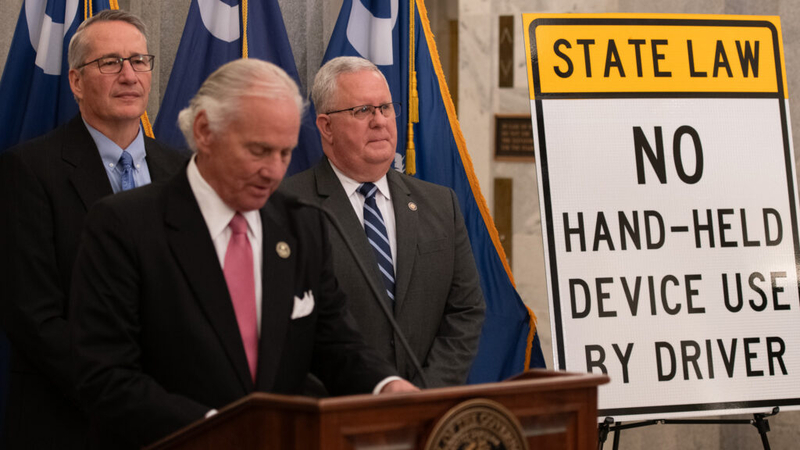
Gov. Henry McMaster and other state officials celebrated South Carolina's new hands-free driving law. Signs advertising the law will go up along state roads to remind drivers of the law, which goes into effect Sept. 1, 2025. (Photo provided by SC Department of Public Safety)
Scrolling and driving will be illegal in South Carolina starting Sept. 1 as the state’s new hands-free driving law goes into effect.
For the first six months, anyone stopped for holding a cellphone while driving — whether talking, texting or watching videos — will receive a warning. But starting Feb. 28, violators will be handed a costly ticket.
“We recognize that this law will cause a very significant change in driving habits for many drivers. So, we will educate first,” Robert Woods, director of the Department of Public Safety, said at a ceremonial bill signing Thursday.
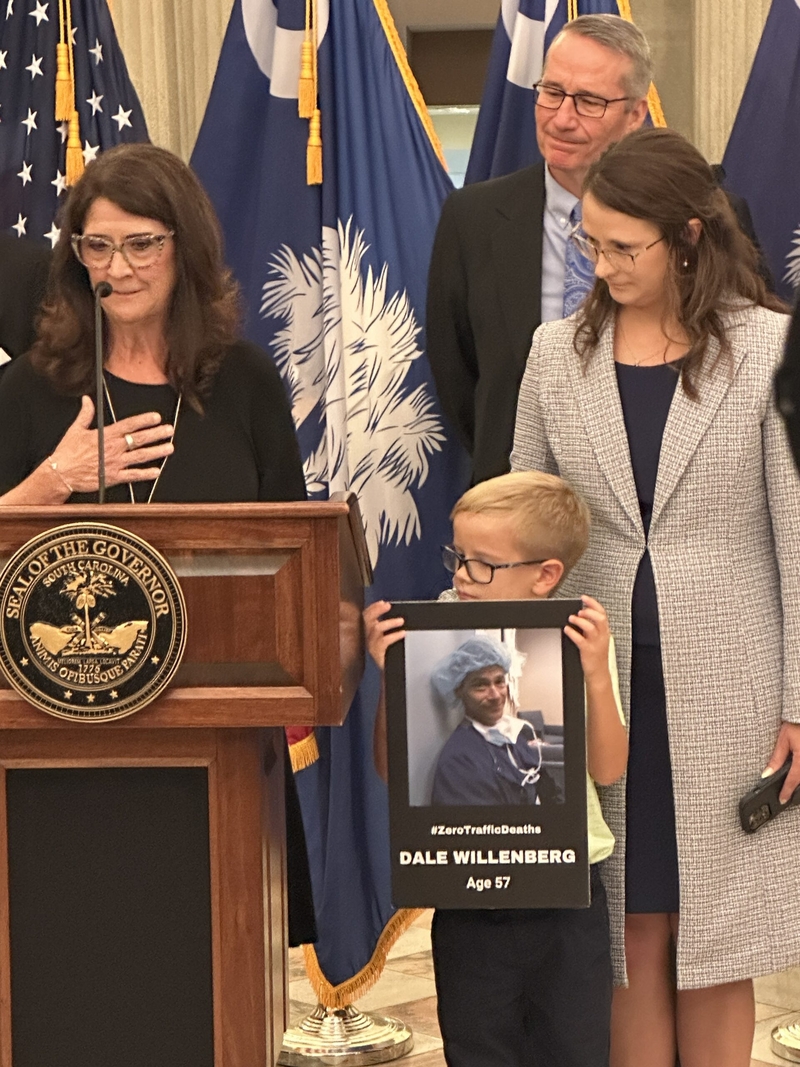
State officials gathered at the Statehouse to celebrate South Carolina becoming the 33rd state to enact such a law, which Gov. Henry McMaster signed in mid-May.
Distracted driving is a contributing factor in more than 20,000 traffic collisions in the state each year, according to DPS.
“We are confident this law will prevent collisions and save lives,” Woods said. “It is important to know that our troopers and officers of the Department of Public Safety, working in cooperation with our local law enforcement partners, will strictly enforce this law.”
Hands-free phone calls and voice-to-text messaging remain legal. And drivers can still have their phones in hand when parked, reporting traffic accidents or during a medical emergency.
“It’s just common sense, but sometimes it takes a law to remind everybody of that common sense,” McMaster said.
“To see some of our people unnecessarily hurt, damaged, to see families suffer from acts of inattention, it’s something that’s just a crying shame,” the governor added.
Under the law, driver’s can also handle their phones when legally stopped, such as when at a red light, however the Department of Public Safety “encourages drivers to always avoid using a mobile device when behind the wheel, even at a red light, as driving a vehicle requires careful attention,” spokesman Kyle McGahee said in a statement.
Fines start at $100 for a first offense. For second or subsequent offenses, the fine rises to $200 and a two-point assessment against your driver’s license, a penalty Woods said is likely to get people’s attention and act as a deterrent.
Without a hands-free driving law, SC could lose upwards of $40M in federal road funding
To get the word out about the new law, the state Department of Transportation will install signs along state roads and display messages on the agency’s digital displays along interstates.
The state Department of Parks, Recreation and Tourism will also alert visitors of the law with signs at its interstate welcome centers.
Attending the bill’s ceremonial signing was the widow of the late Dale Willenberg of Chesnee, along with one of his twin daughters and a grandson.
An avid cyclist, Willenberg died in 2017 at the age of 57 after he was struck by a driver in a hit-and-run.
According to prosecutors, the driver had looked down to check his cellphone before the collision, then fled the scene. The driver later turned himself in to police. He was sentenced to 12 1/2 years in prison for the fatal hit-and-run, WYFF-TV news reported.
“I do not want anyone in this room to suffer the trauma we have suffered — lives crushed under grief and a legacy interrupted needlessly,” said his widow, Kelly Willenberg.
“Choosing screen over safety is not an option. This bill is more than legislation. It is a vow to protect what matters most for us,” she said. “It’s not just a policy. It’s a promise born of our pain and purpose. Our roads will be governed by responsibility, awareness and respect.
Let this law stand as a reminder that no message, no text, no ping or post, is worth the price of a human life.”
Editor’s Note: This story has been updated with more information from the Department of Public Safety.
Columbia