SC senators approve expanding monument protections, banning QR codes for more info
Apr 16, 2026 | 5:00 am ET
Description
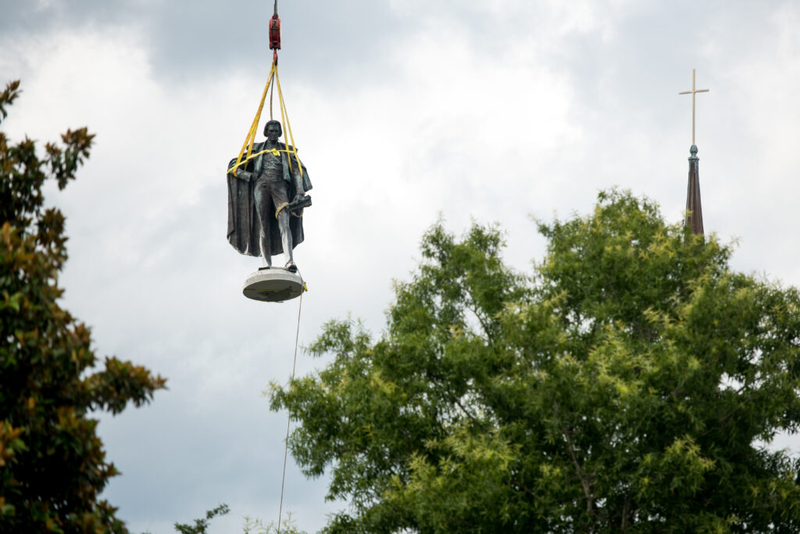
A statue of John C. Calhoun is removed from the monument in his honor in Marion Square on June 24, 2020, in Charleston, South Carolina. Work crews began dismantling the monument on Tuesday evening. (Photo by Sean Rayford/Getty Images)
COLUMBIA — The South Carolina Senate voted to expand a 26-year-old law originally passed to keep Confederate monuments in place.
The bill introduced by Sen. Danny Verdin, R-Laurens, and co-sponsored by 31 other Republicans would extend the protections under a portion of state law commonly called the Heritage Act to all memorials on public property in South Carolina.
It also would stop the use of digital codes or informational plaques placed near some monuments in recent years offering broader context on the thorny parts of history. And private groups could sue to enforce the measure, allowing a judge to order restitution.
The measure now heads to the House for consideration.
Since 2000, state law has given the Legislature sole authority over whether to remove or change the name of any building or memorial on public property that commemorates American wars, as well as Native American or African American history. In 2021, the state Supreme Court upheld that authority.
The Senate voted 31-7 along party lines Wednesday to add colonial wars or any armed conflict involving South Carolinians to that list of protected categories, as well as memorials dedicated in memory of any deceased historic figure or any historical or “commemorated” event.
A statue’s removal
The broad expansion effort is in response to the 2020 removal of the bronze statue of John C. Calhoun from a downtown Charleston park. In response to the removal, a Charleston-based association formed in 2018 to fight the removal of monuments declared the law “no longer effective.”
The American Heritage Association sued on behalf of descendants of Calhoun two years after Charleston City Council voted to hoist the statue from its 125-foot pedestal, where it stood for 124 years. The city council’s vote came in the aftermath of a white police officer killing George Floyd, a Black man, in Minneapolis.
When the group faced legal challenges over whether it was actually eligible to sue, the association followed up last year by asking legislators to change the law altogether.
“They’re whining that they keep losing, so they want us to change the rules so they can win. I don’t think that’s good policy.” said Sen. Ed Sutton, a Charleston Democrat who led the fight against the bill.
The city of Charleston argued in court it was within its rights because the statue was not on public property. The city leases the square from the Board of Field Officers of the Fourth Brigade, a historic militia that owns Marion Square where the statue sat atop a stone pillar.
Plus, the city continued, the 12-foot-tall figure didn’t memorialize a war, Native Americans or Black history.
Attorney General Alan Wilson gave the same reasoning in an opinion released days after Calhoun came down in June 2020: The Calhoun statue was not protected by the law, he wrote.
Sutton now worries by opening the law up to private litigation it could have a “chilling effect,” as cities afraid of getting sued may think twice about putting up a new monument.
“That’s an absolute shame,” he said.
Educational tools
Another sticking point for Democrats was the prohibition on Quick Response (better known as QR) codes, the square barcodes scanned with a cellphone camera to provide information.
The bill doesn’t include the words QR codes. But it bans anything not original to the monument “that facilitates the transmission of messages through digital or electronic means.”
Sutton said those codes are used by the Preservation Society of Charleston at many landmarks around the Holy City. The organization often updates the webpages the codes link to with new information, often customizing them for different events such as Women’s History Month.
And the state has made use of them as part of exhibits celebrating the 250th anniversary of the American Revolution.
“What is the problem of allowing future generations to use the tools that they have in order to tell the story, perhaps in a more comprehensive way?” asked Sen. Darrell Jackson, D-Hopkins.
Verdin argued the problem with going back and retelling that history with a broader or more modern view runs the risk of “taking something out of its point of original context.”
The Senate did make some changes to the original bill. It allowed names to be added to certain memorials that were designed to be altered, such as The Citadel War Memorial, on the campus of Charleston’s military college, which honors alumni who die in military service. More than 750 names are on the memorial to date.
It also says if a building needs to be demolished or a public property is sold to a private group, a monument or plaque can be moved to another, equally prominent public location.
Though it is called the Heritage Act, those words don’t actually appear in state law. The memorial protection was part of a 2000 compromise that moved the Confederate flag from atop the Statehouse dome to a 30-foot flagpole beside a Confederate memorial on the Statehouse’s front lawn. (That compromise also made both Martin Luther King Jr. Day and Confederate Memorial Day state holidays.)
The Legislature removed the flag from the grounds entirely in 2015, following the massacre of nine Black parishioners of Mother Emanuel African Methodist Episcopal Church in downtown Charleston by an avowed white supremacist.
“No one here is trying to erase history. History is not fragile. It does not disappear because we choose not to enshrine it in bronze or stone,” said Sen. Margie Bright Matthews in opposition.
“What this bill asks us to do is something very different,” the Walterboro Democrat continued. “It asks us to honor. And we need to be honest about who and what we are being asked to honor, because what may be heritage to some is really a relic of racism and hatred to many others, especially to those whose ancestors suffered through slavery, mistreatment and generations of injustice.”
While the Calhoun memorial no longer stands in the Charleston park, a relocated monument honoring Confederate Gen. Robert E. Lee was put nearby.
In 2021, the Charleston County School District removed the 2.4-ton highway monument from the Charter School for Math and Science on King Street. The American Heritage Association sued again, this time on behalf of the United Daughters of the Confederacy, which had originally installed the marker.
Ultimately, the lawsuit was dropped after the group reached an agreement with Marion Square’s owners. The monument has been in the park since December.
Charleston and the American Heritage Association also reached a settlement over the Calhoun statue’s removal. The city turned the statue over to a newly formed nonprofit called the Calhoun Monument Preservation Society, which intends to put the monument somewhere outside the city limits.

Columbia