SC Ports sees October cargo jump, favorable ruling in open-records lawsuit
Nov 17, 2026 | 4:57 pm ET
Description
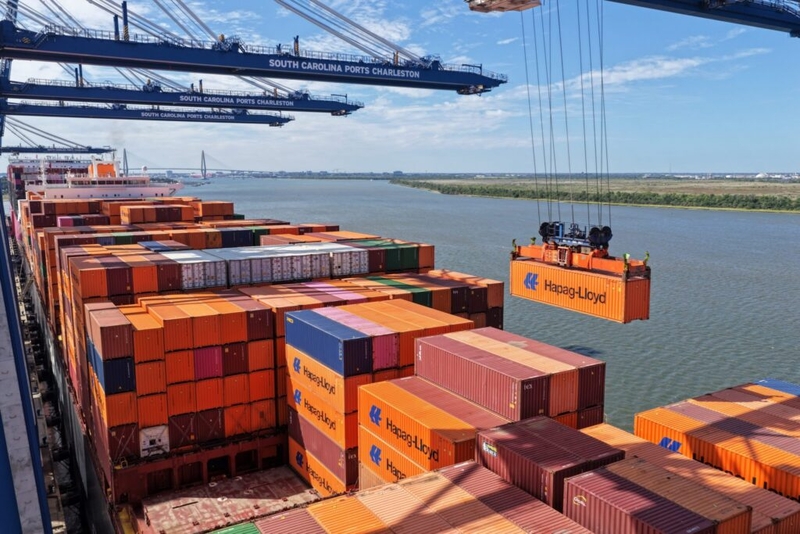
Cargo containers are moved at the Port of Charleston’s Wando Welch Terminal in Mount Pleasant. The State Ports Authority had a year-over-year increase in containerized cargo in October. (Photo by Matthew Peacock/Courtesy of the S.C. State Ports Authority)
MOUNT PLEASANT — The Port of Charleston had an increase in containerized cargo last month as freight promised by businesses earlier in the year started to materialize, although the port continues to lag year-over-year numbers.
Charleston’s container terminals handled 119,494 boxes of all sizes in October for a 5.4% increase over the same month a year ago. Still, the number of containers is down by nearly 3.9% for the fiscal year, which started July 1.
“We saw an uptick in October,” Micah Mallace, president and CEO of the S.C. State Ports Authority, said during the agency’s board meeting Tuesday.
“Now, certainly some of that is market driven,” he said. “However, a sizable portion of that is also due to the awards, the business that was awarded early in the year that we have reported on, and that we are now seeing start.”
Mallace announced during his annual State of the Port speech last month that manufacturers and other businesses have committed to bringing an additional 159,000 containers through the port in the coming year.
Charleston port chief says recovery underway, but more work must be done
That is roughly 6% of the port’s annual total. Mallace said businesses — like Isuzu, which is moving freight for its Upstate truck plant through Charleston’s port — are picking the port because of financial and operational improvements that have been made.
Ports nationwide, including Charleston’s, have experienced a longer-than-usual peak shipping season as retailers prepare for the holidays.
Jonathan Gold, vice president of the National Retail Federation, said ports have seen strong numbers “even as the season winds down.”
“Consumers should find shelves well-stocked with a wide range of choices to meet their needs and budgets for the holidays,” Gold said.
The retail trade group is forecasting a nationwide 1.4% increase in imports for the calendar year.
FOIA lawsuit
Tuesday’s board meeting follows a court ruling earlier this month in which a Charleston County judge said the authority did not violate the state’s Freedom of Information Act when it held an unscheduled closed-door meeting in August 2025 to discuss the employment of former CEO Barbara Melvin.
Mount Pleasant resident and open-records advocate Frank Heindel sued the authority three months ago alleging the maritime agency broke state law by failing to inform the public ahead of time about the specific reason for the closed-door meeting. Instead, the agency provided a vague explanation that didn’t hint at any executive shakeup.
Melvin abruptly resigned from the authority’s top job two days after the closed-door meeting, receiving a severance package that totaled nearly $1 million.
Facing a lawsuit, SC Ports ratifies former CEO’s severance deal a year later
A judge said the authority’s actions were legal because it did not take a vote during the closed-door meeting.
But the ruling ignored the key point of Heindel’s case – that prior public notice was required by law.
“The (judge’s) order answers a question I didn’t ask,” Heindel told the SC Daily Gazette. “I never claimed the board took a secret vote. My claim was that South Carolina law requires a board to tell the public the specific reason it’s going behind closed doors.”
An authority spokeswoman declined to comment on the judge’s ruling.
The board’s attorney agreed during the court hearing that there is room for improvement in the way the agency handles closed-door meetings.
“I agree, and I hope the board acts on that without needing another lawsuit,” Heindel said. “Too many public bodies in this state use the same vague language, and the public deserves better.”
Columbia