SC legislators would need permission to get paid with state dollars, Senate proposes
Apr 27, 2026 | 9:30 am ET
Description
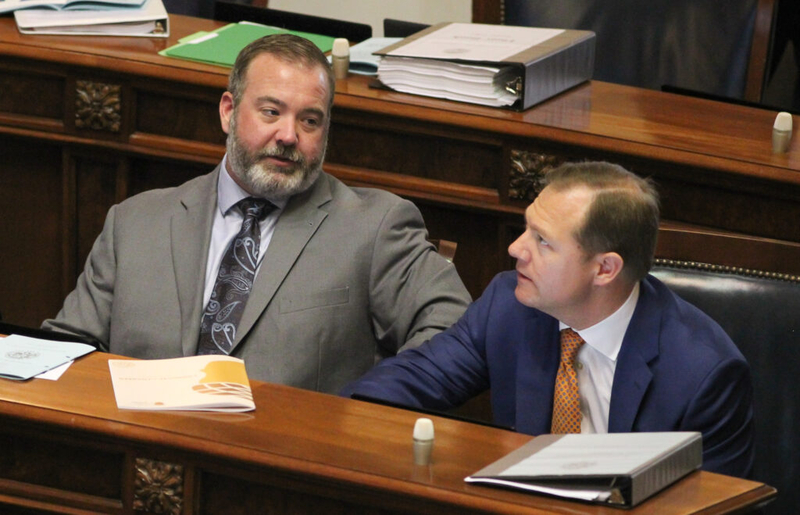
Sen. Stephen Goldfinch, left, and Sen. Wes Climer are seen during session in Columbia, S.C. on Wednesday, March 23, 2022. (Photo by Travis Bell/STATEHOUSE CAROLINA/Special to the SC Daily Gazette)
COLUMBIA — Legislators would need permission from an ethics committee to get any state funds outside their legislative salaries under a clause senators added to the state spending plan after launching an investigation into a representative’s nonprofit.
Senators voted 32-9 to add the clause to the budget Thursday, with opposition coming from a mix of Democrats and Republicans. Most of the concerns senators raised dealt with the logistics of needing to ask for an opinion about every potential interaction between their business and state government.
The proposal, which still needs House approval, follows questions about a nonprofit run by Rep. Gilda Cobb-Hunter receiving tax dollars through a state budget directive since 2002. The State Law Enforcement Division, at the request of Senate Finance Chairman Harvey Peeler, is investigating whether that funding violated state ethics laws.
SC senators call for investigation over money to representative’s nonprofit: ‘I’m an open book’
Unnoticed for decades, the spending was newly scrutinized due to the attorney general’s race.
Sen. Stephen Goldfinch, who is running for the office, noticed the clause mentioned the 1st Judicial Circuit, which is where the nonprofit primarily operates — and where a primary opponent, David Pascoe, is solicitor.
Cobb-Hunter previously told the Daily Gazette she’s followed all reporting rules. Her supporters, including several candidates for office themselves, defended her during a news conference at the Statehouse the same day senators adopted the budget clause.
They called the investigation into Cobb-Hunter political theater, saying the longtime representative is a pawn in the attorney general’s race. Cobb-Hunter, the House’s longest-serving member, is running unopposed for re-election.
“My friend, Gilda Cobb-Hunter, has done no wrong,” said Brandon Brown, a Democrat running for U.S. Senate. “Politics are trying to threaten a hardworking state representative.”
Addressing Cobb-Hunter’s situation specifically, senators changed the decades-old directive to divvy up the money among judicial circuits, ensuring the full amount doesn’t go just to the nonprofit Cobb-Hunter’s led since 1985, which focuses on helping victims of sexual and domestic violence and neglect.
But Sen. Wes Climer, who proposed the new requirement for legislators, wanted to ensure no similar situations come up in the future, he said.
‘Measure of transparency’
Under his proposal, any sort of payments a legislator received from taxpayer dollars, whether through the state or a local government, would need to first get approval from either the House or Senate ethics committee. If a legislator didn’t first get an opinion, they would have to repay the money or risk being kicked out of office.
“Hopefully, this will keep people from getting into trouble that they might have otherwise gotten themselves into,” said Climer, a Rock Hill Republican who’s running for Congress.
During committee deliberations on the $15.3 billion spending plan, Climer initially suggested an all-out ban on legislators accepting payments that include taxpayer money. Fellow senators were quick to shoot that down, pointing to all the payments they receive from state agencies for their jobs outside the Statehouse.
Their examples included major sources of income, such as Medicaid reimbursements, as well as tiny potential contributions, such as the occasional Chick-fil-A sandwich.
Legislators who work as lawyers also often receive state funding for cases.
Public defenders, such as Senate Minority Leader Brad Hutto, an Orangeburg Democrat, and Sen. Tameika Isaac Devine, a Columbia Democrat, both get payments from the state to represent people who can’t afford to hire an attorney, they have said. Others represent the state in workers compensation claims or help out the state attorney general’s office.
Climer’s updated clause was meant to allow all acceptable payments to continue, while catching any questionable spending, he said.
Legislators already must report their incomes on an annual disclosure, called a Statement of Economic Interest. And those who might have a conflict of interest can skip voting on certain parts of the budget, as Cobb-Hunter did with the portion her money came from.
The biggest difference under the proposal would be whether legislators report what they get from the state before receiving it or after, said Sen. Russell Ott, who did not vote.
“All you’re really doing is changing the order of things,” the St. Matthews Democrat said.
Cobb-Hunter pointed to her own State of Economic Interest as including the salary she received for running CASA Family Systems. Although the disclosure doesn’t name the nonprofit, it reports a state-funded salary of $130,643.
Those disclosures aren’t enough, Climer replied. The level of detail varies among legislators, and no one is scrutinizing every report to make sure they meet the state’s ethics requirements, he said.
“The 170 people who serve in the Legislature owe a duty of care to the people of this state that all effort be made to avoid impropriety and conflicts of interest in the choices that get made about the people’s money,” Climer said.
His budget clause would “create a measure of transparency” so voters could more easily see whether legislators benefited from the budget they approve annually, he continued.
Some of the same concerns raised during the committee process came up on the floor, as senators questioned how the requirement would affect business in certain industries.
For instance, Sen. Ronnie Cromer, who protested the initial proposal because the pharmacy he runs receives Medicaid reimbursements, questioned whether he would have to ask for an opinion from the ethics committee for every specific scenario that might come up.
Say, for example, a local school district called Cromer’s staff and asked for medication in an emergency, such as a student having a severe allergic reaction, and offered to pay for it. Would Cromer have to say no?
“I don’t think you can cover every particular situation,” the Prosperity Republican said.
“I think we can cover more than we are currently covering,” Climer replied.
Other senators worried about potentially losing out on a business opportunity, such as a contract or a legal case, while they waited for the ethics committee to give them an opinion as to whether they could accept it or not.
Legislators need another source of income, senators have argued, since their time at the Statehouse pays a salary of $10,400, plus $12,000 split into monthly allowances. (A separate clause approved by senators would increase legislators’ total payments to $40,400 yearly.)
Waiting on an opinion from the ethics committee, with no guarantee on a turnaround time, could force legislators to give up certain business opportunities that might be allowed out of fear of violating the budget clause, said Sen. Ronnie Sabb, a Greeleyville Democrat and attorney.
That’s part of what legislators signed up for, Climer said.
“I understand that it will be inconvenient,” Climer said. “I understand that it will be a pain. Please understand my sincerity when I say this: I think it’s worth it.”
‘No wrong’
Cobb-Hunter’s supporters called the claims against her unfounded during a news conference at the Statehouse on Thursday.
Several Democratic candidates for office were among them, including Brown, who is challenging Upstate U.S. Sen. Lindsey Graham; Jason Belton, who wants to be secretary of state; and Lawrence Moore, who’s running to replace Rep. Jermaine Johnson in the House. Johnson’s running for governor.
Cobb-Hunter was not at the news conference on her behalf. She defended herself previously, calling herself “an open book” and saying she followed all the rules in reporting her salary.
CASA Family Services does annual financial audits, which have all come back clean, according to a statement from the nonprofit. The grant is for operational costs, which include the cost of paying employees, reads the statement sent after the Senate Finance Committee debate.
“Paying qualified staff is not a misuse of funds; it is the mechanism by which services are delivered,” it reads
Along with running a shelter for domestic abuse survivors, which can house up to 21 people at a time, the nonprofit runs community programs for youth and their families meant to deter violence. CASA also runs a regional children’s advocacy center.
In 2025, 655 girls attended a group for middle schoolers meant to foster connections and bolster self-esteem, according to data provided by the nonprofit that operates in Orangeburg, Calhoun and Bamberg counties.
Also last year, 28 families, including 53 children and teenagers, graduated from the nonprofit’s “strengthening families program” that involves parenting classes and teaching skills that reduce conflict and help children with social skills and school performance, according to the data.
Columbia