SC joins multi-state effort to combat fraud of taxpayers’ money
Jul 30, 2026 | 5:52 pm ET
Description
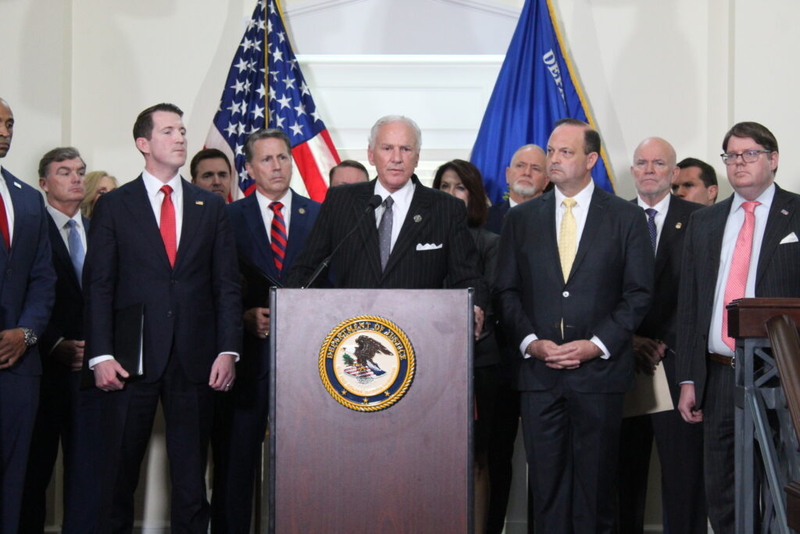
Gov. Henry McMaster, with Assistant U.S. Attorney General Colin McDonald on the left and SC Attorney General Alan Wilson on the right, talks about fraud cases during a news conference at the National Advocacy Center in Columbia, S.C., on Thursday, July 30, 2026. (Photo by Skylar Laird/SC Daily Gazette)
COLUMBIA — South Carolina is among seven Southern states that have agreed to share data and resources to crack down on fraud cases, officials from those states and the federal government said Thursday.
Since President Donald Trump announced the creation of a Department of Justice division dedicated to rooting out fraud, prosecutors have found more than $350 million in potential misspending across 17 cases, according to the federal agency.
The target is misuse of taxpayer dollars across agencies and purposes, said the two dozen U.S. attorneys and attorneys general in Columbia on Thursday. They met in Columbia this week for a discussion on how to fight fraud.
Though most of the officeholders are Republican, the group is bipartisan: North Carolina’s attorney general, Jeff Jackson, is a Democrat.
Recent cases included charges of falsifying tax returns to receive tax credits, stealing identities to get rent subsidies, and misusing grocery and health care assistance.
The public programs are important for helping those who need them, including people who are poor and who have disabilities, said South Carolina U.S. Attorney Bryan Stirling.
“That is your money that these people are stealing,” Stirling said.
The attorneys general and U.S. attorneys’ offices will pool information and resources to make it easier and faster for prosecutors to find fraud and file charges, said Colin McDonald, assistant attorney general of the National Fraud Enforcement Division, at the news conference.
The secretaries of state from Alabama, Florida, Georgia, Louisiana, Mississippi and South Carolina, as well as the treasurers from Florida, Mississippi and South Carolina signed agreements saying they would share data as needed, according to the Department of Justice.
Many agencies already share information. For instance, South Carolina and North Carolina joined forces last year to charge 11 people with defrauding government health insurance in schemes that amounted to more than $23 million.
But there’s no requirement for agencies to share what they know or specifications about what they should give each other, McDonald said. Instead, agencies rely on “hero agents and hero prosecutors” to make sure cases are based on all the information, he said.
“We now have that ability to quarterback the field of fraud, to have the full field in view, so that we can know where we need resources, where is the data missing, and how can we plug those gaps,” McDonald said.
The ultimate goal is to stop fraud entirely and restore faith in public programs, McDonald said. For a long time, prosecutors have gone after individual fraud cases, but partnering will allow them to look at the bigger picture, he said.
“Instead of little bites at the problem, we are endeavoring to solve the entire problem by putting an emphasis on it, by putting out money where our mouth is, by resourcing this fight and by developing these partnerships,” he said.
People can and often do commit fraud in multiple places, raising questions over whose jurisdiction a crime falls into and requiring records from more than one state or agency, said Meg Heap, U.S. Attorney for the Southern District of Georgia.
“The fraudsters are not going to stop in Savannah, Georgia,” Heap said. “They’re going to cross into South Carolina. They’re going to go down to Florida. They’re going to go to North Carolina.”
Fraudsters often work in teams to dupe investigators, said South Carolina Attorney General Alan Wilson.
“Why should we do anything differently when we combat these schemes and these scams?” Wilson said. “We need to be collaborating. We need to be communicating.”
Gov. Henry McMaster likened the partnership to President Ronald Reagan’s drug enforcement task forces of the 1980s, when U.S. attorneys, including McMaster, joined forces to track down drug smugglers. McMaster’s early ’80s crackdown on illegal smuggling of marijuana and hashish into the Lowcountry, called Operation Jackpot, resulted in more than 100 convictions. (A movie loosely based on the operation, produced and directed by one of the so-called gentlemen smugglers, was released last year.)
The new collaboration will give agencies “the power and sustainability to get this done,” McMaster said.
One of the 17 recent cases came from South Carolina. Misty Woody, an employee with ambulance service Vital Care was charged with forging a doctor’s signature on more than 100 forms for patients no longer under that doctor’s care, amounting to an estimated $1.8 million in false billing, according to the Department of Justice.
Woody pleaded not guilty, according to court records. Her attorney declined to comment.
Columbia