SC GOP sues to close primaries to registered Republicans
Jul 08, 2026 | 4:09 pm ET
Description
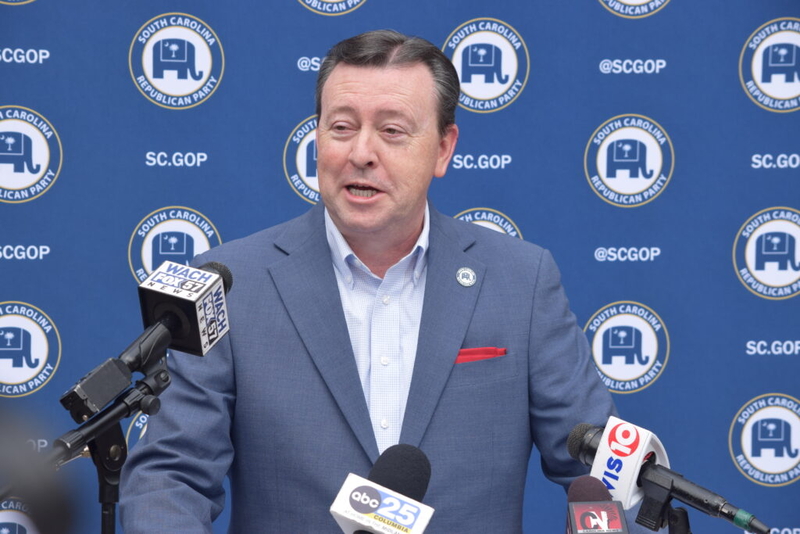
South Carolina Republican Party Chairman Drew McKissick, pictured Wednesday, Nov. 6, 2024, is suing the state to allow only Republicans to elect Republican nominees for office. (File/Photo by Jessica Holdman/SC Daily Gazette)
COLUMBIA — The South Carolina Republican Party sued Wednesday to close primary elections after legislation requiring a closed system failed to advance at the Statehouse this year.
The party has been pushing for years to require party registration in elections. After hinting about a lawsuit for months, party leaders announced plans for a legal challenge in May but said they wanted to wait to submit court filings until after last month’s statewide primaries, which included a question about party registration.
The federal lawsuit, officially filed Monday but announced Wednesday, argues the party has a right to choose who it does and doesn’t associate with under the First Amendment.
It also argues that allowing registered voters to cast a ballot in either party’s primary violates the party’s ability to set its own rules under the 14th Amendment’s guarantee of equal protection.
“South Carolina may regulate elections,” the lawsuit reads. “But it may not, consistent with the First and Fourteenth Amendments, compel a political party to accept non-members into the decisive process by which the party selects its nominees.”
A spokesperson for the State Election Commission did not immediately respond to a request for comment. Neither did Robert Bolchoz, chairman of the board that oversees the agency, who is named in the lawsuit.
Under existing state law, voters can choose either a Republican or Democrat ballot when they vote in primaries. There are restrictions, however, in primary runoffs. Crossover voting is not allowed during the primary cycle. In other words, people who vote in the Democratic primary can’t vote in the Republican runoff, and vice-versa.
In the ruby red state, elections are often decided in GOP primaries.
The state Republican Party contends state law allows Democrats and independent voters to help choose Republican nominees. They could potentially select a weaker or more divisive candidate that’s “less faithful to Republican principles” or more likely to lose, the lawsuit reads.
Opponents of closed primaries, including Gov. Henry McMaster, counter that’s not happening. A party that grew its base through open primaries shouldn’t prevent people from voting, the former state GOP chairman told reporters earlier this year. He also noted that many South Carolina voters consider themselves independent, asking, “What are they going to do?”
The issue split the House GOP earlier this year, with two bills detonating amid contentious intra-party fighting.
Rep. Brandon Newton of Lancaster, author of the bill repeatedly endorsed by the state Republican Party, opened a hearing in January by saying neither bill should advance amid the internal GOP wrangling. It was clear neither bill would become law anyway, especially since McMaster promised a veto.
The bills never received a second hearing and died with the end of session.
Attorney General Alan Wilson, the Republican nominee for governor, has supported closing primaries. In May, he joined state GOP officials to announce the impending lawsuit. The existing system didn’t hurt him last month. He emerged from a crowded GOP primary to ultimately win the runoff by more than 37 percentage points.
In a video announcing the lawsuit, state GOP Chairman Drew McKissick said the party’s executive committee agreed in December to give legislators “one last chance to get partisan voter registration passed” before taking the matter to court.
Bills to close SC’s party primaries stall amid GOP ‘civil war’
“We tried to work with the Legislature for over a decade to fix this problem, but nothing has changed,” McKissick said.
The lawsuit’s filing comes after GOP voters were again asked about closed primaries.
Just over 89% of voters answered “yes” to this question on GOP ballots June 9: “Should people have the right to register with the political party of their choice when they register to vote?”
The last time the GOP put that question on ballots was in the February 2024 presidential primary, when more than 73% said “yes” to the right to get a choice. The question has been on ballots five times in the last 10 years. Whether voters understood what that choice meant is arguable.
Questions on primary ballots are advisory only. Both parties can put questions on their primary ballots, with the wording of their choosing. The results neither change state law nor require legislators to do anything. Instead, they act as a survey to bolster the party’s arguments. The lawsuit didn’t reference the results, though McKissick pointed to them June 10 as proof most Republican voters agreed with the party’s stance.
The lawsuit doesn’t specify how registration might work, and McKissick has said the party first needs a legal victory before hammering out the details.
But the state GOP has repeatedly backed legislation, as sponsored by Newton, that automatically registers voters as Republicans the first time they vote in a GOP primary. In other words, South Carolinians wouldn’t have to re-register by party in order to vote.
“We believe that when we nominate a candidate to represent us on the ballot, that process should belong to Republicans and Republicans only, period,” McKissick said.
The League of Women Voters doesn’t see people voting for another party at levels high enough to really move the needle, said Lynn Teague, vice president of the state chapter.
Instead, closed primaries could deter voters from participating in primaries, worsening already low turnout rates, she said.
Last month, 25% of registered voters participated in the June 9 primaries, which had competitive races on both parties’ ballots. In the runoffs, less than 11% participated, according to state Election Commission data.
“Everyone needs a voice in how they are governed,” Teague said. “Closing the primary potentially shuts that off.”
Automatically registering voters to whichever party’s ballot they choose in the primary is often suggested as a compromise, but it puts a label on independent voters who don’t want to identify with a party, she said.
“That’s not equitable, either,” Teague said.
South Carolina is one of 15 states that don’t restrict who can participate in its primaries, according to the National Conference of State Legislatures.
Eight states have completely closed primaries, requiring all voters to register with a party. Fourteen states aren’t completely open or closed but either allow parties to choose who can participate or require party registration but let voters switch for a primary.
Texas’ Republican party is also suing the state in an effort to restrict who can vote in party primaries. That case is ongoing.
Columbia