SC elections chairman says he ‘didn’t even thumb through’ budget request he signed
Oct 20, 2025 | 4:39 pm ET
Description
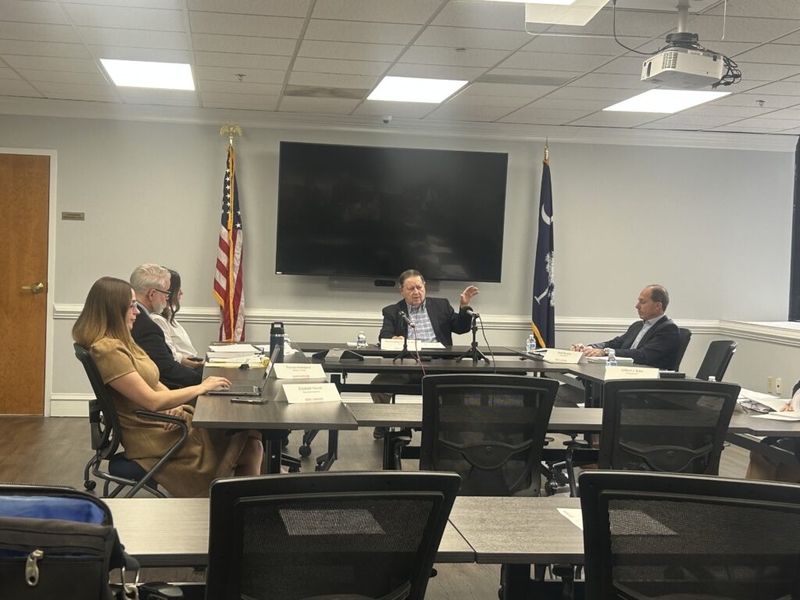
Chairman Dennis Shedd leads a special called meeting of the State Election Commission in Columbia, S.C., on Monday, Oct. 20, 2025. (Photo by Skylar Laird/SC Daily Gazette)
COLUMBIA — The chairman of the State Election Commission did not read the agency’s budget request, which included a payment he claimed was far beyond what the commission approved, before signing off on it last year, he said Monday.
Dennis Shedd has repeatedly said he and other commissioners thought voting machines bought last year would cost $28 million in taxpayer money. He blamed recently fired executive director Howard Knapp for not telling commissioners about an additional $4 million in the contract, which Shedd said commissioners learned about in the past two weeks.
But in September 2024, Shedd signed off on a budget request that included $32 million for new ballot scanners. Shedd’s signature and printed name appeared beneath a line affirming he had “reviewed and approved” the plan, “which is complete and accurate to the extent of my knowledge,” according to the document.
Shedd didn’t know about the discrepancy because he didn’t read the 32-page document, he told reporters following a State Election Commission meeting Monday.
“I probably didn’t even thumb through it,” Shedd said.
Shedd again faulted Knapp, who he has accused of creating a “toxic and perhaps hostile work environment” within the 65-person agency and misrepresenting the contract to commissioners, for not telling the commission about the increase in price.
An attorney representing Knapp has not responded to requests for comment Monday or last week.
The commission’s work is on a voluntary basis, so commissioners shouldn’t be expected to comb through budget requests, Shedd said.
“That’s not our job normally,” Shedd said. “We don’t take apart the budget and requests for expenses line by line.”
Gov. Henry McMaster appointed Shedd to the commission as its chairman in March 2024, saying in a statement at the time he was “uniquely qualified to lead the state election commission” because of his 12 years as a U.S. district judge. The governor’s office declined to comment Monday. The governor is responsible for appointing the entire governing board.
The five-member commission, which currently has one vacancy, acts as the executive director’s boss by overseeing and approving the director’s work, including spending.
Chairs for boards and commissions overseeing state agencies must sign off on budget requests alongside their respective executive directors. The requests, submitted in the fall to the state Department of Administration, start the process for the next budget year.
Unlike other board chairs, however, Shedd asked agency staff to add a line that he claimed showed he did not take responsibility for the accuracy of the request. The first page behind the sign-off cover sheet was a listing of 10 funding requests that totaled nearly $43.7 million, with the $32 million for a “voting system upgrade” at the top.
SC Election Commission has questions about $32M contract after firing director
“This document was completed by agency staff in compliance with state law and thereafter transmitted to the Department of Administration,” reads the “disclaimer,” as Shedd called the addition.
The first time Shedd saw the $32 million listed in the budget request was when reporters showed him a copy Monday, he said. Even if he had read through the document, he wasn’t sure he would have known whether the money was for the contract commissioners had authorized or if some of the money was meant to go elsewhere, he said.
Shedd wouldn’t have signed off if he saw the $32 million and understood where it was going, he said. He would have asked Knapp to go back to the company selling the voting equipment and attempt to negotiate the price down.
“I can tell you this much: If I had an inkling that $32 million represented that deal on the voting machines, I would have said, ‘Wait, wait,’” Shedd said.
Each item in a budget request includes a brief explanation for lawmakers of how the agency plans to spend the money. The election commission planned to use the $32 million to pay off a loan used to purchase ballot scanners and tabulators provided to every county, according to the description in the document.
Instead of reading through the request, or the included summary sheet, Shedd relied on Knapp to go over the highlights out loud during commission meetings, including any changes in amounts, he said.
“Don’t you have to take it that the person who’s working for the agency is truthful and is disclosing everything to you?” Shedd said. “Don’t you assume that?”
What began as a $28 million agreement ballooned without the commission’s knowledge, Shedd said.
The agreement Knapp made with the voting machine company came out to be about $800,000 higher than what the commission had authorized, and the loan he signed through the treasurer’s office was higher still. Knapp signed a second loan in January to add on about $2 million in sales taxes not included in the initial deal, said interim director Jenny Wooten, who took over when Knapp was fired last month.
The agency was supposed to make its first payment by Sept. 30 on machines bought and put in place ahead of last November’s election.
But it won’t get its $11 million that legislators approved in the state budget until February. That’s because the Legislature put a directive in the state budget delaying one-time allotments to agencies in case last year’s surplus would be needed to plug any gap due to an economic downturn for ongoing expenses.
Late fees on the voting machine bill start Oct. 30. Delaying the first payment is expected to cost the commission an additional $140,000, bringing the total for the ballot scanners, with interest, to more than $33 million.
The bank financing the loan agreed to push back the first installment, and the commission unanimously agreed Monday to authorize a change to the contract, allowing the agency to avoid defaulting on its payments.
Despite Shedd saying repeatedly he would have scrutinized every part of the document if he knew what he knows now, the chairman acknowledged he did not thoroughly examine the request submitted last week for the budget slated to begin June 1, 2026.
Shedd took home the request, “looked through it generally,” then told Wooten everything seemed fine and signed his name, he said. He again relied on Wooten, who mentioned a $25 million request to pay off the remainder of the loan during the last meeting, to get everything right, he said.
“I don’t go through it line by line,” Shedd said of the requests.
Columbia