Sanders, Ocasio-Cortez make electability case for El-Sayed
Jul 19, 2026 | 8:46 pm ET
Description
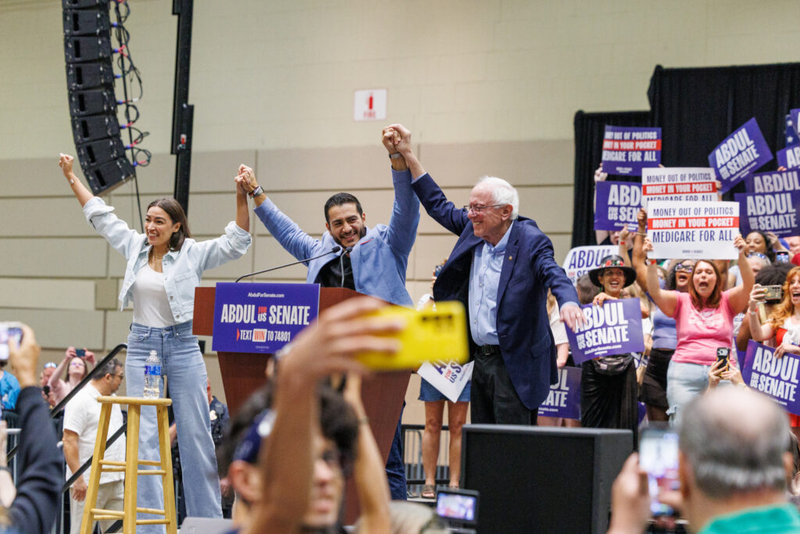
U.S. Rep. Alexandria Ocasio-Cortez, left, U.S. Senate candidate Abdul El-Sayed, center, and U.S. Sen. Bernie Sanders, right, at a rally in Lansing, Mich., on July 19, 2026. The rally also included U.S. House candidate William Lawrence. (Photo by Andrew Roth/Michigan Advance)
Questions of electability have loomed large for Abdul El-Sayed as he inches toward the finish line in a tight Democratic race for the U.S. Senate — both as a progressive candidate against a more establishment opponent in the August primary but also as it concerns the general election in November.
A rally held in downtown Lansing on Sunday, featuring U.S. Sen. Bernie Sanders (I-Vermont) and U.S. Rep. Alexandria Ocasio-Cortez (D-New York), aimed to bolster El-Sayed’s viability in his race against U.S. Rep. Haley Stevens (D-Birmingham). It also served the purpose of raising the argument that he can win in November against the presumed Republican candidate, former U.S. Rep. Mike Rogers of White Lake.
The progressive roadshow in Michigan included a stop in Detroit on Saturday, featuring Sanders but also U.S. Rep. Rashida Tlaib (D-Detroit), UAW President Shawn Fain and 13th Congressional District candidate Donavan McKinney, who faces incumbent U.S. Rep. Shri Thanedar (D-Detroit). Following the Lansing rally, the Democratic Socialist revue traveled to Grand Rapids later Sunday as a trio with Sanders, Ocasio-Cortez and El-Sayed in tow.
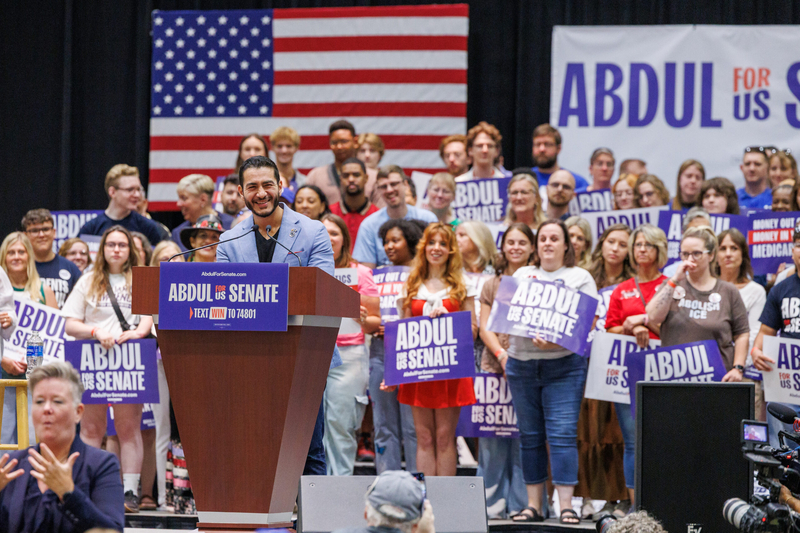
In all, both Sanders and Ocasio-Cortez, representing the old and new guard of the progressive left, told committed supporters and potential new voters that El-Sayed can win his race on Aug. 4 against the centrist U.S. Rep. Haley Stevens (D-Birmingham) and would go on to win against Rogers in the fall.
For Sanders, the immediate horizon was not just a gateway to the real race in November — it was a battle for the soul of the Democratic Party in Michigan.
“There is a reason why the whole country is watching this race. In fact, people all over the world are watching what’s happening here in the state of Michigan,” Sanders said to a sold-out crowd of 1,600 people, packed into a convention hall at the Lansing Center just blocks from the state Capitol. “The reason for that is, that in a time when we have more wealth and more inequality than we have ever had in the history of this country, at a time when fewer people, a handful of people, have never held so much wealth and power in the history of this country, people all over America and the world are asking: Is democracy alive and well in America?
“Or will a handful of billionaires and their super PACs be able to buy this election?”
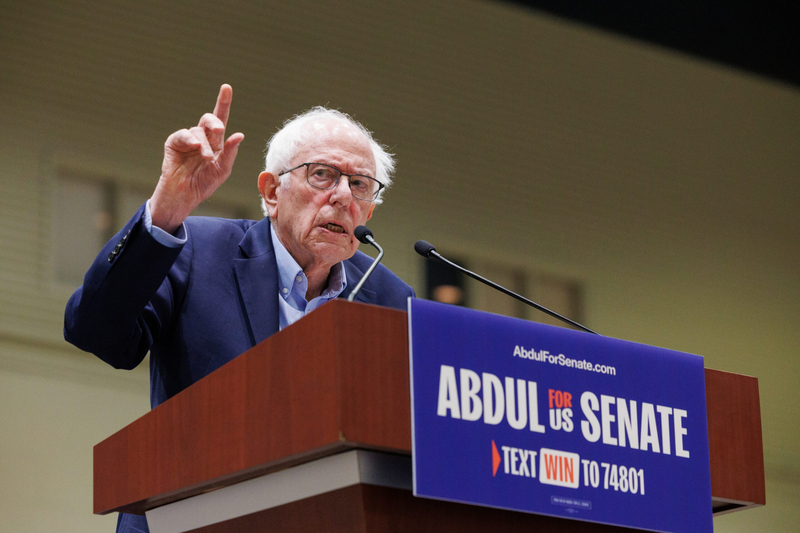
To Sanders’ point, the race has brought in all kinds of outside spending on behalf of the candidates, and much of it in favor of Stevens and against El-Sayed. AdImpact reported on July 13 that, over the next week, over-the-air TV advertising is expected to land from United Democracy Project, which supports Stevens, to the tune of $4.6 million. That is in addition to the nearly $50 million in advertising already purchased to boost Stevens and defeat El-Sayed.
While El-Sayed is slated to spend his own campaign funding to get on the air, with necessary additional advertising support from outside spending, the advertising and spending in the race has been stacked against him.
Some of that advertising has come from the American Israel Public Affairs Committee, or AIPAC, which has backed Stevens in the primary and has backed Rogers during past runs for the U.S. Senate. Both Stevens and Rogers are supporters of Israel, and Stevens this month voted against some of her Democratic colleagues in the House as they pushed to end military aid to Israel. El-Sayed has stood in solidarity with the Palestinian people and has called for ending U.S. military aid to Israel.
The dynamic of the outside spending has bolstered Sanders’ assertion that the election was coming down to “oligarchy versus democracy,” he said Sunday. Sanders added that the same outside advertising schemes tried and failed in more recent races where progressives have excelled, with the ascension of New York City Mayor Zohran Mamdani as a guiding light for progressives seeking big wins in 2026 and beyond.
The same “big idea” and “structural change for the better” rhetoric that propelled Mamdani earlier this year is the same being used to talk about El-Sayed. Sanders laid that on thick during his third rally tour featuring El-Sayed over the course of the cycle.
“This campaign is about whether we maintain the status quo — a status quo which is failing working families in Vermont, Michigan, and all over this country,” Sanders said.
The Lansing rally also featured 7th Congressional District candidate Will Lawrence, who faces a three-way Democratic primary race against former U.S. ambassador to Ukraine Bridget Brink and former Navy SEAL Matt Maasdam. Should he win in August, he would go on to face incumbent U.S. Rep. Tom Barrett of Charlotte.
Sanders spent some of his speech propping up Lawrence as he faces some headwinds for past comments made about Black Democrats, their place in upholding the establishment and a comment that their entrenchment in Democratic politics served to “defang the white left.”
AOC calls El-Sayed the future of Michigan politics
Ocasio-Cortez, who has quickly become a power player in progressive politics, also said the issues facing the nation started well before the rise of President Donald Trump, and that it wasn’t just his election that brought on a new wave of right-wing populism predicated on anti-immigrant, anti-choice and anti-diversity rhetoric.
“We have to be willing to name the mistakes that got us here, because it wasn’t just that Donald Trump won — it’s that the Democrats lost,” she said. “The moment we are willing to admit that and name some of the causes that got us here is the moment we can start turning the ship around and making things right again. … When the stakes are so high, and when more people than ever are living so close to the bone, eventually, we have to ask ourselves: ‘Is the answer to our problems the same playbook over and over again?’”
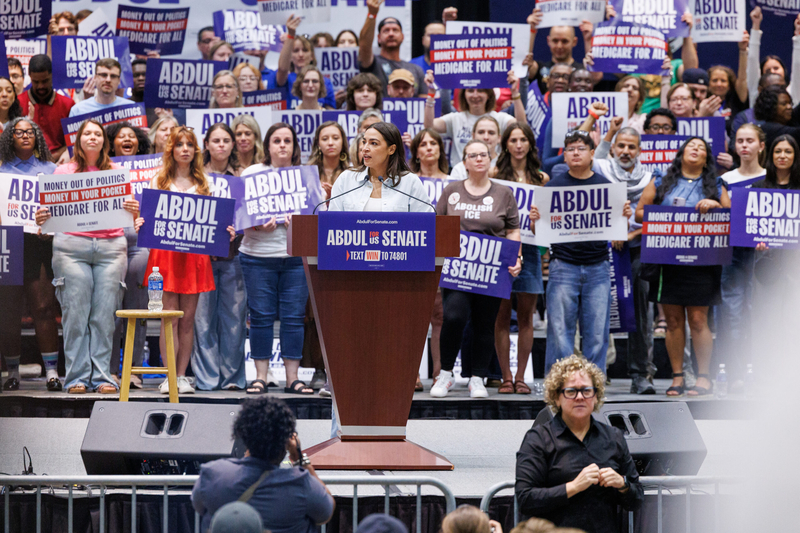
That also requires electing progressive candidates with a real willingness to not repeat those same mistakes, Ocasio-Cortez said — including El-Sayed.
“We can choose to reward the $50 million in dark money by voting their way. … Do you think that $50 million is for free? Do you think that $50 million is an act of charity? We know how this works,” Ocasio-Cortez said. “There’s $50 million in this race because they’re expecting a return. It’s an investment in how they make back their money, by allowing all of this stuff to continue, so that you pay more and more into their pockets. That’s what that $50 million is about. So we can choose that, or we can choose Dr. Abdul Al Sayed.”
Ocasio-Cortez said that El-Sayed represents the politics of the future, not only to win the Senate majority for Democrats, but as a way “that actually changes something.”
“Abdul had all of the opportunities before him,” she said. “He could have gotten a fancy job somewhere and ignored what was happening here at home, but instead he came home and rebuilt … health departments here in Michigan. Abdul is a man of integrity and discipline, a man of faith devoted to his family, to his beautiful daughters. He is the son of workers in this state and has stood alongside them in every fight, along every step of the way, and that is why he earns the endorsement of the UAW.”
El-Sayed and Stevens have created sharp contrasts between their campaigns following the exit of former U.S. Senate candidate Mallory McMorrow. They are still fighting to pick up her supporters, and doing so as more advertising and mailers are poised to inundate undecided voters.
Unlike Sanders, Ocasio-Cortez did not mention Lawrence.

El-Sayed confident he can beat Rogers if elected in August
Following the rally, El-Sayed spoke to members of the media. Michigan Advance asked him about the electability argument being made on his behalf, given that much of the race will now be decided by those uncommitted to either candidate.
El-Sayed pointed undecided voters to a multi-pronged question.
“I don’t think most people walk around asking, ‘Where do I fit on the left, right?’ I think most people are walking around thinking, ‘How am I going to afford paying rent next month?’” El-Sayed said. “‘My premium is way too expensive. What happens if I get sick? I really would like to take my kids out to a nice meal, but I don’t have the money for that.’ That’s what Michiganders are asking. This campaign is answering that question.”
El-Sayed was asked a second time during that same scrum on what makes him more electable in November over Stevens against Rogers.
“Maybe we’ve actually built a campaign of real people by real people, grassroots donors investing in grassroots organizers who knock on doors across this state.” El-Sayed said. “If you can’t make a contrast with your opponent, it’s hard to win an election. If DTE is funding both Stevens and Rogers, if Blue Cross is funding both Stevens and Rogers, if AIPAC is funding both Stevens and Rogers, what’s the contrast? Maybe, just maybe, we could win campaigns by actually talking about the problems real people have, but that’s not what’s coming out of their campaign. It’s all a distraction about me.
“If their whole thing is ‘he’s bad,’ at some point you have to ask, ‘why are you good?’ I’d like to hear that.”
Lansing, MI