The Democratic Senate convention is Saturday. Why is Jackson already the presumptive nominee?
Jul 20, 2026 | 4:26 pm ET
Description
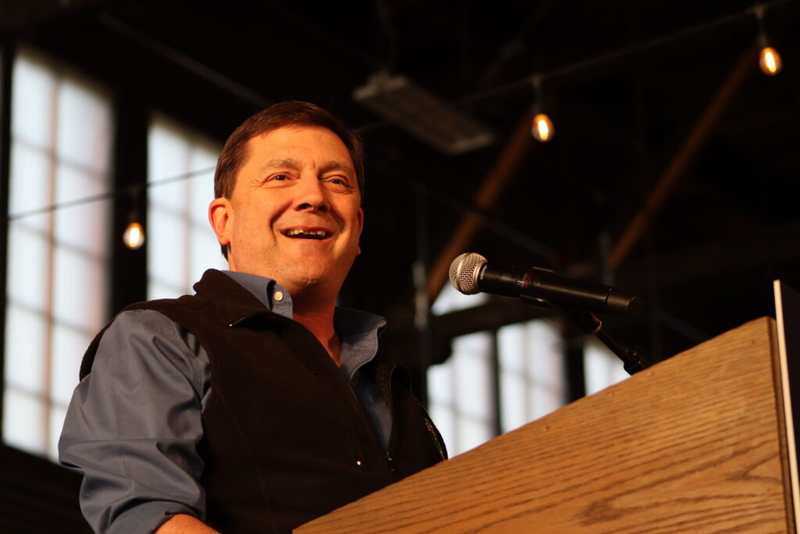
Gubernatorial candidate Troy Jackson campaigns with U.S. Senate candidate Graham Platner and U.S. Sen. Bernie Sanders of Vermont on May 25, 2026, in Portland. (By Emma Davis/ Maine Morning Star)
Troy Jackson emerged as the expected Democratic U.S. Senate nominee even before each county selected its delegates to send to the nominating convention, which isn’t until Saturday.
Politics got ahead of the process, as 478 of the 500 county delegates elected over the weekend are aligned with Jackson, according to Maine Morning Star’s analysis of the results compared with the aligned delegates list shared by Jackson’s campaign.
“Clearly there was a ground game,” as Maine Rep. Allison Hepler (D-Woolwich) put it.
When Democratic support for Graham Platner, who had secured the nomination in the June 9 primary, tanked after an accusation of sexual assault earlier this month, candidates vying to replace him worked quickly to line up slates of supportive delegates to increase their odds of securing the nomination.
The Maine Democratic Party decided to replace Platner through a convention, allowing 601 delegates — 500 chosen from the counties and 101 being members of the party’s state committee — to select the new nominee in Bangor on Saturday.
Most of the state’s largest counties appear to be clean sweeps for Jackson, the former Maine Senate president and logger from Allagash who had campaigned alongside Platner during his earlier bid for governor. However, Jackson has far less support in some of the smaller counties.
It’s unclear how exactly Jackson and the other candidates vying to replace Platner went about determining which delegates were supporters. Many delegates vying for spots showed up on multiple candidates’ lists. Some independent delegates also incorrectly appeared on supporter lists and were later removed.
Even if delegates are aligned with one candidate, they are not required to vote for that candidate at the convention.
The deadline for candidates to submit the required voter signatures to get into the convention is Monday at midnight, but major names like Nirav Shah and Shenna Bellows, who also ran for governor, have already dropped out. That leaves few challengers that could overcome Jackson’s support, making him the likely nominee.
Democratic voters who Maine Morning Star spoke with during and after the county-level meetings had mixed reviews on how the delegate selection process went. However, they are largely now rallying behind Jackson — many focused on the larger stakes of the election as incumbent Republican U.S. Sen. Susan Collins’ seat is seen as consequential for the balance of power in Congress.
Delegate selection
Portland resident Sophie Creamer, 26, participated in Cumberland County’s delegate convention on Saturday along with their partner. Displaying the virtual meeting on their TV, the couple watched as many people they knew made their pitches to be delegates. But beforehand, they’d also looked up the list Jackson’s campaign had posted to help them decide who else to vote for, since they were looking for Jackson-aligned contenders.
In Cumberland County, all 149 names on Jackson’s slate of delegates ultimately matched the county’s chosen delegate list.
Throughout the roughly 10 months Platner had been in the running, Creamer maintained skepticism and only decided to back him in the primary after a one-on-one conversation in which Platner spoke about his Senate bid as a means of building broader organizing infrastructure across Maine.
Creamer had been skeptical the convention process would result in a nominee who represented the progressive movement Platner had tapped into.
“I do still think that a flash caucus would have been more Democratic,” Creamer said of the process the state party chose, but added, “I am glad that it shook out the way that it did.”
Now confident in their choice come November, Creamer thinks Jackson is the right person to lead the charge. Having canvassed for Jackson during his gubernatorial bid and protested alongside him for various causes, Creamer said Jackson listens to organizers and respects their tactical and strategic choices.
That organizing muscle was evident in how the delegate selections played out over the weekend.
“There’s not a person here that hasn’t decided which way they’re going,” said Jim Betts, a Bellows supporter who unsuccessfully ran to be a delegate in Kennebec County.
Kennebec was one of eight counties that selected delegates who are all Jackson supporters, according to the Maine Morning Star analysis.
The candidates’ lists of supporters are an imperfect resource. Some independent delegates incorrectly appeared on those lists.
“When I decided to apply to be a delegate to the convention, I had intentionally decided that I would not commit to any candidate and that I would go into the convention with an open mind, and that’s what I put in my statement,” said Maine Sen. Anne Carney (D-Cumberland), who was ultimately not chosen as a delegate.
However, her name appeared on both Jackson’s and Shah’s lists of supporters. The campaigns removed her name when she contacted them, but she said the error demonstrated the challenges of campaign’s operating under the condensed timeline.
Jackson appears to have the least support in Lincoln, Washington and Franklin counties.
Eight of Lincoln’s 15 delegates don’t appear on Jackson’s list of delegates. That’s the case for five of Washington County’s eight delegates, and three of Franklin County’s nine delegates.
Consolidating support
All registered Democrats in Maine were able to vote for delegates, whether they attended meetings in person or not. Some intentionally did not look at the lists of aligned delegates released by the campaigns. That was the case for Hepler, who represents Woolwich in the Maine House of Representatives.
“I was looking for young people,” said Hepler, 70, adding that she wanted to encourage newly politically engaged folks who stepped up.
Hepler, who had endorsed Gov. Janet Mills when she was still in the race in March, said she’ll vote for Jackson if he secures the nomination, which had also been her position on Platner (before the sexual assault allegation) in the general election — with an eye toward winning control of Congress.
“He’s somebody who’s been through it and been in the public for a long time,” Hepler said of Jackson. One of her key concerns about Platner had been his lack of experience.
Top rivals drop out, clearing Jackson’s path to clinching U.S. Senate nomination
Hepler volunteered at the Sagadahoc County meeting on Sunday, where all but one of the 16 selected delegates support Jackson, according to his campaign’s list.
Bellows had already dropped out of the race by the time Sagadahoc Democrats met on Sunday afternoon to pick delegates. Shah dropped out later that night, as did Maine Beer Company founder Dan Kleban and former U.S. House candidate Jordan Wood.
Some voters appreciated their decision to step aside.
“Especially in this moment where we’re recovering in a post-Platner world, it kind of feels nice to sort of see even less progressive candidates like Shah just be like, ‘No, anything to get Collins out. That’s totally fine,’” Creamer said.
While the nominating convention is still days away, many voters and Jackson’s campaign are already turning their full focus to the general election.
“This weekend showed what’s possible when people come together around a shared purpose,” Jackson said in a statement on Monday. “I know everyone who stepped forward in this process did so because they care deeply about Maine’s future. Now it’s time to come together, grow this coalition even larger, and put in the work to defeat Susan Collins and send a fighter for working people to the United States Senate.”
Augusta, ME