Sand supports letting Iowa prison workers bargain as public safety employees
Sep 22, 2026 | 6:47 pm ET
Description
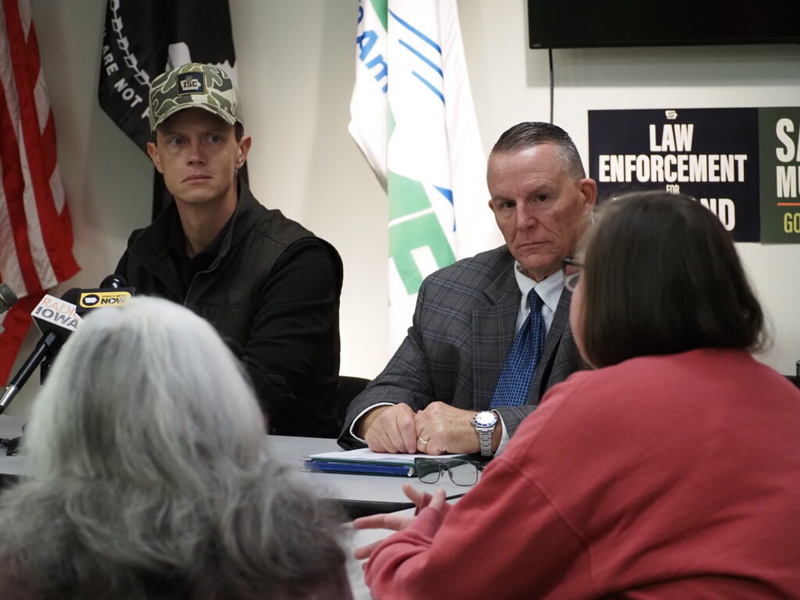
Iowa Auditor Rob Sand, left, running for Iowa governor, held a roundtable discussion with Todd Copley, AFSCME Council 61 President and employees in state correctional facilities at the AFSCME Council 61 headquarters in Des Moines Sep. 22, 2026. (Photo by Robin Opsahl/Iowa Capital Dispatch)
Democratic gubernatorial candidate Rob Sand said he would support classifying prison employees as public safety workers to give them access to more bargaining rights under Iowa law.
Sand met Tuesday with correctional officers and others working in the state’s prison system for a roundtable discussion at the Des Moines headquarters for AFSCME Council 61, a public sector union. Roundtable participants told Sand, who currently serves as Iowa auditor, about problems they saw in Iowa’s prison system.
Neil Lemaster, who works at the Iowa State Penitentiary in Fort Madison, said Iowa prisons are overcrowded and understaffed, putting prison employees in more potentially dangerous situations. Lemaster said while private-sector jobs offered better pay, he made the choice to work in the state prison system because of access to Iowa Public Employees’ Retirement System (IPERS). But, he said, low wages, increased overtime and unsafe working conditions have made him feel “trapped” in his job.
“I never looked at it like that until recently, where I felt trapped in my job because I can’t leave because I’m close to retirement,” he said. “I’m 52 years old, and and I got to wait three years to retire — I have over 30 (years) in, but it’s getting so bad. I was telling my wife, who’s a retired correctional officer, I was like, ‘I feel like I’m like sacrificing my safety.’ I’m like, ‘I don’t know if I’m going to be murdered at work for retirement.'”
Lemaster and other speakers said they believed the staffing shortage could be solved by providing higher wages for prison employees. However, they said the 2017 law making major changes to Chapter 20 of Iowa Code significantly limited their ability to bargain for benefits, safety and hours. The law, which limits public employee unions to bargaining only for base wages, does contain exemptions for public safety employees, like law enforcement and firefighters — but does not include workers in Iowa’s correctional facilities.
Sand said he planned to look further into the problems facing prison employees, but said he believed looking at changing Chapter 20 to classify Department of Corrections staff as public safety officials makes sense.
“I think if you ask the average Iowan, ‘Hey, somebody who’s working in prison, are they public safety workers?’ They’d say. … yeah, like, ‘What? Of course they are. What are you talking about?’ And so I don’t think that request is anything outside of common sense. And then when you talk about the fact that you got people doing it here — and they could be making $15 or more per hour working at a nursing home, well, how are you going to staff prisons? It makes a great point. If you’re building more and you can’t staff the ones we have, how’s that going to work out? So clearly, what we’re doing right now is not working, and nobody knows that better than the people who’ve been injured on the job, or the families of those that have been injured on the job, or even killed on the job.”
The Legislative Services Agency, a nonpartisan entity, estimated in June there were 230 vacant positions in Iowa’s prison system, with more than half of vacancies being for correctional officer positions. Iowa prisons are also over capacity by 28.47%, according to daily statistics from the Iowa Department of Corrections.
Prison populations are expected to rise further after Gov. Kim Reynolds signed House File 2542 into law earlier this year, a version of Republicans’ “three strikes” proposal that requires individuals to face a seven-year mandatory prison sentence after they have been convicted of their third felony offense. LSA projected this change will result in 4,363 more individuals in Iowa prisons by fiscal year 2030, which would require building three new medium-security prisons to house the increased prison population.
Sand shared a story about getting his concealed carry permit when he was prosecuting an armed robbery case in Hancock County, seeking a sentence above the mandatory minimum against an individual who was not in custody. Sand said, “You’re not going to find anybody, probably running for office anywhere, who has put their own safety on the line to extend somebody’s prison term.”
However, he also said it was cause for concern that the higher population could cause further strain on Iowa’s prison system, according to DOC staff comments at the roundtable.
“I don’t think that that law was thought through a deep sense, because clearly you have a lot of people who are involved with that around the table here today, who know a lot about the situation, who have some beef with a decision that they made,” Sand said. “That said, changes are going to have to originate in the Legislature. If there are legislators who think there are better ways to protect public safety than what they went with last year, I’d be all ears for listening.”
Sand is running against Republican gubernatorial candidate Zach Lahn in the Nov. 3 election. Lahn announced endorsements from 40 sheriffs Tuesday, who said in a news release they supported Lahn and conservatives who back public safety. Dan Capodilupo, a spokesperson for Lahn’s campaign, said the endorsements come “because he is the only candidate in this race who stands up for law enforcement.”
Marion County Sheriff Jason Sandholt said in a statement he was backing Lahn as a candidate who shares his belief in “accountability.”
“What does accountability mean to me? Accountability is holding criminals accountable for their actions and not having a catch and release program where they’re in and out of prison,” Sandholt said. “I want a governor who has those same conservative beliefs that I have, and that’s why I’m supporting Zach.”
Sand was backed by group of law enforcement officials, prosecutors, and other public safety workers earlier in September.
Des Moines, IA