RI federal judge voids DOJ subpoena for trans youth medical records
May 13, 2026 | 5:21 pm ET
Description
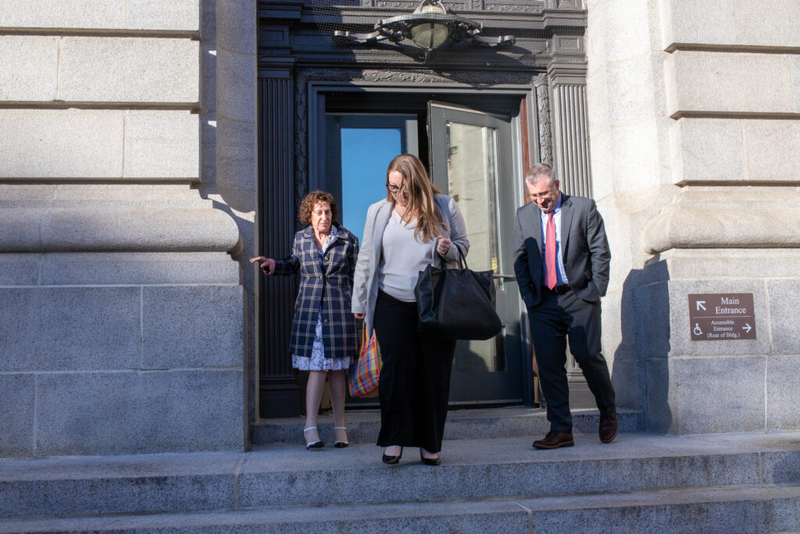
Rhode Island Child Advocate Katelyn Medeiros, center, leaves U.S. District Court in Providence after a Tuesday, May 12, 2026, hearing on her office’s motion to quash a federal subpoena seeking Rhode Island Hospital records tied to transgender minors’ medical care. (Photo by Alexander Castro/Rhode Island Current)
U.S. District Judge Mary McElroy on Wednesday night nullified a U.S. Department of Justice subpoena seeking roughly six years’ worth of medical records of young patients at Rhode Island Hospital prescribed puberty blockers or hormone therapy.
McElroy’s 24-page order came a day before the deadline set by a Texas federal judge for Rhode Island Hospital to submit the requested records. She began by noting that the Department of Justice (DOJ) possesses “immense prosecutorial authority and discretion,” with citizens trusting that “this awesome power against a state, a company, or certainly against vulnerable children” will be wielded fairly.
“DOJ has proven unworthy of this trust at every point in this case,” McElroy wrote.
The Justice Department, she wrote, acted in bad faith, fibbed to federal courts, and sought records guarded by constitutional rights. The subpoena was part of a nationwide effort to obtain transgender-related medical records from hospitals and providers which treat young people with puberty blockers and hormone therapies in an investigation into alleged violations of the Food, Drug, and Cosmetic Act (FDCA). The DOJ wanted Rhode Island Hospital’s records for gender-related care at the hospital from 2020 through 2025.
Because the subpoena was administrative — it came from the DOJ, and not a court — McElroy could slash it down, severing the root cause of the Texas court’s order rather than the Texas order itself.
“This Court quashes the administrative subpoena — the instrument issued by the DOJ — not the enforcement order entered by the Texas Court,” McElroy wrote.
McElroy’s Wednesday night order also crystallizes many of the questions she had during a Tuesday bench hearing about how the U.S. Department of Justice went about the case.
Had the DOJ lied, or at least omitted something important, when it asked a Texas judge to enforce its subpoena against Rhode Island Hospital for treatment records of transgender youth? Was the DOJ misleading the Rhode Island court in a similar manner?
“It’s unfathomable that the process comes down to this level of adversarial,” McElroy said toward the end of an over four hour hearing about the DOJ’s recent interactions with the federal courts. “It never was.”
McElroy granted the motion filed last week by Rhode Island Child Advocate Katelyn Medeiros after presiding at a hearing Tuesday in Providence’s federal court. The medical records the feds want to see include names, birthdates, Social Security numbers, addresses, details about parents or guardians, as well as clinical documents pertaining to diagnoses, assessments, intake and informed consent.
Rhode Island Hospital had until Thursday to hand over the documents per a deadline set by the U.S. District Court for the Northern District of Texas on April 30.
Office of Child Advocate fights to block DOJ subpoena for trans youth private medical records
The hospital and Rhode Island’s Office of Child Advocate, which is statutorily charged with legal advocacy and defense of children in state care, argued the subpoena is rooted in dubious arguments and that the feds maneuvered to have the subpoena enforced in a more receptive venue.
McElroy agreed in her ruling.
“The presiding judge in the Texas court has branded ‘the Department of Justice, the world’s largest law firm’ a ‘frequent forum shopper,’” she added in a footnote. “It is clear that the DOJ has done so here.”
Wednesday’s order echoes concerns from Tuesday’s hearing
Outside the courthouse Tuesday, Medeiros told reporters she could not disclose the number of kids in state care whose records would have to be turned over to the feds. But state law authorizes her office to defend young Rhode Islanders — and, by extension, their individual privacy rights which, in most circumstances, not even the federal government can trample.
That is why Kevin Love Hubbard, a former chief of DOJ’s Civil Division in Rhode Island who now stood to represent the child advocate in court Tuesday, argued that the case is one of constitutional rights — specifically, informational privacy, which guards an individual’s personal information from outside prying.
“Again, temporally, when the subpoena was issued, where was the investigation carried out?” Hubbard asked. All signs, he suggested, pointed to Rhode Island and Washington, D.C., as the likely venues for the case’s investigation and litigation.
“One state is missing from those factors, and it’s Texas,” Hubbard said.
The feds, who claim their fraud investigation is primarily centered in Texas, are arguing that the decision from U.S. Chief Judge Reed O’Connor in the Northern District of Texas cannot be easily invalidated.
McElroy did not elect to immediately grant the child advocate’s motion to quash the subpoena on Tuesday, but she was deeply concerned with how the DOJ obtained that decision in Texas, so the bulk of McElroy’s inquisition fell upon DOJ Counsel to the Assistant Attorney General Brantley Mayers.
Mayers told the judge he had joined the department in November 2025.
McElroy said that, given Mayers’ somewhat fledgling status within the DOJ’s civil division, his appearance Tuesday was “unfair” to both him and the court. There was something intentional, she thought, in the DOJ’s sending a neophyte to field questions — not all of which he could answer — for a subpoena process which had started in July 2025, months before Mayers’ arrival.
Mayers, who contested that take, said at one point, “I’m happy to be here.”
“I’m sure you are, and I’m sure they require you to say that,” McElroy replied.
At around 4:46 p.m., nearly three hours into the hearing, McElroy noted in an aside that the U.S. Court of Appeals for the Fifth Circuit had denied Rhode Island Hospital’s appeal to stay the Texas order — an outcome, Mayers argued at one point, that should prove germane to the court’s own conclusions.
“They did it in one sentence, so I’m not impressed,” McElroy said.
The search for search terms
Still, Rhode Island Hospital had 10 months to respond to the subpoena issued in July 2025 and originally due August 2025, the feds noted in filings and in court.
Lisa K. Hsiao, acting director of the DOJ’s Enforcement and Affirmative Litigation Branch, wrote in her declaration to the North Texas court that the hospital had produced “only one document totaling six pages,” which she cited as a failure to meaningfully comply, given that the department had requested 15 categories of documents — about five of which are patient-level data that has provoked the core of the dispute.
The hospital’s counsel, Eric Olshan — a former U.S. Attorney for the Western District of Pennsylvania — vigorously disputed some of Hsiao’s claims Tuesday.
“It made us sound like we dropped off a six-page document and said, ‘See ya later,’” Olshan said, noting the hospital and the DOJ were discussing search terms — that is, what keyword and filters should be used to identify possibly responsive records — as recently as February.
Olshan argued that it was actually the Justice Department which held things up. A Feb. 4 email from the hospital’s legal team about clarifying search terms went unanswered by DOJ until April 28, when trial attorney David Gunn replied, “I’ve been out a few weeks and hope all is well.”
Two days later, on April 30, after a follow-up response from Rhode Island Hospital, Gunn wrote back with a copy of the proposed motion to enforce — a motion which was filed, and approved, in the District of North Texas that same day.
“We are here all these months later because we relied on the conduct of the government,” Olshan said.
Olshan also relayed that the feds’ stated purpose of investigation should not apply to Rhode Island Hospital, since the hospital is neither a manufacturer nor distributor of medicines used in hormone therapy for gender dysphoria. McElroy asked Olshan for his interpretation of what the DOJ is investigating.
“It is confusing even in this litigation,” Olshan said.
Mayers said in his arguments that physicians at the hospital might be incentivized to participate in fraudulent billing or medical coding practices. The hospital can be “witness” to such fraud, he said.

Hsiao’s declaration alleged that some Rhode Island Hospital providers used diagnosis or billing codes like “endocrine disorder, unspecified” or “precocious puberty” instead of “gender dysphoria” to obtain insurance coverage or payment for puberty blockers or hormones. A DOJ analysis showed that claims bearing a gender dysphoria code more than doubled from 2020 to 2025, Hsiao wrote, while claims for “endocrine disorder” saw comparable growth.
Putting aside the loosening distinction between criminal and civil offenses in the DOJ’s argument, McElroy asked the feds how a broad demand for children’s medical records would help substantiate claims about provider fraud.
“You chose Judge O’Connor in Texas,” McElroy said. “Just be honest enough to admit that.”
“Admit what, your honor?” Mayers replied.
But even if DOJ did seek out a “favorable forum,” as McElroy phrased it at one point, she maintained that she did not need to decide whether O’Connor “did something wrong.”
“I don’t need to set it aside,” she said of the Texas ruling. “I’ll just quash the subpoena.”
The fault, she thought, resided with the DOJ for its possible failure to tell O’Connor “the full jurisdictional landscape” before he made his decision.
Hsiao’s declaration — one version of which had been partially provided sealed, or ex parte, to O’Connor — contained an assertion to which McElroy returned several times. The last time Rhode Island Hospital had contacted the DOJ, Hsiao wrote, was Feb. 4, 2026.
But an email thread contained in Rhode Island Hospital’s petition for a stay — filed in the North Texas case — showed the email thread with DOJ’s Gunn, to which the hospital responded April 29 — a day before the department filed its petition in Texas.
We are here all these months later because we relied on the conduct of the government.
“You don’t think Miss Hsiao’s statement is at best misleading?” McElroy said, adding later, “If Miss Hsiao is going to hang her hat on that being accurate, I’m not hopeful for her chances.”
Another question: Had an offer been made — as it had been made to other hospitals subpoenaed for gender-related care — for Rhode Island Hospital to provide anonymized data? Olshan said the hospital had not received that offer. Mayers said he could not recall.
That unresolved question prompted McElroy to squeeze a new filing out of the DOJ, a declaration the department produced by Wednesday morning.
“It is probable that the Department provided this information to Rhode Island Hospital, just as the Department provided it to others; however, I do not specifically recall,” Gunn wrote. “In subsequent conversations, to the best of my recollection, Rhode Island Hospital did not provide any plan to produce patient records whether anonymized or not.”
Gunn added that the DOJ was open to anonymized records only if the hospital “was willing to later unmask particular patients upon the good faith request of the Department.”
“Did you inform the Texas court about the back and forth you had with Rhode Island Hospital for 10 months?” McElroy asked Mayers at one point.
“Our focus was on production,” Mayers said.
“So, you did not,” McElroy replied, adding later that a discussion about search terms certainly sounded like an attempt to produce.
Subpoena is suspiciously vast in scope
The Justice Department also supported its attempt to counter the child advocate’s motion by referring to the doctrine of collateral attack. The doctrine looks down upon the use of one District Court as a proxy venue to challenge another court’s decision.
But, McElroy said from the bench, the doctrine is not as one-directional as DOJ suggests, especially if the original court lacked information in its decisionmaking.
You chose Judge O’Connor in Texas. Just be honest enough to admit that.
When Mayers said the doctrine precludes actions such as the child advocate’s, McElroy replied, “Or allow. Or allow. The corollary is ‘allow.’ You want to focus on ‘preclude.’”
McElroy thought the DOJ’s subpoena was suspiciously vast, so vast, in fact, that she said she had not seen one quite so far-reaching in her 25 years of experience.
Furthermore, the judge offered, it is not at all unusual that when an entity like a hospital is subpoenaed, it contacts the patients or people whose information would be affected by any resulting disclosure. So, those people may, in turn, file their own motions to quash.
Motions to quash such subpoenas, she argued, will inevitably multiply. The DOJ, McElroy said, “should be prepared to field thousands — tens of thousands, maybe — of motions to quash.”
McElroy also referenced the Rhode Island court’s recent release of an undocumented man with a murder charge in the Dominican Republic, a crime which had not been communicated but rather actively hidden from the court by ICE.
“We’re at the end of our tether with the DOJ making false representations to this district,” she said.
- 9:48 pmUpdated with U.S. District Judge Mary McElroy's ruling Wednesday night.
Providence, RI