R.I. Ethics Commission says no conflict for Shekarchi on subdivision bill
Apr 30, 2025 | 2:55 pm ET
Description
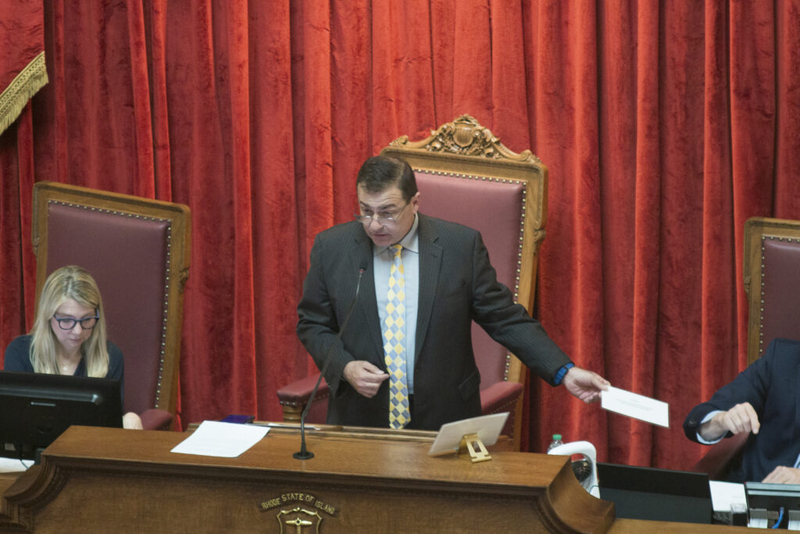
House Speaker K. Joseph Shekarchi is seen presiding over the House of Representatives during the 2024 session. (Photo by Alexander Castro/Rhode Island Current)
When House Speaker K. Joseph Shekarchi rolled out a 12-bill housing package in late February, he wasn’t thinking about one of his private law practice clients from four years ago.
But after Shekarchi got an email from a resident of Cranston’s Alpine Estates a month later, he questioned whether his day job might conflict with State House advocacy on a bill aiming to ease local restrictions on subdividing large parcels of land.
“I thought it would be prudent to ask the Ethics Commission if it was appropriate to vote on the legislation,” Shekarchi said in an email Wednesday.
Good news for Shekarchi: The state ethics panel determined there’s no ethical conflict between his housing bill and his former client, John Casale.
Because the Cranston developer is no longer Shekarchi’s client, there’s no way Shekarchi might benefit from the bill’s passage, concluded an advisory opinion written by the Rhode Island Ethics Commission’s staff. The nine-member panel voted unanimously to accept the opinion Tuesday, with one recusal and one member absent, to approve the staff opinion.
Shekarchi hasn’t represented Casale since 2021 in his battle with municipal officials to develop a few acres of empty residential land in western Cranston, and has been paid in full for his work, Shekarchi wrote in his request to the ethics panel. Shekarchi also wrote that he does not anticipate a future business relationship with the developer.
Therefore, Shekarchi is free to discuss, advocate for, and vote on the legislation, according to the ethics opinion.
Shekarchi in a statement Wednesday said he was “pleased” with the ethics panel’s determination.
Shekarchi is one of nine Democratic co-sponsors on the subdivision bill put in by Rep. Cherie Cruz, a Pawtucket Democrat. The legislation had an initial vetting before the House Municipal Government and Housing Committee on March 11, with a slightly amended version advanced out of committee in a vote on March 20.
A floor vote has not been scheduled as of Wednesday, Larry Berman, a spokesperson for House leadership, said.
There is also no Senate companion bill yet.
Shekarchi’s work representing Casale has ended, but the high-profile dispute over residential development is far from over, with an appeal filed by Casale now pending before the state Superior Court, according to news reports.
The pending legislation does not specifically name Alpine Estates or his former client, Casale. But if signed into law, the bill could help Casale win the legal battle by easing restrictions on subdividing “oversized lots.”
Casale could not be reached for comment Wednesday. Elizabeth Noonan, an attorney with Adler, Pollock & Sheehan representing Casale in the appeal, did not immediately respond to inquiries for comment.
Thomas Casale, John’s brother, who spoke on his behalf at municipal hearings on the development plans, declined to comment when reached by phone Wednesday.
“I don’t really have anything to do with that,” Thomas Casale said before hanging up.
The legislation authorizes municipal zoning officials to grant exceptions to local zoning rules on residential development, including subdivisions, as long as the changes reflect the surrounding neighborhood.
The proposal drew praise from housing advocates, including the Rhode Island Coalition for Housing Providers and Neighbors Welcome! Rhode Island, in written comments to the House Municipal Government and Housing Committee. Robert Azar, deputy director of planning and development for the city of Providence, also expressed written support for the intent of the legislation, but suggested a few tweaks.
No one from the city of Cranston or Alpine Estates wrote the House panel regarding the bill.
Cranston city planning staff initially agreed to the requested zone change, filed in 2019, that would let Casale divide four open lots into eight. However, the City Council initially rejected the zoning change in 2022. After signing a consent order noting that the zone change was consistent with its long-term comprehensive plan, the City Council in 2024 approved a second application for the same zoning change. However, Mayor Ken Hopkins vetoed the council’s approval, and the council failed to garner enough votes to override Hopkins’ veto, sending the dispute back to the courts, where it remains pending, according to news reports.
Hopkins declined to comment Wednesday.
Nicholas Hemond, the outside counsel representing the city in the development dispute was not immediately available to comment on Wednesday. Christopher Millea, city solicitor, also did not immediately return inquiries for comment.
Ethics Commission Chairman Lauren Jones recused himself from the commission’s vote Tuesday on the advisory opinion for Shekarchi. Commissioner Emma Peterson was absent from the meeting.
Updated to correct the name of the developer formerly represented by House Speaker K. Joseph Shekarchi in the Alpine Estates development proposal. Shekarchi formerly served as the lawyer for John Casale. The story was also updated to include a response from Cranston Mayor Ken Hopkins.
Providence, RI