RFK Jr. delivers youth screen time advisory while in Iowa for MAHA bill signing
May 20, 2026 | 6:46 pm ET
Description
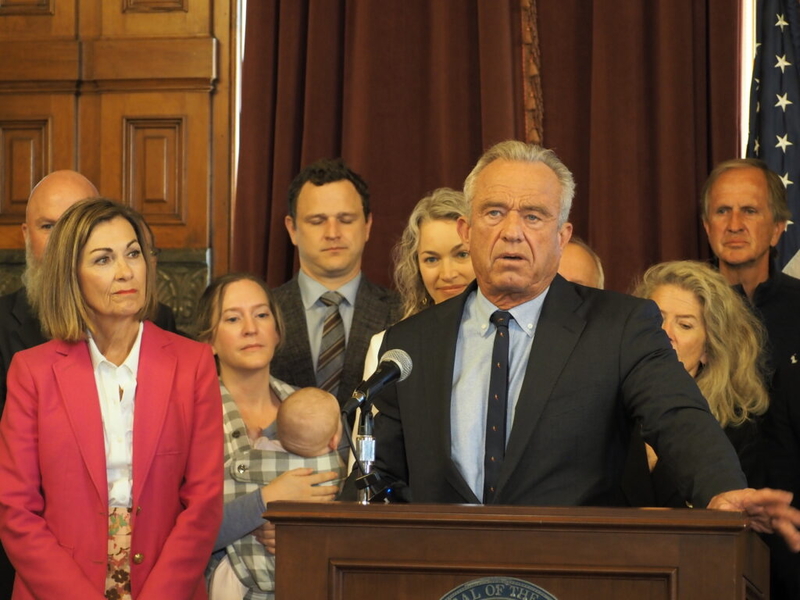
U.S. Secretary of Health and Human Services Robert F. Kennedy Jr. delivered remarks at the Iowa Capitol in Des Moines May 20, 2026 in support of Gov. Kim Reynolds signing into law a "Make America Healthy Again" measure. (Photo by Robin Opsahl/Iowa Capital Dispatch)
GILBERT — U.S. Health and Human Services Secretary Robert F. Kennedy Jr., in Iowa Wednesday, announced a surgeon general’s advisory on the harms of screen time for children.
He said states like Iowa that have implemented restrictions on cellphone use in schools helped chart the path on national guidelines around screen time for youth. He also joined Gov. Kim Reynolds as she signed legislation including a limit on digital instruction in schools.
The advisory, released alongside a “toolkit” providing tips and guidance for families, schools, healthcare providers and policymakers, specifically lays out guidance on creating a school cellphone policy. It is similar to the measure signed into law in 2025 by Reynolds requiring public K-12 school districts in Iowa set policies that at minimum ban the use of cellphones during class time.
Kennedy said during a news conference held at Gilbert Elementary School that “Iowa is leading the nation by taking decisive action to protect children’s health, including limiting excessive classroom screen time,” and the advisory is aimed at having more states and local communities take similar steps.
He called excessive screen use “among the most urgent public health challenges facing American children,” saying high use of cellphones and similar devices are correlated with children developing problems with their physical health, mental health, academic performance and social development.
“Our message to children is simple: life exists beyond the screen,” Kennedy said. “Children build confidence, imagination, resilience, and joy with nature, with books, through creativity and friendship, through conversations, and being full of human connections. Screens do often displace these experiences instead of supporting. Today’s advisory is not just a warning, it’s a call to reclaim childhood, lead our children to spend less time scrolling and more time living, less time isolated online and more time connected with family, or their community, to nature, or to real life.”
The advisory is a call to action, but does not set any specific policy mandates or restrictions on screen use in schools. However, Kennedy’s visit also came in conjunction with Reynolds signing House File 2676 into law — a measure that incorporates a number of health-related proposals into one package. The bill is referred to as the state’s “Make America Health Again,” or “MAHA” bill — referring to the national health-centered movement led by Kennedy.
One of the provisions in the law limits screen time through digital learning for students in kindergarten through grade 5 to one hour per day, with certain exemptions. Reynolds said the state departments of Education and Health and Human Services will work to develop these policies for school districts to implement, as well as looking at the impacts of screen time for digital education on students in grades 6-12.
“Not only are we limiting the digital instruction … we’re encouraging kids to get healthy, and we’re really refocusing our systems and the benefits on nutrition,” Reynolds said. “So it’s really an all-of-the-above policy that was included in the ‘MAHA’ bill, and its intent is to really help these kids get out there and experience life, communicate, enjoy each other.”
New law restricts food dyes, SNAP choices
The Iowa “MAHA” law includes measures requiring the state to continuously request waivers to the federal government to keep in place approved restrictions on purchasing unhealthy foods through the Supplemental Nutrition Assistance Program (SNAP), as well as through the federal Summer EBT program. It also requires Iowa medical school students to complete at least 40 hours of coursework on nutrition and metabolic health prior to graduation alongside continuing nutrition coursework to remain certified as a physician.
Reynolds thanked Kennedy at the bill signing as someone who “inspired the MAHA movement.”
“He has never wavered in his commitment to reform what’s broken across food, health, and scientific systems, and restore better health for Americans,” Reynolds said. “And, as you know, the time for action is now. … Iowa isn’t immune to the chronic disease epidemic that’s plaguing our nation. More than 37% of adult Iowans are obese, and sadly, so are 17% of our youth aged 16 to 17. Obesity significantly increases the risk of developing and worsening many chronic illnesses.”
There are also several policy pieces related to nutrition and exercise at Iowa’s K-12 schools. The law will ban certain food dyes and additives from school meal programs and vending machines, implement the Presidential Fitness Test in schools, and have K-5 students to have two hours of physical activity a week. It also requires the state Department of Education to apply for a waiver to the Federal Child Nutrition Act of 1966 to exempt sodium limits, whole grain requirements and fruit and vegetable variety stipulations, which Republicans said during floor debate in March is aimed at prioritizing regional food sources.
Additionally, the proposal allows the ivermectin, a drug used to treat parasitic infections that some sources claim can be used to prevent or treat symptoms of COVID-19, to be distributed over the counter by pharmacists.
Kennedy said the measure shows Iowa’s leadership on making changes to address an “existential crisis” in public health.
“Iowa is showing the country what bold public health leadership looks like by focusing on prevention, nutrition, physical fitness, and healthier lifestyles for the next generation,” Kennedy said. “… Decades of failed policy and perverse incentives transform one of the world’s greatest healthcare systems into a sick-care system that profits from illness instead of protecting health. But under President Trump’s leadership, HHS has delivered the most sweeping public health reforms in modern history in just 15 short months.”

Des Moines, IA