Resistance at the University of Michigan was supposedly dead — In fact, it’s spreading
Sep 29, 2025 | 8:00 am ET
Description
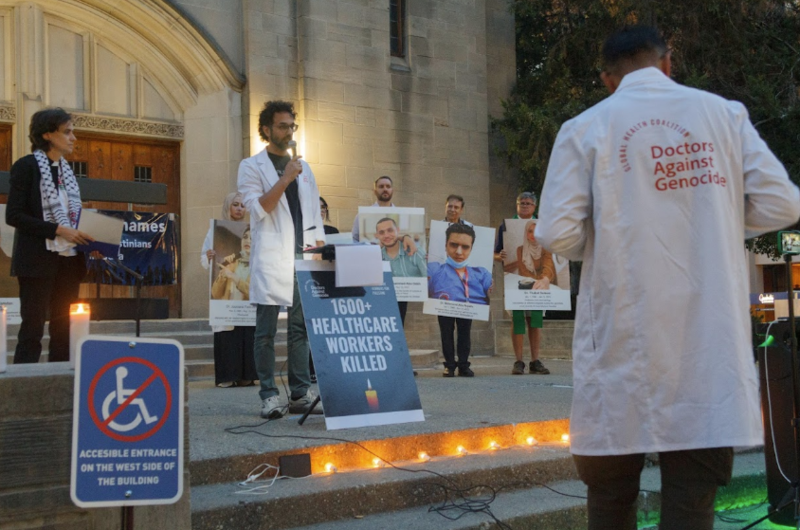
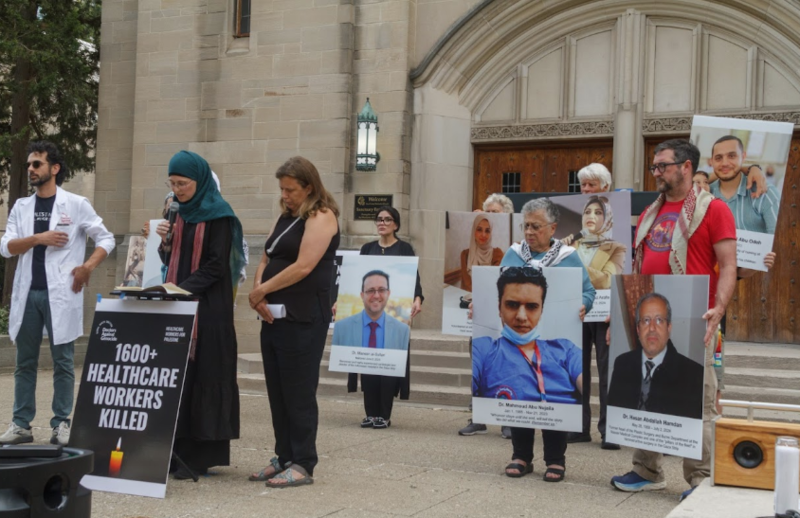
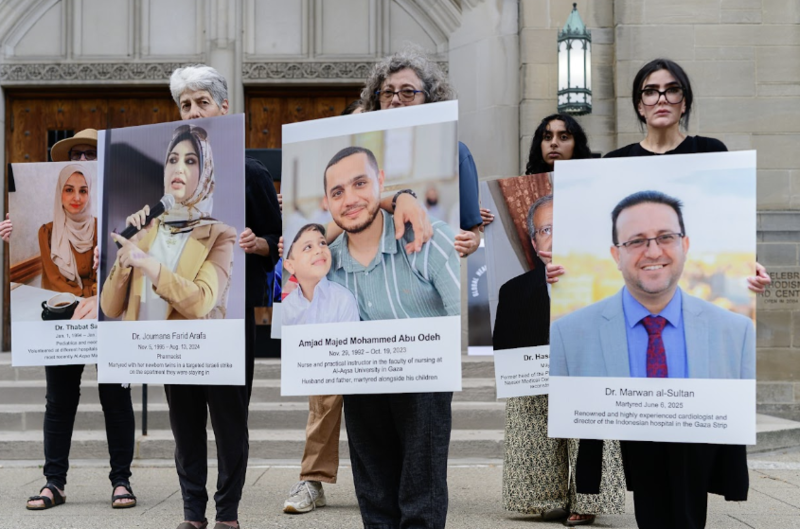
“They All Have Names: Remembering Palestinians Killed in Gaza” vigil organized by University of Michigan faculty and staff on September 19, 2025 in Ann Arbor, MI. | Photo credit L. Napier
At the University of Michigan, seven more charges were handed down last week against pro-Palestine students and alumni.
These latest disciplinary charges represent a decision by University of Michigan (UM) leadership to double-down on its strategy of seeking to repress campus pro-Palestine activism. Beginning in November 2023, when former University President Santa Ono called in police from multiple jurisdictions to barricade his office building against students seeking to meet with him, the University has sought to repress students calling for divestment from Israel rather than engaging with them.
This strategy of muscle over mediation was on full display in May 2024 during the forceful early morning police clearing of UM’s Gaza Solidarity Encampment, when students were sprayed with chemical irritants and their tents were ploughed by heavy machinery. In addition to being dragged through University disciplinary proceedings, student activists have been surveilled, banned from entering classroom buildings, followed off campus, and smeared in various all-university communications.
University of Michigan denounced for using private investigators to surveil student protesters
Most recently, the art exhibit organized by pro-Palestine UM student activists as part of a weeklong “Freedom School” was kicked off of University grounds by the University’s Division of Public Safety and Security.
Revealingly, some of those charged in recent months through the University of Michigan’s Office of Student Conflict Resolution (OSCR) and the new Office of Student Accountability (OSA) are members of the Encampment 11. These UM students and alumni successfully defeated Michigan Attorney General Dana Nessel’s political charges in May, but they are now facing disciplinary probation, suspension, and re-enrollment bans for actions that Nessel declined to prosecute. These actions by University of Michigan leadership not only chill expressions of dissent on campus, but discourage the moral conviction to call out a genocide that is unfolding before the entire world.
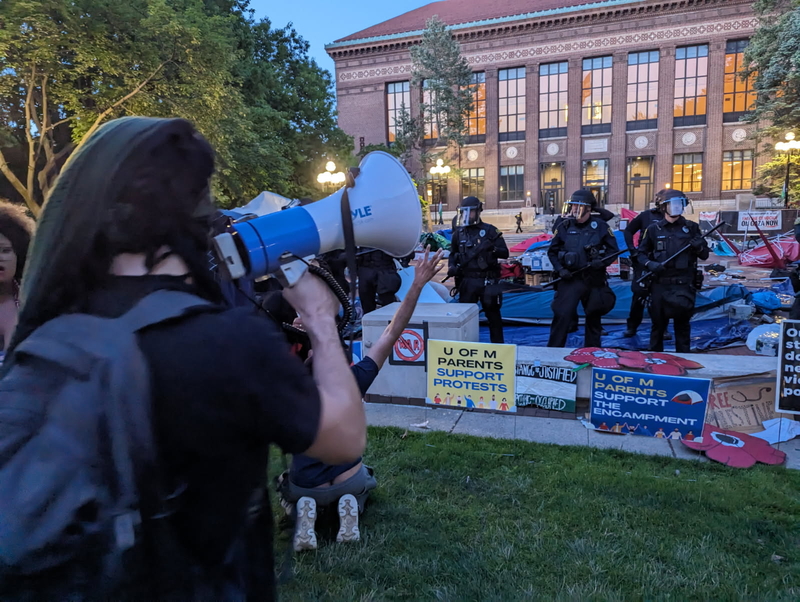
Yet even as the University sinks to new lows in its repression of pro-Palestine student activism, resistance is spreading on campus in subtle yet new and important ways.
Just last week, on September 19, University of Michigan faculty, staff, students, alumni, parents, and community members organized a vigil to honor the lives of Palestinian health workers. Standing across from the University’s Central Campus, vigil participants read the names, ages, and occupations of over 1,200 Palestinian health workers killed during the genocide in Gaza. Those reading names during the 4-hour vigil included a renowned poet and literary journal editor, a children’s book author, a senior faculty member in computer science and engineering, and the director of a local arts institution, among others.
Standing with the readers were faculty and staff who are active in a variety of campus labor unions and in faculty government. Representatives of local faith communities joined in solidarity with multi-religious prayer offerings.
And this spirit of resistance – against institutional efforts to direct public attention away from the genocide in Gaza – expanded and gained momentum on the University’s Ann Arbor campus over the weekend of September 20 and 21, when Doctors Against Genocide (DAG) convened its Second Annual Conference at the University of Michigan Medical School.
Throughout the two days of conference sessions, several hundred participating doctors and medical students explored strategies for anti-genocide awareness raising within medical institutions, discussed their own experiences of practicing medicine under conditions of genocide, and heard the live-streamed testimony of doctors providing medical care in Gaza amidst the massive Israeli military assault now underway.
Participants and visitors entering the lobby of the Biomedical Sciences Research Building encountered a massive three-dimensional model that visualized the destruction of all aspects of civilian life in Gaza. And alongside this cartography of genocide stood a wall of posters prepared by medical students that detailed the timeline of attacks on Gaza’s shelters, hospitals, universities, schools, cemeteries, archaeological sites, mosques and churches, fields and orchards, greenhouses, water wells, bakeries, and aid distribution sites.
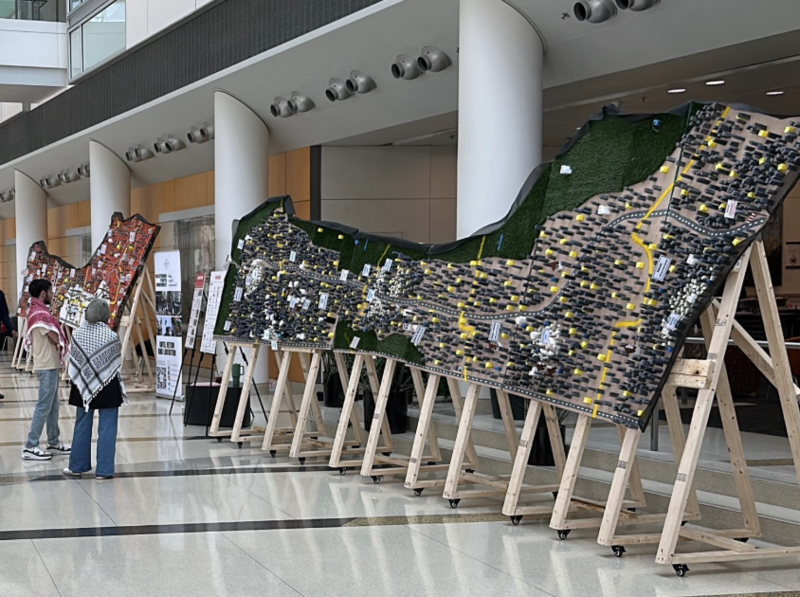
A key message of the conference was that the systematic destruction of Gaza’s healthcare sector has critical consequences for the population and is itself an instrument of genocide.
Medical doctors are generally not known for being overtly political. But Doctors Against Genocide has been on the forefront of raising public awareness about genocides in Palestine, Sudan, Congo, Tigray, and elsewhere. For two days, UM’s medical campus was invigorated by the presence of physicians wearing white coats with DAG’s red logo printed across the back, who had come together to share best practices in medical care and public advocacy for those suffering the catastrophic health consequences of the ongoing genocide in Gaza.
Equally significant is the fact that organizers of the vigil and organizers of the DAG conference worked together to plan their events. Medical faculty and medical students participated in the Friday evening vigil. Likewise, UM faculty and students from outside the Medical School participated in the DAG conference that took place over the days that followed.
This intentional effort to bridge the divide between the medical side of the University and the traditional faculties of literature, arts, sciences, as well as other professional schools is important, because it builds on the critical vote by the UM Faculty Senate in May 2023 to unite faculty governance across campuses, including the Medical campus, where Michigan Medicine employs a large share of clinical professors.
With the already-urgent situation in Gaza worsening and a U.N. Commission confirming that Israel has committed genocide against Palestinians, UM faculty are coming together in an effort to remind the entire University of Michigan community, including its top-tier hospital and Medical School, that we must act with intention and with courage before there are no more Palestinians in Gaza to protect.
This is not to suggest that UM faculty in the past have been silent. Over the past two years, UM faculty and staff have found various ways to criticize the University’s heavy-handed efforts to silence pro-Palestine student activists’ calls for university divestment.
For example, the University’s proposed “Disruptive Activities Policy” was widely condemned by faculty in March 2024, who criticized it for targeting student activism and curtailing First Amendment rights. The following semester, more than 1,300 faculty voted in November 2024 to pass a Faculty Senate motion censuring the University of Michigan Regents and calling on them to “cease the use of surveillance, policing, physical violence, and legal power as mechanisms to silence speech.”
Over the past two years, the UM Ann Arbor Chapter of the American Association of University Professors (AAUP) has repeatedly issued statements critical of the University’s actions to curtail pro-Palestine student activism on campus. Moreover, as State Attorney General Nessel’s office moved forward with prosecuting student activists, faculty and staff participated individually in court support. And University of Michigan Faculty & Staff for Justice in Palestine (FSJP) was established with the explicit aim of providing support to pro-Palestine student activists facing repression.
Yet at the beginning of this academic year, something different is happening. The jointly organized vigil and DAG conference indicate a growing awareness among UM faculty that their role need not be confined to supporting students. Indeed, UM scholars and clinicians alike are coming to understand that they have their own role to play beyond supporting students. Faculty feel empowered in a new way to channel their own skills and training towards the task of calling out the University’s silence – and thus its complicity – concerning the ongoing genocide in Gaza.
This represents a new approach for faculty in terms of how they understand their roles, both professionally and as citizens, in relation to the genocide in Gaza. It suggests that the sort of faculty-led resistance that took place earlier this year in leading opposition to the closure of the University’s Office of Diversity, Equity, and Inclusion might be spreading into new areas. In both of these examples, faculty mobilized around their vision of what the University’s mission entails, regardless of what central administration asserts it to be.
Prayers and a solemn reading of names may not be what people initially think of as resistance. However, at a time when violence and repression seem to be worsening, and even the mention of Palestine or genocide draws ire, creating the discursive space on campus to collectively bear witness to the sacrifice of doctors saving Palestinian lives is momentous. In the present moment of unprecedented attacks on higher education, insisting on a set of values for the university community to uphold and then putting those values into practice is at its core an act of resistance. We need more of this kind of resistance.
Lansing, MI