Researchers stress case-by-case approach when evaluating Michigan data center deals
Jul 08, 2026 | 5:58 pm ET
Description
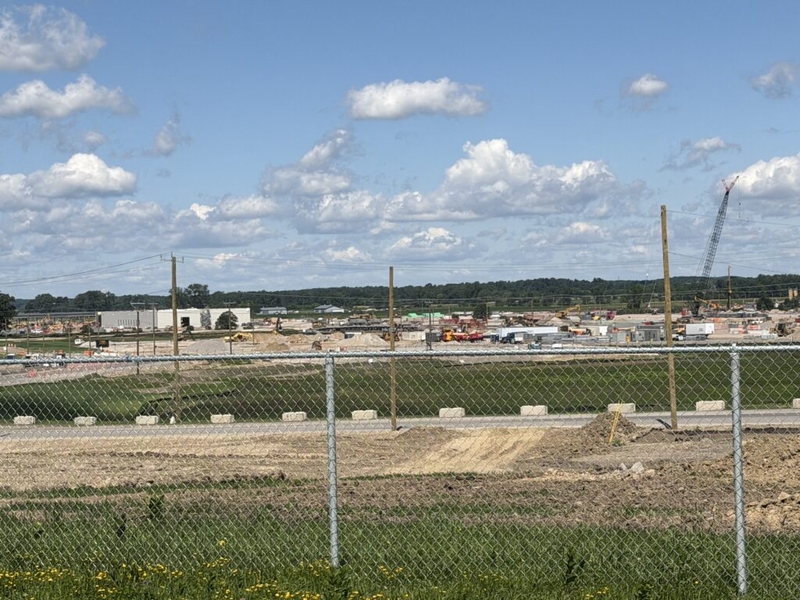
Construction underway on Related Digital's hyperscale data center in Saline Township, Michigan. June 20, 2026. | Photo by Jon King/Michigan Advance
Data centers have become a contentious issue across Michigan, as environmental concerns, skepticism toward Big Tech and arguments on local control sit at odds with job predictions, economic growth and the often promised opportunity for Michigan to participate in the economy of the future.
However, analysts at the Citizens Research Council of Michigan are urging data center boosters and opponents alike to step back and examine these projects on a case-by-case basis.
The privately-funded, nonpartisan public affairs research organization released a report in June examining the controversies around hyperscale data center development in the state. During a Wednesday webinar, Eric Paul Dennis, a research associate focused on infrastructure policy, broke down the findings, emphasizing that not all data centers are created equal.
Data center development is moving forward at an unprecedented scale, Dennis said, with some tech companies working to expand the digital infrastructure supporting services like email, streaming and e-commerce while others invest heavily in AI tools and large language models.
However, not all data centers are large-scale AI factories, Dennis said, noting that there are dozens of smaller facilities that have operated in the state for years.
While the report focuses on hyperscale facilities, Dennis cautioned against equating these facilities with other, smaller projects which can provide server support for multiple businesses.
Dennis noted that states with a sales and use tax exemption for data centers, or no sales and use tax at all, are typically targets for data center development.
“Much of Michigan and other states’ objective in providing tax exemptions, such as this, is the idea that these investments will prompt future investments and some kind of long-term tech industry economic base,” Dennis said. “Evidence suggests that doesn’t typically happen.”
While hyperscale data centers can be a boon for construction firms, subcontractors and laborers, there aren’t many jobs once the facility is completed, Dennis explained.
Additionally, data centers are not business magnets, Dennis said, noting that data centers do not require the services or supply chain that a large industrial facility might.
“The best analogy that I’ve been able to come up with is that they’re kind of like an oil field, they are a site of extraction producing a commodity, potentially for global export,” Dennis said. “In this case, that commodity is data, which can be exported at near light speed, assuming sufficient bandwidth.”
While there can be regional bottlenecks on the internet, there’s very little reason for businesses to locate in the same city or even the same state as the data center they are connected to, Dennis said.
When you get a data center, you’re typically just getting a data center, he said.
Weighing the economic trade-offs
However, local governments could see tax benefits from these facilities, Dennis said, noting that even with the partial tax breaks these facilities receive, the revenue could be a game changer for some communities.
It’s also typical for localities to negotiate community benefits agreements alongside property taxes or payments-in-lieu of taxes, which could also support a local government’s fiscal health, Dennis explained.
Regarding concerns about how hyperscale data centers impact energy rates and electrical reliability, Dennis noted that these facilities are hooked into the transmission energy grid, whereas residents and small businesses use the distribution grid.
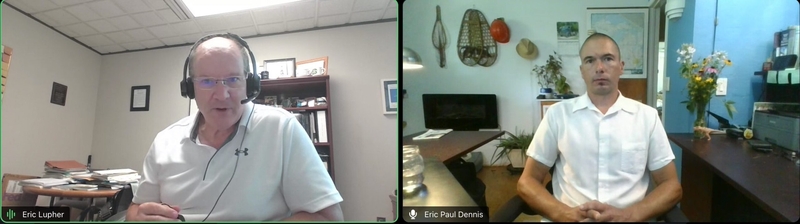
Eric Paul Dennis, a research associate focused on infrastructure policy. July 8, 2026 | Screenshot
When regular citizens’ power goes out, it’s generally a distribution grid failure, whereas the transmission grid is well-protected from storm damage and is overseen by regional transmission organizations, Dennis said. These organizations hold regulatory authority and work with the North American Electric Reliability Corporation, the Federal Energy Regulatory Commission as well as state public utility commissions and the energy companies themselves to maintain reliability.
While there have been instances of data centers creating issues for the distribution grid, they have yet to cause a failure, Dennis said.
Additionally, the North American Electric Reliability Corporation has issued a level three alert to ensure reliability on the broader energy system as large-load facilities come online. The corporation has also offered voluntary guidelines for allowing large users onto the grid while maintaining grid stability.
“We should acknowledge that reduced reliability on the grid is a risk, but I think the regulators are on top of this,” Dennis said.
While increased electrical costs from data centers are also a risk, Dennis said it’s unlikely that Michigan will see those concerns realized.
If a utility has a large customer consuming a lot of energy and generating significant revenue, the energy company can apply that revenue to its fixed costs of energy production, which reduces the cost burden on other ratepayers, Dennis explained. Data centers could also further reduce energy rates, compared to other large-load users, if they agree to be flexible and reduce their energy use when the grid is near capacity.
Alongside the overlapping regulatory structure overseeing energy utilities, there are also incentives for companies to get things right, and contested case processes where groups can intervene and give their input, Dennis said. Although there is a risk of data centers raising energy costs, it is manageable, he said.
Water, noise and heat remain key questions
When looking at the amount of water data centers consume, Dennis said he did not see much risk for the state.
Under a worst-case scenario, a hyperscale facility could use 10 million gallons of water per day. Dennis said. While this would be problematic for a water-stressed region, he said that is not a concern for most of Michigan.
In 2024, the state consumed 450 million gallons a day, marking a 25% decrease from the water it used and lost in 2020, Dennis said, noting it would take 10 of these worst-case-scenario facilities to bring the state back to its 2020 level of consumption.
There is a caveat when it comes to sensitive watersheds that have been, or could be depleted with unsustainable withdrawals, Dennis said. He noted, however, that regulations are in place, with the Department of Environment, Great Lakes and Energy assessing new withdrawals of more than 100,000 gallons per day.
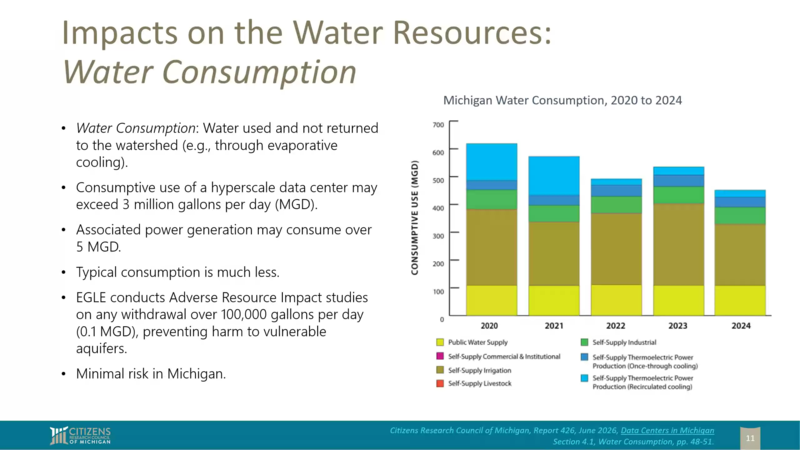
“If one were found to be problematic, it would not be permitted,” Dennis said. “So we have regulatory frameworks in place to protect our waters, and data centers are receiving extra scrutiny, so I don’t see much risk with water consumption.”
For Dennis, the biggest issue he could find with the facilities was the threat of noise pollution, explaining that the way noise is traditionally studied discounts the lower frequencies emitted by data centers.
“There are more and more frequent complaints about data center noise from facilities that aren’t technically violating any ordinance,” Dennis said. “And I don’t think this is people just finding a reason to be upset. I think that many ordinances truly are not sufficiently protective.”
Dennis also pointed to another potential concern in the form of a “data heat island effect” citing a study that has yet to be peer-reviewed that found that waste heat data center operations contribute to higher land surface temperatures in the surrounding area, with an average increase of about 3.5 degrees Fahrenheit.
While the study has been challenged, Dennis noted that two other studies on the topic using different methodologies also found evidence of localized warming tied to data center operations.
“I expect this will become an active area of research very soon, if it hasn’t already. At the moment, I can’t say how big of a deal this is,” Dennis said, concluding that more research is needed.
Lansing, MI