Republicans in CD1 clash over who would best preserve the Trump agenda
Jun 25, 2026 | 9:27 am ET

Description
Former state Rep. Joseph Chaplik, former Cardinals kicker Jay Feely and John Trobough participate in the 2026 AZ Clean Elections primary debate for the 1st Congressional District at Sneaky Big Studios in Scottsdale on June 24, 2026. (Pool photo by Diannie Chavez/The Arizona Republic)
Republican candidates vying for the chance to represent Arizona’s 1st Congressional District sought to convince voters that they’re the best choice to preserve President Donald Trump’s agenda and keep the party in power in the nation’s Capitol during a Wednesday night debate.
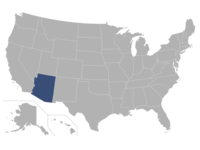
The district is one of the state’s wealthiest, spanning Scottsdale, Paradise Valley and Fountain Hills. It’s also among the most competitive and has in recent years been a top priority for Democrats hoping to claw back control of Congress. U.S. Representative David Schweikert, who currently represents the district and has served in Congress since 2011, won his last election against Democrat Amish Shah in 2024 by a narrow margin, netting 52% of the vote to Shah’s 48%. Last year Schweikert chose not to seek reelection and instead launched a campaign to unseat Gov. Katie Hobbs, a Democrat.
Running to replace Schweikert are former state lawmaker Joseph Chaplik, who represented Scottsdale in the Arizona House of Representatives for six years, former Cardinals kicker Jay Feely, who won Trump’s endorsement, and businessman John Trobough. Feely’s endorsement from the president puts him ahead of the pack, but Chaplik isn’t far behind, benefitting from his time in office to pull in a groundswell of local support.
Who’s who: legislative know-how, Trump ally and Tech CEO
To differentiate themselves from each other, the trio pointed to their professional backgrounds, arguing that their unique experience and connections would help them make gains for Arizona in Congress. Chaplik highlighted his legislative experience, saying his participation and frequent leadership of committees has prepared him for similar work in Washington, D.C.
“I can hit the ground running in D.C. with that experience,” he said.
Chaplik pointed to his support of legislation that enshrined a flat income tax, expanded school choice vouchers, and prohibited mask mandates as proof of his conservative bonafides and ability to get laws passed.
Feely, meanwhile, repeatedly referenced his close friendship with Trump to convince voters that he has a direct line to the White House which he could leverage to make inroads for Arizonans. And he sought to bill himself as a dedicated conservative, invoking Charlie Kirk as part of the inspiration for his campaign and likening his willingness to listen to opposing viewpoints from constituents to the Turning Point USA founder, who after his assassination has been hailed by conservatives as a champion of free speech.
“Who can call (President Trump) and get him to answer? That’s me,” Feely said, when touting his ability to make progress on water policy. “He will take my call and he will listen. I have the ability to get the ear of the president.”
Troubough set himself apart from his rivals as someone knowledgeable about economic pressures and the technological landscape, which he billed as critical to advancing the right legislation to move Arizona and the country forward. The former tech CEO especially sought to distinguish himself as better able to handle the regulation of artificial intelligence as the country grapples with getting a jump on the technology while at the same time limiting its impacts on the local electric and water supplies.
Inflation: immigration and Biden to blame
The trio waved away concerns over the country’s high inflation rates, shifting the blame onto the Biden administration and immigration. The economy and inflation are top of mind for voters going into the election season, and Democrats have worked to hammer Trump for record-high inflation rates. In May, inflation spiked to a level not seen since 2023, worsened in part by the ongoing war in Iran, according to experts, but Trump and his allies have played down the issue.
Feely criticized Democrats who campaign on the affordability crisis as “ridiculous” and “hypocritical,” saying that the fault for the country’s struggling economy lies with them because of Biden-era policies that allowed immigrants to remain in the country while their legal cases moved forward.
“Now these people are here, and they’re buying homes and they’re renting homes and they’re driving up the costs,” he said. “They’re on SNAP and driving up the costs of groceries.”
The vast majority of people who receive help from the Supplemental Nutritional Assistance Program, formerly known as food stamps, are U.S. citizens. Data from the U.S. Department of Agriculture for 2023 found that 89% of SNAP recipients were citizens, and only 11% were foreign-born. Few categories of immigrants are eligible to apply for SNAP, including refugees, asylees and lawful permanent residents.
Troubough agreed that immigration was to blame for the country’s skyrocketing inflation and Chaplik praised the Trump administration’s hands off approach, saying that allowing free market competition would eventually push inflation downwards.
“Inflation has skyrocketed in those four years of the Biden administration and it takes time to bring the inflation down,” Chaplik said.
Feely called for slashing housing regulations to make homeownership more affordable. And Chaplik and Troubough both said that addressing the country’s deficit would help resolve inflation rates. Chaplik said reducing “bloated” government would be one way to cut down on the national deficit and advocated for lowering taxes to keep more money in people’s pockets. But Troubough countered that lowering taxes won’t make a dent in the national debt without also reducing spending on services.
“We turn around as Republicans and we cut taxes but then we turn around and we don’t reduce our spending,” Troubough said. “We do not have a revenue problem, we have a spending problem. We need to get our spending in line with the services that we want to offer to our citizens.”
Candidates juggle support for ICE and Trump’s deportation agenda with potential legal immigration reform
The candidates each firmly sided with the Trump administration’s approach to immigration enforcement and called for strengthening border security while at the same time carving out moderate stances on immigration reform.
Chaplik said he is in favor of opening up labor force opportunities for immigrants, but said his priority would be to first “thin out” criminals among immigrants already in the country. He said he would be open to revisiting the country’s legal immigration system and addressing the Deferred Action for Childhood Arrivals program, but also said he believed anyone who crossed the border without authorization should be punished.
“If you’ve crossed over our border, you’re illegal, you have already broken the law,” he said.
He added that he supports the work of U.S. Immigration and Customs Enforcement despite the public criticism the agency has weathered in the wake of the fatal shootings of Renee Good and Alex Pretti in Minnesota.
Trobough said he would support a seasonal immigration program and restructuring the country’s legal immigration system into one that’s merit based. He noted that he supports the DACA program as one way to address the country’s labor shortage.
“We need to come up with smart immigration if we are going to fuel our economy and maintain our leadership as the global power,” he said.
Feely blamed Democrats for funding the protests that resulted in the killings of Good and Pretti and criticized calls to abolish ICE in the aftermath as too extreme.
“The Democrat Party is paying for those protestors to go there and to interact with ICE and try and get a reaction, to try to get something that we saw happen unfortunately up in Minnesota,” he said. “No one wants to see any American lose their life interacting with ICE but we have to be honest about this evidence.”
The evidence-free claim that Democrats and progressive groups are paying protestors is frequently voiced by Republicans as a way to dismiss public criticism of the Trump administration.
When questioned about his views on legal immigration reform, Feely shared a story about his family’s decision to help a Haitian man apply for an education visa in the U.S. Chaplik recently pointed to pictures of Feely with the man on social media as proof that he supports illegal immigration. But Feely clarified on Wednesday that people can be “ardently against illegal immigration while still loving immigrants.”
“The legal immigration process needs to be easier,” Feely said. “But the illegal immigration process and the border has to be completely secure.”
Should data centers be built in Arizona?
While the technology industry pushes to make artificial intelligence more mainstream and lobbies for data centers across the country to support that goal, much of the public, including in Arizona’s 1st Congressional District, has been opposed to data centers near their homes.
Troubough, Feely and Chaplik all agreed that the country should invest in artificial intelligence to bolster its defense ability and maintain its place in the world order, especially to fend off competition from China. But the trio differed on whether CD1 should be the landing hub of such efforts.
Troubough and Feely both said Arizona needs to host data centers, saying that the benefits outweigh the costs and claiming that much of the backlash is based in misinformation. Troubough added that the Congress should regulate artificial intelligence with a “light hand” so as to not stifle innovation.
“You can create (data centers) and have them without adding to the cost of the local consumer,” Feely said. “They should be investing into the local areas, driving down the costs for the local consumer, they should make sure that they’re using recirculated water.”
Chaplik, by contrast, said he supports the creation of data centers and the continued advancement of artificial intelligence but said he is against building data centers in the district because residents oppose doing so, and added that he is for regulating artificial intelligence to prevent the spread of misinformation, including during political campaigns.
“The people of this district do not want data centers right next to their homes. We have plenty of land to build it,” Chaplik said, noting that there are other, less populated areas in the country they could be better placed.
A sidebar on the 2nd Amendment
Feely was briefly given an opportunity by moderators to defend himself against accusations leveled by Chaplik’s campaign that he opposes Arizonans’ Second Amendment rights. He noted that his views on the issue have changed since his time playing in New York after he moved to Arizona and began shooting guns with friends. He added that he was persuaded of the importance of the right to bear arms during the Black Lives Matter movement and the COVID-19 pandemic, when he was convinced that the government was willing to take away people’s civil liberties. Feely said that at that time he and his neighbors saw their neighborhood on a list that was going to be “attacked” and armed themselves in advance.
“Our neighborhood was on this list that they were going to attack next and so we stood in defense of our homes and walked around our development with our guns to make sure that our homes didn’t get attacked,” he said, chuckling.
Voter ID laws, mail-in ballots
Public trust in elections was also a topic of discussion, hours after Trump scuttled a plan to sign bipartisan housing affordability legislation until Congress approves the Safeguarding American Voter Eligibility Act. Known as the SAVE Act, the proposal enshrines voter ID and citizenship verification requirements and it’s long been a priority for the Trump administration, which has advanced evidence-free claims that noncitizens vote.
Each of the candidates said they would support the SAVE Act and expressed misgivings about the state’s current election procedures, calling for quicker results and casting doubt on how election officials handle ballot tracking and verification processes. Arizona already requires voters to provide proof of citizenship to vote in local elections.
Chaplik went further, saying he favors significantly limiting the ability of Arizonans to vote by mail and returning the state to a precinct-style voting.
“We should go back to one day voting, and if you can’t vote on that one day we should have absentee ballots. Now we have all mail in ballots and mail in ballots I don’t believe in,” he said.
Trobough, however, declined to oppose voting by mail, noting that Arizona has a sizable community of retirees who favor doing so.
The vast majority of Arizona voters use no-excuse vote by mail, which was first implemented in the state in 1991.
In their final remarks, the Republican candidates framed the upcoming election as critical for keeping Democrats away from the levers of power and urged voters to back someone who would work toward preserving and advancing Trump’s political priorities.
“The most important thing is making sure we keep the House, and making sure that we can codify what President Donald Trump has done,” Feely said, which he had warned earlier could be undone by a future administration unless Congress enshrines it in law.
Phoenix, AZ