Public worker health plans poised for another year of premium hikes
Jul 08, 2026 | 4:33 pm ET
Description
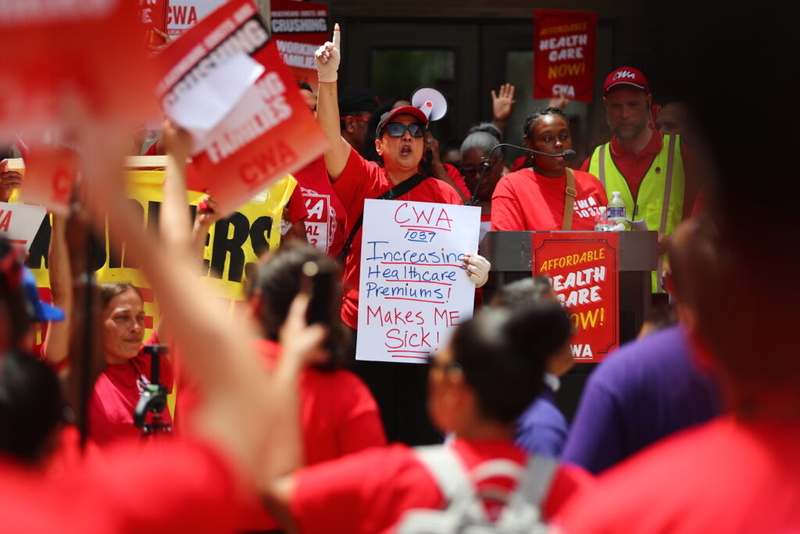
Hundreds of public workers rallied outside the Statehouse in Trenton on June 18, 2026, to demand lawmakers rein in rising healthcare costs. (Photo by Dana DiFilippo / New Jersey Monitor)
Premiums under New Jersey’s public worker health plans should rise by double digits, with current and former local government workers again poised to face the steepest increases, state officials learned Wednesday.
Premiums for local government workers should increase by 17.3%, with a 15.1% increase for their counterparts in state government, actuaries from Aon told the State Health Benefit Commission Wednesday.
Retirees on the local side face even larger premium hikes. The rates paid by early retirees on the local government plan should rise by an average of 36.5%, Aon said, while Medicare retirees on the same plan should pay 19.3% more on average in 2027 than they have in 2026.
Premiums for state government workers who retired early should rise by 17.6%, while the state government’s Medicare retirees should pay 4% less for health insurance premiums than they have in 2026, Aon said.
The proposed increases, which are expected to come to a vote in September, are the latest in a series of large hikes that have imperiled the future of New Jersey’s state-run health insurance plans for local governments and schools and that, last year, prompted a warning from the Treasury that the local government program had entered a “death spiral” that the schools plan threatened to follow it into.
“Quick action is needed before September, otherwise the death spiral will continue and worsen, making the plan unaffordable for employees and taxpayers alike,” the New Jersey League of Municipalities, Conference of Mayors, and Association of Counties said in a joint statement Monday.
This year’s projected increases, which follow years of double-digit hikes, come on the heels of agreements meant to limit cost increases by boosting copays for GLP-1 weight loss drugs, limiting out-of-network coverage, and raising the share of health care visit costs workers are responsible for, among other things.
Those changes took effect July 1, and they are reflected in actuaries’ newest projections.
Those reforms included the introductions of new high-deductible and tiered-network plans that carry lower premiums but greater cost sharing and were meant to lower expenses for younger, healthier workers who are less costly to insure and who have fled local government plans amid recent cost increases.
Though those plans did lower costs compared to New Jersey’s generous legacy public worker health plans, actuaries warned that sicker workers with high health care needs — and costs — had joined them in larger than expected numbers.
“The people who have historically enrolled in those options are the lowest utilizers, right — people who don’t generate claims — so the premiums reflected an assumption that that utilization value was reflected in the premiums,” Tappe said. “With all of the, what I’m going to call, incentivized migration into those options, it’s broken the typical utilization mechanisms.”
As a result, premiums for those health plans should rise faster than for legacy alternatives though the new plans’ overall premiums would remain lower. For example, premiums for medical coverage on the local government tiered-network plan for active workers should increase by 30.8% compared to 11.6% for their HMO plan, actuaries said.
Risk has grown
As in past years, the increases recommended for local government workers are higher because those plans’ pool of workers has grown increasingly risky as municipalities and counties with younger, healthier workforces leave for cheaper options in the private market.
Once those workers leave — the local plan’s headcount fell by 25% going into 2026, Tappe said — the insurance pool becomes riskier, prompting more increases that in turn prompt more departures, a vicious cycle called adverse selection.
Representatives for the Communications Workers of America, New Jersey’s largest public-sector union, said policymakers should examine hospital pricing and the practices of the plans’ third-party administrators to control costs rather than look to more rate hikes.
“Another double-digit increase isn’t a solution,” said Rebecca Miller, legislative director for CWA District 1. “It’s a failure to actively manage the plan. The old playbook keeps shifting costs onto workers instead of taking on the hospitals and insurers driving these numbers. We have never accepted that and won’t start now.”
This year’s local government increases are largely a result of additional hikes needed to rebuild the program’s reserves and repay loans it took from the state workers’ plan to remain solvent in 2025. The local plan is expected to owe about $90 million, of the $150 million borrowed, at the start of 2027.
Those factors account for about 11.3 percentage points of active local government workers’ increases and 34.5 percentage points of the increases for local government retirees.
That doesn’t mean costs for the plan didn’t increase, Tappe said. Last year’s rate increases also included a buffer to repay the loans and rebuild reserves, but higher-than-expected costs left retirees’ reserve at a deficit and the active workers’ plan with enough funds to cover less than two weeks of claims.
Though the plans have historically targeted reserves equal to two months of claim costs, actuaries are recommending only one month of buffer for the local plan to forestall even steeper increases, like an average 27.5% hike for active local government workers.
Separately, language in the budget Gov. Mikie Sherrill signed last week calls for a separate committee that sets plan coverage rules to make changes that would lower the public plan’s costs by $75 million in the first six months of 2027, or $150 million across the full calendar year.
At the same time, Sherrill signed legislation that would allow the School Employees’ Health Benefits Program to issue loans from its retiree plans to those used by its active workers if plan reserves fall under 10 days of costs, but top Democrats have acknowledged that measure, like the loans issued to the local government workers’ health plan, is a stop gap.
“That is not the long-term solution to this, and yes, I think there’s a commitment on all of our parts — the governor’s, the Senate, and certainly the Assembly — to try to work through making real meaningful changes because we’ve reached the point where it’s just so damn expensive that it necessitates that we get something done,” Assembly Speaker Craig Coughlin (D-Middlesex) told the New Jersey Monitor last week. “We just have to.”
Actuaries are set to reveal their rate recommendation for school employees’ plan on July 27.
Trenton, NJ