Proposed Alabama constitutional amendment would ban naturalized citizens from state office
Oct 31, 2025 | 8:01 am ET
Description
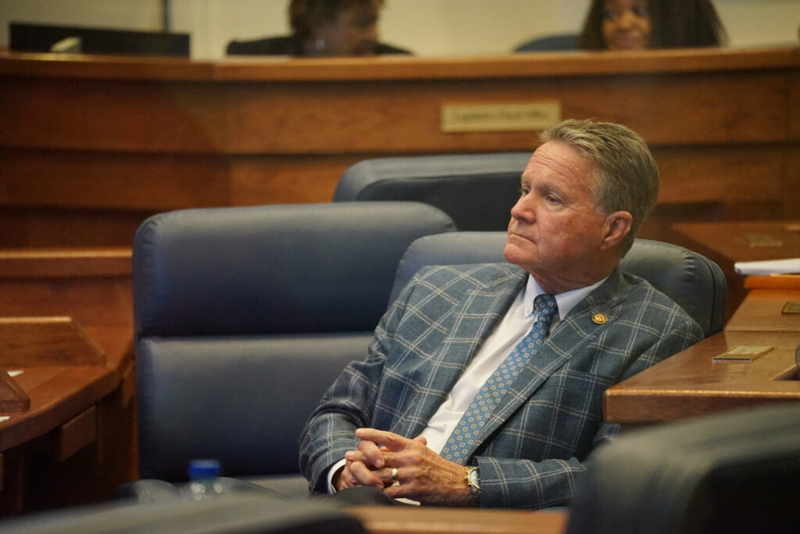
Sen. Donnie Chesteen, R-Geneva, listens to a debate in the Alabama Senate on March 18, 2025 in Montgomery, Alabama. Chesteen is sponsoring a constitutional amendment for the 2026 Legislative session that would require state office holders to be natural born citizens of the U.S.(Alander Rocha/Alabama Reflector)
An amendment filed for the 2026 session would ban naturalized citizens from holding many political offices in the state.
SB 21, sponsored by Sen. Donnie Chesteen, R-Geneva, would require candidates for most political offices to be “natural born citizens” of the United States. Those offices include governor and lieutenant governor; state legislators, civil and criminal judges, attorney general and secretary of state, and local sheriffs and district attorneys.
Chesteen said in an interview Thursday that he is not worried about constitutional challenges, despite the Fourteenth Amendment guaranteeing equal protection to all citizens, naturalized and native-born.
“The language in the bill speaks for what it’s trying to accomplish,” Chesteen said. “I don’t want to make this anything more complicated than it is.”
According to the American Immigration Council, about 77,300 Alabama residents were naturalized citizens in 2023, about 1.5% of the state’s population.
The amendment came from Secretary of State Wes Allen, Chesteen said. Currently, the only office that requires a candidate to be a natural-born citizen is President of the United States. Allen said in a release Monday that the requirement should apply to state government officials.
“For the same reasons our founding fathers sought to ensure that our nation’s leader was a natural born American citizen, we believe the same standard must be required of those operating in the highest levels of our state government,” Allen said.
Currently, Alabama law requires the governor and lieutenant governor to be U.S. citizens for 10 years; the secretary of state, treasurer, and commissioner of agriculture for seven years; and state lawmakers for three years, according to the bill. Other constitutional offices do not have a specified length of citizenship requirement.
No state requires all constitutional office holders to be natural born citizens. Chesteen wants Alabama to be the first.
“I don’t think it’s ever been challenged before. There’s a first time for everything,” Chesteen said. “We’ll try to move the bill through the legislative process. If it’s challenged, it’s challenged.”
Until a repeal in 1955, Maine required its governor to be a natural born citizen. It was amended to require U.S. citizenship for 15 years.
Only one immigrant has served as Alabama governor. Robert Lindsey, who was born in Scotland and came to the United States when he was 20, served as governor from 1870 to 1872.
While nobody is entitled to a right to hold office, every citizen has the right to run for office under the Equal Protection Clause of the Fourteenth Amendment, according to a University of Pennsylvania law review.
The review quoted a 1969 U.S. Supreme Court case that originated in New York, 1969 Kramer v. Union Free School District No. 15.
“Statutes granting the franchise to residents on a selective basis always pose the danger of denying some citizens any effective voice in the governmental affairs which substantially affect their lives,” the opinion said. “Therefore, if a challenged state statute grants the right to vote to some bona fide residents of requisite age and citizenship and denies the franchise to others, the Court must determine whether the exclusions are necessary to promote a compelling state interest.”
Pam Karlan, a professor of law at Stanford Law School, said in an interview Thursday that beyond the unconstitutionality of the proposal, there is a question of what a natural born citizen is. People born in Indian tribes are considered citizens at birth since a law passed in 1924, she said, as well as children born outside the country to parents who are U.S. citizens.
“As a matter of morality and policy, this is a truly evil proposal, because some of some of our most distinguished citizens over time have been people who were immigrants to the United States,” Karlan said. “This idea that even if the people of Alabama think that one of these people who’s an immigrant would be the best governor or be the best state legislator, they’re prevented from voting for this person by this law that says, well, because you weren’t born here, your citizenship is not good enough. It’s really kind of staggering.”
She said that regardless of what type of citizenship somebody has, they are protected equally under the Fourteenth Amendment and seen as citizens of the U.S.
“I don’t see the constitutional argument for why it is okay to treat these groups differently,” Karlan said. “On top of that, I don’t see any normative argument for why you would want to treat them differently, other than, to my mind, nativism. That is really quite inconsistent with American values.”
If 60% of both houses of the Legislature approves the bill, it must get a majority approval from voters to be added to the Alabama Constitution. Currently, the Republican party holds 71% of the Legislature in both chambers. Chesteen said he has talked with the Republican caucus and the members are supportive of the bill.
“It could be a challenge working the bill through both sides of the aisle, but we’ll get to work on it in session,” he said.
The 2026 Legislative session begins in January.
Chesteen said he has concerns about naturalized citizens in other states running for office, but did not specify who or which offices. He said he is not aware of any such candidate in Alabama.
Montgomery