Prison deaths ignite GOP criticism of Arizona corrections chief’s reforms
Aug 27, 2025 | 1:43 pm ET
Description
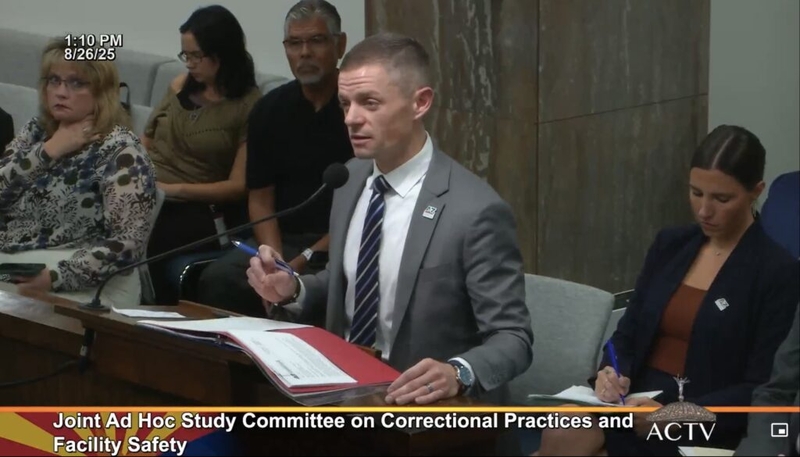
Arizona Department of Corrections, Rehabilitation and Reentry Director Ryan Thornell testifies on Aug. 26, 2025, before a legislative panel investigating violence in Arizona prisons. Screenshot via ACTV/azleg.gov
At least 11 inmates have been killed in Arizona prisons since January of last year, a spate of violence that drew harsh condemnations from Republican lawmakers on Tuesday during a public hearing scrutinizing whether changes implemented by the state prisons chief are to blame.
The legislative inquiry was prompted, in part, by the brutal murder of three men at the Tucson Prison Complex in April. The man accused of killing them, Ricky Wassenaar, had been moved out of maximum security conditions only a year prior, despite holding two guards hostage for 15 days in an escape attempt at a Buckeye prison in 2004.
Republican lawmakers pointed to the Tucson murders and the overall spike in inmate deaths as proof that the state corrections department is being mismanaged. Rep. Kevin Payne, the co-chair of the study committee on correctional practices and facility safety, said he has been contacted by multiple prison staff members about reforms that they believe are contributing to the department’s death rate.
“‘Since the appointment of Director (Ryan) Thornell, the department has gone far left,’” Payne read aloud to the committee from one letter. “The spirit of DEI is alive and well, but officer safety is gone. Max custody inmates have been placed into open yards and we are told things will get worse before they get better. Well, now people are dead. How much worse do things need to get?”
Past employees, advocates voice speak out
Over the course of a nearly five-hour long debate, lawmakers heard testimony from critics of Thornell, who was appointed to lead the Arizona Department of Corrections, Rehabilitation and Reentry by Gov. Katie Hobbs in 2023.
Thornell told legislators that he’s worked to align the state prisons system with recommended industry standards and eliminate outdated practices. But his opponents accuse him of adopting an inflexible approach and implementing reforms that they argue only create problems for guards and inmates alike.
Travis Scott, who retired in May after three decades in corrections, criticized the Medication-Assisted Treatment program, which is intended to help people in state prisons overcome substance abuse disorders. Scott, who said he left earlier this year in part because the department was moving “too far left,” told lawmakers that the program was billed as a way to prevent overdoses and reduce the risk of assaults. But, he said, from what he saw, that promise didn’t pan out.
“Overdoses have not decreased, contraband levels have risen, assaults on staff have increased and lives have not been saved,” he said. “In fact, last year saw the highest number of murders on record.”
The problem, Scott said, is that staff shortages mean that prisoners who receive medication are allowed to leave without fulfilling the required 15 minute, supervised waiting period. Those same prisoners then sell their medication instead of taking it, or combine it with other drugs, leading to an increase in new medical emergencies.
Staci Ibarra, a former warden of the Eyman prison who also retired in May after she was put on administrative leave following an inmate’s death, said that she attributes the rise in violence in prisons to a department-wide overhaul in security classifications.
There are four custody levels: maximum, close, medium and minimum. According to data sent to lawmakers by the department, 1,356 were classified in maximum custody in January 2023 . Less than a year later, in September, there were just 257.
Donna Hamm, the founder and executive director of Middle Ground Prison Reform, said that the mass demotion of inmates from maximum security to custody arrangements that allow them to interact more with other prisoners has many on edge. She pointed out that the department has more than 900 correctional officer vacancies, which calls into question its ability to ensure prisoners transitioning from maximum custody to lower security conditions are sufficiently monitored.
“There’s no plausible way that this many vacancies cannot have an impact on their operations,” she said. “Prisoners and staff do not feel safe.”
‘I wanted to kill them all’: Inmate admits to targeting child sex offenders in prison killings
A key focus of the committee was how Wassenaar’s reassignment was a possible reflection of a flawed system. In March 2024, Wassenaar was approved to transition to close custody after spending years in maximum security since his return to Arizona in 2018. Under max custody, inmates are housed in a single cell alone, are under frequent supervision and move around the facility with constraints. By contrast, inmates who are under close custody can be housed with roommates.
Hamm told the committee that Wassenaar contacted her in November 2024 to confess that he had murdered his first roommate, and warned that he would kill whoever was housed with him next. She quickly emailed Thornell, but he assured her that the man had died of natural causes.
Months later, Wassenaar committed the triple murders at the Tucson Prison Complex. One of the three men was his new roommate.
Hamm denounced Thornell’s dismissal of her email and said changes are sorely needed at the department.
“There’s no polite or soft way to put it: Their blood is on the director’s hands,” she said.
Director, lawmakers tangle over classification system, causes of violence
Thornell defended his tenure at the state prisons department by pointing to the positive effects of his reforms. While there is a staffing shortage, it has significantly improved from when he first took office and there were more than 1,500 vacancies.
He added that, despite the complaints shared with the committee, the majority of the department’s staff members are happy with his policy changes, which are intended to bring Arizona’s prison system closer to the recommended industry guidelines being implemented in other states, and even at the federal level.
“We’re charting a course to bring ADCRR into the 21st century,” he said. “When you look around the country, nearly every state, including the Federal Bureau of Prisons, is on a path to modernizing its prison practices.”
Thornell told lawmakers that the increase in violence isn’t attributable to just one factor. The reality, he said, is that Arizona’s inmate demographics and trends at the national level have changed. As much as 72% of Arizona’s inmate population, which numbers around a total of 35,000, has a violent criminal record. And in the last five years, the national rate of assaults on inmates has increased 54% and assaults on staff have spiked as much as 77%.
In response to those trends, and to address concerns following Wassenaar’s murder spree in Tucson, Thornell said that ADCRR has established a new task force to combat the movement of contraband into prisons, implemented body-worn cameras and enhanced search processes for when prisoners leave and enter their cells.
Republican lawmakers grilled Thornell on his handling of Wassenaar’s security classification, in a bid to repudiate the department’s mass shift of inmates in max custody to lower security designations. Thornell explained that Wassenaar was moved to close custody on the recommendation of staff after thorough monitoring and discussion and years without committing an infraction.
Thornell also refuted the claim that Wassenaar killed his first roommate in November of 2024, saying he often lies to achieve notoriety. In fact, according to prison staff, Wassenaar was the one who notified them of his roommate’s collapse. An investigation was also conducted afterwards, which found no evidence that Wassenaar killed his roommate.
Thornell shared that, according to the classification process, Wassener was initially meant to be demoted to medium custody, but staff recommended he instead be placed in the second-highest security level. Lawmakers latched onto that admission as further proof that the custody classification system should be thrown out.
“If you forcibly take prison personnel as hostages, any classification system that asserts that you’re at medium custody thereafter is a failure, is not an appropriate classification system and it needs to be changed,” said Rep. Neal Carter, R-Queen Creek.
Prescott Republican Rep. Quang Nguyen pressed Thornell on why, knowing Wassener’s history, he didn’t use his authority to keep the man in maximum security.
“Why didn’t you take that particular individual into consideration and say: ‘Lock him up permanently somewhere in the dark?’” he asked.
While Thornell acknowledged that the classification system could likely be updated, given that it’s been in place for more than 15 years, he firmly disagreed with the idea of forcing people to remain in maximum custody for longer than necessary. The security level was never meant to serve as a permanent solution, he said, and adopting it as such would not only be detrimental for the inmate, but also the community once they are released because they were never given an adequate transition period.
And there are financial and legal implications: Federal funding requirements, industry guidelines established by the Department of Justice more than a decade ago and a federal court injunction stemming from how Arizona treats its prisoners also bar doing what Nguyen demanded.
Republicans remained skeptical about the effectiveness of the custody classification system, and were particularly critical about the 81% drop in total maximum security classifications between January 2023 and September 2023.
Thornell explained that, when he took office, COVID-19 protocols were still active, and many of the prisoners in maximum custody had not been assessed to determine whether they could once again join the general inmate population. Additionally, many other people in maximum security were incorrectly placed there because they needed protective custody, and still others were automatically put into maximum custody after receiving a life sentence, despite the fact that a life sentence alone doesn’t merit the most restrictive form of custody.
Even before Thornell took office, the department had a standing policy that people on death row were to be removed from maximum security. The dramatic change in the number of people in maximum custody, in the end, didn’t occur because of lax policies, he said, but was instead the result of a stricter adherence to existing regulations.
Payne was unconvinced, saying that he viewed the rise in assaults and homicides as directly linked to the revamping of inmate custody classifications. He questioned whether returning to a locked down state like implemented while the department was still following COVID-19 protocols wouldn’t be the right move, given how low the violence rate was at the time. During fiscal year 2021, only 537 assaults on staff and 1,353 inmate on inmate violence incidents were recorded. But in fiscal year 2025, those numbers jumped to 716 and 3,054.
“Bringing these people out of max custody and bringing them down to lower custody — it isn’t working,” he said. “This is insane, this can’t continue.”
But Thornell argued that custody classifications by themselves aren’t the whole picture when it comes to prison violence, and said he would be willing to go over in more depth what other causes may contribute to the recent spike in incidents.
“Whether its classification related, whether its substance use related, whether its gang related, whatever the different complexities are,” he said. “I don’t think it’s as simple as saying it’s a classification issue that resulted in the inmate assault rate.”

Phoenix, AZ